
Share this @internewscast.com
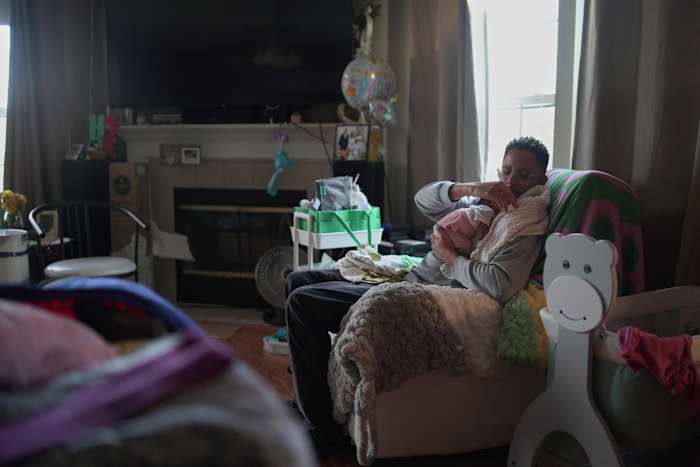
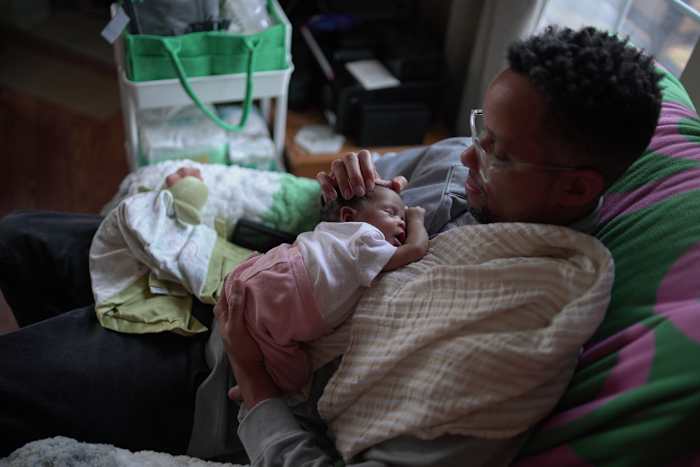
INDIANAPOLIS – As JaKobi Burton gently holds his newborn daughter in their Indianapolis home, the tenderness and affection he feels for her are unmistakable with every gentle touch.
Burton’s dedication to fatherhood began well before her arrival. He was present at every medical appointment and actively participated in Dads to Doulas, a program by Dear Fathers. This initiative equips Black fathers-to-be with the knowledge to offer physical, mental, and spiritual support throughout pregnancy and beyond.
JaKobi and his wife, Crystal Wilmot-Burton, were aware of the significant challenges posed by their pregnancy. Both in their 40s and part of the Black community, they faced heightened risks. Federal statistics indicate that Black women are nearly 3.5 times more likely than their white counterparts to die around childbirth.
Healthcare professionals and community advocates are optimistic that empowering Black expectant fathers with hands-on resources—facilitated by government and nonprofit support—can help reduce these alarming statistics. Program organizers have noticed a positive change, as more Black men are now willing to openly share their concerns and anxieties about pregnancy.
“I want you to know that from day one, I was there for you, ensuring your safety and learning everything I could to protect you,” Burton whispers to his daughter, now a month old. “That commitment will never change.”
Experts emphasize that an engaged father is “directly correlated with better outcomes” for both mother and child.
Health disparities, racism and equal access to prenatal care are among the contributing factors for the disparities in mortality rates among women of different races, according to the National Center for Health Statistics. Two recent viral cellphone videos — including one in Indiana — show hospital staff dismissing the concerns of Black women in labor.
The maternal mortality rate for Black women soars above that of other racial groups. They suffered 50.3 deaths per 100,000 live births in 2023, according to the Centers for Disease Control and Prevention. White women experienced 14.5. Hispanic and Asian women faced 12.4 and 10.7, respectively.
The National Healthy Start Association, which was created in 1998 to help improve infant and maternal mortality rates, has “fatherhood practitioners” at its 116 project sites. They, along with case managers, offer men assistance including webinars, a texting service and even cooking lessons.
Kenneth Scarborough, who has been the NHSA’s fatherhood and men’s health consultant for 10 years, has noticed a shift toward including male partners in the efforts to preserve the health of pregnant women.
“There’s more research that is being done to be able to change those narratives, without a shadow of a doubt,” Scarborough said. “The challenge with that is still getting these institutions to understand the value of making sure that Dad is there and he is at the table.”
Doctors still leave Black fathers “on the fringes of the conversation” while society often codifies them as “scary and rough,” said Dr. Ndidiamaka Amutah-Onukagha, founder and director of the Center of Black Maternal Health and Reproductive Justice at Tufts University.
She said she has heard countless anecdotes of fathers being ignored in the exam room, even though paternal involvement is “directly correlated with better outcomes.”
Mothers- and fathers-to-be face racism in medical institutions
Black patients are frequently advised to seek out an OB-GYN who looks like them, and Wilmot-Burton did just that.
“I thought maybe she would be more caring, be more willing to listen to my issues, which she was,” she said.
But Black doctors make up a tiny share of OB-GYNs nationwide. Of the estimated 43,700 practicing OB-GYNs, 7.5% are Black women, according to 2023 data from the American Medical Association and the Association of American Medical Colleges. Even fewer — 2.3% — are Black men.
Deborah Frazier, the CEO of National Healthy Start, said medical organizations must let go of any stigma about paternal involvement. Black and brown fathers still face stereotypes of absenteeism.
“We have data and interviews with fathers, and those fathers have told us that they wanted to be there with their partners, and they wanted be present for their births,” Frazier said.
Charles Johnson IV founded 4Kira4Moms in 2017 after his wife, Kira, bled to death during a cesarean section at Cedars-Sinai hospital in Los Angeles. Johnson sued the hospital in 2022, saying she died because of a culture of racism.
Fathers should be able to walk the line between assertive and aggressive while still being a “force in the room,” the group’s executive director Gabrielle Albert said.
“What if you happen to be 6-foot-5 and 200-something pounds? If you speak up, what’s gonna happen?” Albert said. “Let’s role-play conversations. How do you push back against the doctor?”
From dad to doula
In August — two months before Wilmot-Burton gave birth — Burton was one of a dozen prospective dads holding a Black baby doll at a Dads to Doulas workshop. Facilitator Kyra Betts Patton tells them studies show present fathers-to-be can lower the chances of premature births.
“The largest time frame for maternal mortality, you’re looking at 43 to 100 days after you’ve had a baby. No one’s there but the partner,” Patton said.
Burton said the classes gave him the courage to advocate throughout the pregnancy, and that he took a checklist of questions from the class to every appointment.
“I pushed hard prior to the delivery to make sure that our birth plan was followed, even though it wasn’t completely. But she (Phoenix) still turned out great and was delivered successfully,” said Burton. He also took classes with the Indiana Breastfeeding Coalition.
Wilmot-Burton gives her husband credit for taking these workshops while also working and attending grad school. His presence was vital, especially when she felt unwell or was nervous.
“I would encourage other Black women to make sure their partners are on board to attend some classes or read books,” she said, “and definitely go to as many appointments as they can.”
___
Tang reported from Phoenix.
Copyright 2026 The Associated Press. All rights reserved. This material may not be published, broadcast, rewritten or redistributed without permission.