

NEW YORK – Historically, U.S. presidents have gone to great lengths to steer clear of any potential profiteering from their time in office. This tradition of maintaining a clear separation between personal gain and presidential duty is well-documented.
Harry Truman famously refused to attach his name to any commercial enterprise, opting for a modest retirement. Richard Nixon, wary of the implications of familial associations, went so far as to have his brother’s phone tapped to prevent even the suggestion of exploiting presidential connections. Similarly, George W. Bush divested himself of his personal stock portfolio before assuming the presidency to avoid any conflicts of interest.
In contrast, President Donald Trump has taken a distinctively different path.
Under the leadership of Eric and Donald Jr., the Trump family’s real estate empire has embarked on one of its most aggressive periods of international growth since its inception nearly a century ago. Each new venture carries potential implications for geopolitical factors such as tariffs and military assistance.
Moreover, the Trump brothers have ventured into the burgeoning world of cryptocurrencies, launching initiatives that have generated billions. However, these ventures have sparked debate over whether substantial investors might have received preferential treatment in return for their involvement.
Adding another layer of complexity, Eric and Donald Jr. have either joined or invested in several companies that seek to engage in business dealings with the very government their father presides over. Notably, last month, they secured a lucrative deal involving stakes in an armed drone manufacturer. This company is actively pursuing contracts with the Pentagon and Gulf states, many of which are under threat from Iran and rely on the U.S. military’s protection, an organization commanded by their father.
The White House and the Trump Organization deny there are any ethical problems. Asked about the issue at a recent crypto conference, Donald Jr. said, “Frankly, it’s gotten old.”
The problem of conflicts of interest goes back a decade to when Trump first ran for office, but some government ethics experts and historians argue it’s more pressing than ever as conflicts pile up in his second term that they consider unprecedented, blatant and dangerous to democracy.
“I don’t think there’s any line right now between policy decisions and political calculations and the interest of the Trump family,” said Julian Zelizer, a presidential historian at Princeton University.
Deal-making spree abroad
In Trump’s first term, the Trump Organization did zero deals in foreign countries. In a little over a year into his second term it did eight, all ostensibly complying with the Trump Organization’s self-imposed rule not to do business directly with foreign governments.
But governments in authoritarian and one-party states rarely take a hands-off approach — especially when the business belongs to a sitting president.
In Qatar, a Trump golf club and villa project is being developed in part by a company owned by the Qatari government. In Vietnam, where The New York Times reported the government pushed farmers off their land to make way for a Trump resort, the country’s deputy prime minister signed off on the deal at a ceremony. And in Saudi Arabia, a planned “Trump Plaza” resort on the Red Sea is being built by a Saudi real estate developer close to the ruling family.
Whether the deals played any role in changing U.S. policies in ways these countries sought is nearly impossible to know but the countries did get what they wanted – access to advanced U.S. technology for Qatar, tariff relief for Vietnam and fighter jets for Saudi Arabia.
And the Trump Organization got something too: Tens of millions in fees.
Asked about those projects, the Trump Organization said it has done no deals with governments so far, noting that the Saudi company was private and has said it is “collaborating” with the Qatari business and had not struck a “partnership” with it that would have broken its self-imposed rules.
The UAE, crypto and Binance
Another deal raising conflicts of interest questions first came to light in a Wall Street Journal article in January — a year after it was struck.
Days before the inauguration, the Trump family sold nearly half of its World Liberty Financial crypto business to a UAE government-linked company run by a member of the UAE royal family for $500 million.
A second UAE entity, a government fund, invested in the offshore cryptocurrency exchange Binance using $2 billion worth of a digital currency called a stablecoin issued by World Liberty. That allowed the Trump company that received the dollars to put it in safe investments such as bonds or money market funds and keep the tens of millions of dollars in interest for itself.
Shortly after, the Trump administration reversed a Biden-era restriction and granted the UAE access to advanced U.S. chips. Binance’s founder, Changpeng Zhao, later got a pardon from Trump, despite having pleaded guilty to failing to stop criminals from using his platform to move money connected to child sex abuse, drug trafficking and terrorism.
A lawyer for Zhao denied any connection between the Binance’s business with the Trump family and the pardon.
“Any claim of a quid pro quo by Binance or CZ, or preferential financial treatment by Binance, is a clear misstatement of the public record,” said Teresa Goody Guillen in a email to the AP, referring to Zhao by his initials.
Asked about the pardon, the White House said federal authorities had unfairly punished Zhao in what it called “The Biden Administration’s war on crypto.”
World Liberty dismissed the notion of a conflict, saying the UAE deal had no connection to the president’s chips policy.
Crypto billions
World Liberty has also provided a separate income stream to a new Trump limited liability corporation through sales of “governance tokens” that give owners certain voting rights in its business, though not equity stakes, raising $2 billion last year. That translates into hundreds of millions of dollars for the Trumps through their World Liberty ownership stake and a separate side deal allowing them a cut of these sales.
One big token investor was Justin Sun, a cryptocurrency billionaire who as a foreign citizen would be banned under U.S. law from making political donations to U.S. politicians. Between Trump’s election and inauguration, Sun spent $75 million on the tokens.
In February last year, a federal lawsuit charging Sun with duping investors was paused before being settled last month for a $10 million fine.
Then there are the souvenir-type “meme” coins stamped with Trump’s face that went on sale days before he took the oath of office last year.
Over the next four months, the coins generated $320 million, mostly going to Trump-related entities, according to blockchain tracker Chainalysis. That is more than double the money collected in four years running his Washington D.C. hotel in Trump’s first term.
Unlike the lobbyists or campaign donors trying to influence Trump, the coin buyers can buy anonymously. One who chose to make his purchase public was Sun, who spent $200 million on the coins and got access to Trump at a gala party he held for the biggest buyers.
Another family cryptocurrency business, American Bitcoin went public in September, giving Donald Jr. and Eric about $1 billion in paper wealth at that time. Months earlier, their father announced a new national bitcoin reserve, sending the price for the cryptocurrency soaring to a record.
The Trump businesses aren’t completely immune to crypto’s notorious volatility. The value of bitcoin and other digital tokens have since plunged and rattled investors. Both American Bitcoin stock and the value of Trump’s souvenir meme coins have collapsed 90% from their highs.
Last month, Trump announced he would hold another dinner with new top holders of his meme coins, giving the coin a boost before it fell back again.
“Whatever constraints there were in the first term appear to have completely disappeared,” says Columbia University historian Timothy Naftali. “Do you want future presidents to be open to the highest bidder?”
Trump thinks people don’t care
Asked to comment for this story, the White House said Trump acts in an “ethically-sound manner” and that any suggestion to the contrary is either “ill-informed or malicious.” It reiterated that his assets are in a trust managed by his children and stated he has “no involvement” in family business deals.
“There are no conflicts of interest,” said spokesperson Anna Kelly.
In a separate statement, the Trump Organization said it is “fully compliant with all applicable ethics and conflicts of interest laws” and added, “The implication that politics has enriched the Trump family is unfounded.”
Trump in January told The New York Times that when it comes to potential conflicts of interest, “I found out that nobody cared, and I’m allowed to,” alluding to an exemption the president gets from the federal statute banning federal officials from holding financial interests in businesses impacted by public policy they help shape.
It’s not clear he’s wrong about American attitudes, though they appear to be changing even among Republicans. In a Pew Research Center poll in January, 42% of those voters said they were confident that Trump acts ethically in office, down from 55% at the start of his second term a year ago.
Change of fortune
Forbes estimates Trump’s net worth is now $6.3 billion, soaring 60% from before he returned to office, a striking development given how much the Trump Organization struggled before.
The Trump International Hotel in D.C. never turned a profit before being sold. Two Trump hotel chains catering to middle class travelers in his first term shut down for lack of demand. Condominium buildings stripped the Trump name off their facades after discovering that instead of attracting buyers, it was repelling them.
No new U.S. condominiums are putting the Trump name above their entrances in his second term, but his name is prized in Washington where people have business before the federal government.
Donald Jr., Trump’s oldest son, opened a private club in the Georgetown section of Washington that is charging initiation fees as high as $500,000 for founding members.
One of the few clubs with comparable fees, the Yellowstone Club in Montana, offers access to multiple resorts, 50 ski trails and more than a dozen restaurants across a members-only area the size of Manhattan.
Donald Jr.’s club is in the basement of a building but offers something else — proximity to power.
The club’s name is “Executive Branch.”
Bibles, guitars and sneakers
Other presidents and their families have done things in pursuit of profit that stained that high office.
Hunter Biden got paid as a director of a Ukrainian gas company while his father was vice president. The Clinton Foundation got foreign donations, though after Bill Clinton had left office. And Jimmy Carter’s brother Billy cashed in on the family name by selling beer.
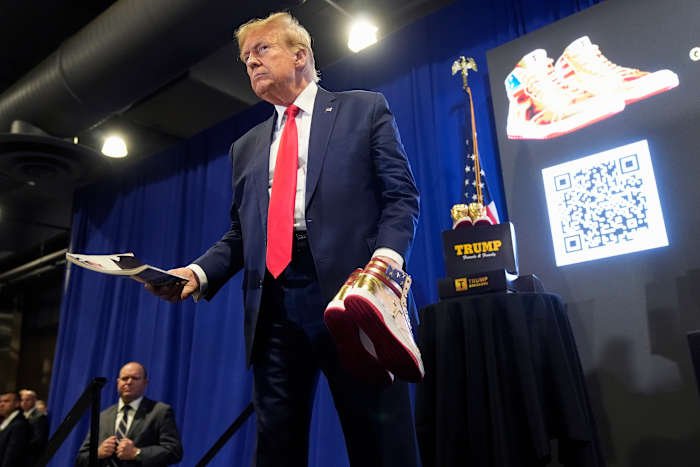
In Trump’s case, the president himself is hawking goods, including $59.99 “God Bless the USA” Bibles, $399 sneakers stamped “Never Surrender” and electric guitars priced up to $11,500 — shipping not included — for a model autographed by the president.
New year, new profits
In the first months of Trump’s second year back in the White House, the momentum hasn’t let up.
In January, the Trump Organization announced its third deal involving Saudi Arabia in less than a year, this time a “collaboration” with a company more directly tied to the government because it is owned by the country’s sovereign wealth fund chaired by its crown prince, Mohammed bin Salman. Asked by the AP whether the project outside Riyadh for Trump mansions, a hotel and golf course violated the company’s pledge not to strike deals with foreign governments, the Trump Organization said it doesn’t “conduct business with any government entity” but didn’t address the project specifically.
Meanwhile, as the two oldest brothers’ new drone company seeks Pentagon contracts, other government contractors in which one or both have gotten ownership stakes this past year are taking in tens of millions of dollars of new taxpayer money. That includes a rocket motor maker, an AI chip supplier and a data analytics company, according to government contracting records.
Asked about potential conflicts after the drone deal was announced, Eric said, “I am incredibly proud to invest in companies I believe in.” A spokesman for Donald Jr. said he doesn’t “interface” with the government on companies in his portfolio, adding that “the idea that he should cease living his life and making a living to provide for his five kids just because his dad is president, is quite frankly, a laughable and ridiculous standard.”
A new investment firm that the brothers joined as advisers last year has raised $345 million in an initial public offering to buy stakes in U.S. companies designed to help their father revive America’s manufacturing base. After the AP asked Trump’s chief business lawyer about language in a regulatory filing stating the firm would target companies seeking federal grants, tax credits and government contracts, he filed a new document with that language removed.
Zelizer, the Princeton historian, says he expects future presidents will show more restraint in enriching themselves, but worries about the message Trump is sending.
“He has shown politically there is no price to be paid to making money,” he said. “You know you can go there.”
Copyright 2026 The Associated Press. All rights reserved. This material may not be published, broadcast, rewritten or redistributed without permission.