

LONDON – European nations find themselves in a difficult situation as a group of countries gathers in Paris on Thursday to discuss security assurances for Ukraine after the war.
The conflict continues with no end or ceasefire in sight, leaving the critical issue of America’s role in ensuring Ukraine’s future safety still unanswered.
For several months, the so-called “coalition of the willing” has been assembling to deliberate on aid for Ukraine, including outlining strategies for military assistance if a ceasefire occurs to prevent future Russian hostility.
Leading the coalition, French President Emmanuel Macron and U.K Prime Minister Keir Starmer have emphasized that any European protective force in Ukraine requires U.S. support. Yet, U.S. President Donald Trump has only suggested potential involvement, distancing himself from calls for a ceasefire, and resisting imposing strict economic sanctions on Russia.
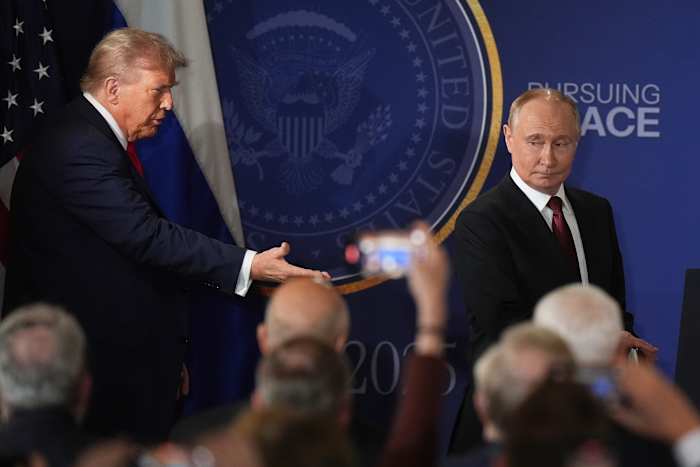
Despite expressing his “disappointment” with Russian President Vladimir Putin and issuing numerous warnings to push for negotiations, Trump’s efforts have been ineffective. In August, during a meeting with Putin in Alaska, Trump was unable to convince the Russian leader to halt hostilities and has yet to facilitate negotiations between Putin and Ukraine’s President Volodymyr Zelenskyy.
Following the Alaska meeting, Trump and European leaders convened in Washington, and U.S., European, and NATO military officials engaged in discussions about supporting Ukraine. However, detailed plans for security guarantees to dissuade Moscow from pursuing future aggression remain lacking.
Former military generals and experts suggest Europe is in a bind — not knowing the level of support the U.S. is prepared to provide the coalition, the nature of any ceasefire or if the U.S. will abide by commitments made. It’s also far from certain that Putin would agree to a cessation of hostilities, something Russian officials have invariably dismissed.
“Talking about detailed operational planning when you don’t actually have your mission is, quite frankly, impossible,” said Ed Arnold, an expert in European Security at the Royal United Services Institute in London and a former military planner.
Why Europeans believe a ceasefire is necessary
The “coalition of the willing” is a broad term for about 30 nations supporting Ukraine, but the so-called “reassurance force” that would provide security guarantees to Kyiv is a subset of that group.
The U.K., France and Estonia have all suggested they are ready to deploy troops to Ukraine to deter Putin from attacking again, while officials in Poland said Warsaw will not take part and will instead focus on bolstering NATO security in the east of Europe.
There is “no suggestion” that any troops will be deployed without a ceasefire because it’s too risky, said François Heisbourg, special adviser at the Foundation for Strategic Research in Paris.
Despite Zelenskyy signaling his willingness to talk, a ceasefire agreement is not currently in the cards — not least because of the positions of the U.S. and Russian presidents.
At his Aug. 18 meeting with European leaders at the White House — a day after meeting Putin — Trump walked back his previous demands for a ceasefire in Ukraine and said he thought a peace agreement was preferable.
The comments marked a shift toward the Russian position from Trump and would allow Moscow to fight on in Ukraine while peace negotiations are underway.
Russian Foreign Minister Sergey Lavrov later suggested an end to hostilities was even further away, stating that Moscow will not accept Zelenskyy’s signature on any peace agreement as Russia considers him to be an illegitimate president.
“If Putin doesn’t want a ceasefire — and if Trump doesn’t call for a ceasefire — what are the chances of a ceasefire happening?” asked Heisbourg.
What a European security guarantee for Ukraine could look like
Even if a ceasefire or peace agreement for Ukraine were implemented, it’s not clear it would be a sufficient deterrent to Putin and would be “very, very risky” for European nations, said Arnold at RUSI.
Such an operation hinges on the U.S. providing intelligence support and the deterrent effect of U.S. airpower in countries outside Ukraine.
The Western appetite to potentially shoot down Russian missiles violating a ceasefire or target launchers firing them from within Russia is “close to zero,” said Heisbourg.
Any response to a ceasefire violation, he said, would likely depend on “how many Western soldiers the Russians would have actually killed…and nobody wants to think about that too much in advance.”
In March, Starmer told allies that a force for Ukraine would need at least 10,000 troops, but that would potentially require around 30,000 troops when taking into account those on rotation and rest.
As a coalition leader, the U.K. should look at contributing a brigade of 5,000 soldiers which would become 15,000 when taking into account rest and rotation, said Arnold.
That figure would account for about 30% of the deployable capacity of the British Army, he said, and potentially create a “tricky” problem whereby the U.K. deploys more forces on behalf of non-NATO ally Ukraine than it does for NATO allies such as Estonia.
European officials have indicated that the troops could be involved in training Ukrainian soldiers and likely based away from the frontlines although the risk of Russian missile and drone strikes would remain high.
But there would be “zero credibility” if Western troops were put in various Ukrainian towns without a clear mission or purpose, said Ben Hodges, former commanding general of the U.S. Army in Europe.
“That will not impress the Russians at all,” he added.
US as a reliable partner
European leaders are also grappling with the question of whether to take Trump and his officials at their word while also eyeing the rise of populist parties — particularly in the U.K., France and Germany — which may not share the same commitment to Ukraine as current political leadership.
That means the future of any security guarantees for Kyiv could be extremely fragile.
There is “absolutely no guarantee” that Trump will abide by commitments made to European nations over Ukraine, said Arnold, pointing to Trump’s withdrawal from previous agreements, including the Paris climate agreement and Iran’s nuclear deal.
That means European nations cannot rely on him ordering U.S. jets into action in the event of a ceasefire violation because “at one time he may say yes, at another time he may say no,” Arnold said.
With NATO membership for Kyiv ruled out by Trump and a host of hurdles to overcome to implement security guarantees for Ukraine, European leaders may decide to navigate the situation by spending “a lot more money on weapons” for Kyiv, said Heisbourg.
Arnold agreed, adding that the best option could be to give Kyiv “loads of guns and loads of ammo.”
“There’s no easy way out,” he said. “None of the options, especially for the Europeans, are good.”
Copyright 2025 The Associated Press. All rights reserved. This material may not be published, broadcast, rewritten or redistributed without permission.