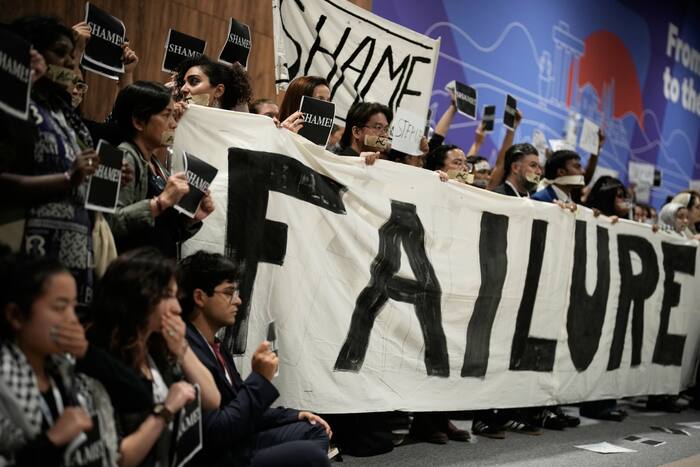

This year’s United Nations climate summit in Turkey ended without agreement on how the world should respond to climate change, even as worsening disasters continue to strike vulnerable nations that contributed little to the crisis.
Dozens of countries rejected the final text presented Sunday at COP31, saying it failed to address fossil fuels — especially coal, oil and gas, the main drivers of global warming. The proposal also omitted stronger financial commitments to help countries facing the greatest damage adapt to a hotter planet.
The impasse leaves major questions about what comes next and how the failure will affect people’s daily lives. Scientists warn that the world is heading toward temperatures beyond the limits established by the 2015 Paris Agreement.
Here’s what to know:
Climate progress can continue without a global deal
Although COP31 failed to produce a final agreement, climate efforts are continuing through actions by individual countries, states, provinces, Indigenous communities and local governments.
One example is a voluntary initiative focused on moving away from fossil fuels outside the formal U.N. process. Nearly 60 countries took part in the first International Conference on Transitioning Away from Fossil Fuels in Colombia this year. The next gathering is planned for next year in Tuvalu, a Pacific island nation.
Instead of losing momentum, nations “are building new networks to work together,” said Katharine Hayhoe, a climate scientist with The Nature Conservancy.
Hayhoe noted that much of the world’s climate action happens below the national level. That includes the United States, which for the second consecutive year did not participate officially in the U.N. talks. President Donald Trump withdrew the country from the Paris Agreement, but a U.S. delegation that included California Gov. Gavin Newsom attended the summit and pledged to pursue climate action.
Experts say emissions must fall rapidly and dramatically to prevent the most severe consequences of climate change.
A growing urgency to address climate change
COP31 followed a year of deadly disasters that were intensified — and made more likely — by a changing climate.
A heat wave across Europe killed more than 50,000 people during the summer, and human-caused climate change was linked to nearly two-thirds of those deaths. In Nepal, the partial collapse of a Himalayan glacier unleashed flooding that destroyed entire villages and left thousands dead or missing. Other unstable glaciers pose similar risks.
Wildfires also swept across large parts of the world, including Canada. Smoke from the fires pushed air quality in several U.S. cities among the worst globally and prompted warnings that public health was at risk.
Yet those disasters, along with repeated warnings about record-breaking heat, failed to persuade developed nations at COP31 to confront fossil fuels more forcefully.
A report released during the summit by the independent nonprofit Climate Action Tracker said progress in slowing global warming has effectively stalled for five years. As a result, the world is almost certain to miss the Paris Agreement’s goal of holding warming to 1.5 degrees Celsius (2.7 degrees Fahrenheit) above preindustrial levels.
Countries have adopted plans to cut fossil fuel emissions, but the report said that even full compliance — an increasingly unlikely prospect — would leave global temperatures 2.6 degrees Celsius (4.7 degrees Fahrenheit) above preindustrial levels by the end of the century.
Experts warn climate inaction will deepen inequality
Moving beyond fossil fuels requires substantial investment, and vulnerable nations arrived at the U.N. summit urging wealthy countries most responsible for climate change to provide more assistance.
At previous summits, developed nations pledged to help poorer countries finance the transition to cleaner energy and strengthen infrastructure against disasters. But COP31 produced no agreement to increase that support. Experts say current commitments fall far short of projected needs, while disputes continue over who should contribute and whether wealthier nations will honor existing promises.
That shortfall could make basic protections — including early-warning systems in Nepal after this year’s devastating floods — harder to establish, Hayhoe said. Island nations facing rising seas may also be unable to fund essential projects without more affordable access to financing.
At the same time, international programs supporting climate adaptation and disaster preparedness have been cut even as threats intensify. Among them are abrupt reductions in U.S. foreign aid ordered by the Trump administration in 2025, which eliminated or sharply curtailed programs serving millions of people around the world, including disaster-preparedness efforts.
Climate change is also hitting wealthier nations, including the United States and countries across Europe. They are facing more severe heat waves, droughts, wildfires, record flooding and other increasingly expensive disasters.
Experts say those impacts offer only a glimpse of the far greater dangers confronting poorer and more vulnerable countries.
“If we fail on climate, the inequities we see today will grow almost beyond imagining: widespread crop failures, people losing access to water, rising conflict over basic resources, mass migration and growing tensions between countries,” Hayhoe said.
Tasneem Essop, executive director of Climate Action Network International, blamed developed countries for the breakdown at the U.N. talks.
“We are witnessing human suffering on an unimaginable scale, and we had hoped this COP would take steps to protect people from the worsening climate crisis,” Essop said. “Instead, rich nations gutted the very measures that could have made a difference.”
___
The Associated Press’ climate and environmental coverage receives financial support from multiple private foundations. AP is solely responsible for all content. Find AP’s standards for working with philanthropies, a list of supporters and funded coverage areas at AP.org.


