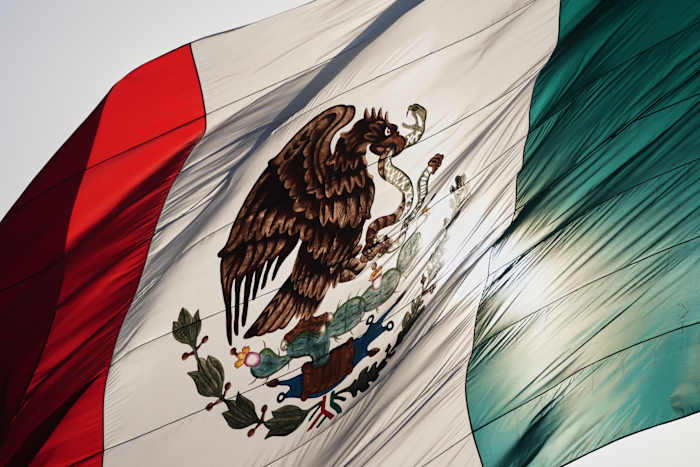


MEXICO CITY – Dominating Mexico’s national flag, the majestic eagle gripping a serpent while perched on a cactus is more than mere imagery; it reflects a compelling legend tied to the capital’s origins.
This symbolism stems from a tale involving the god Huitzilopochtli, who instructed the Mexica people, later known as the founders of the Aztec Empire, to embark on a journey away from their homeland to find a site for a new city.
After an extensive 175-year search, they finally encountered the prophesied sign, leading to the founding of Tenochtitlan in 1325, the site of today’s sprawling Mexico City.
The enduring legacy of the eagle, cactus, and serpent as symbols of identity, especially through the trials of European conquest, is explored in a new exhibition titled “A coat of arms, an emblem, a symbol of identity,” open until December 15 at the historic Old City Hall in downtown Mexico City.
This exhibition is part of a series of government-led commemorations celebrating the 700th anniversary of the Mexica capital’s founding.
“Honoring Tenochtitlan is not about remembering a bygone era but acknowledging the vibrant spirit that pulses beneath our modern city,” stated President Claudia Sheinbaum in a July ceremony. “It was the heart of an Indigenous civilization that crafted its own societal model, one that thrived in harmony with the Earth, the cosmos, and its deities.”
Fragments of that civilization lie underneath the Old City Hall, the current seat of Mexico City’s government.
Built by order of Spanish conqueror Hernán Cortés in 1522, its construction used stones from ancient Mexica sacred sites. The building has been renewed over time, but its halls have witnessed centuries of governance and symbolism.
“Holding the exhibition in this City Hall, a place of decisions and memory, is a way to recognize the history of those who once inhabited it and how its transformations still echo in Mexico City’s identity,” said Mariana Gómez Godoy, Director of Mexico City’s Cultural Heritage, during the exhibit’s inauguration in November.
A city’s mythic origin
The Mexica themselves recorded their story after Tenochtitlan fell to the Europeans. Several codices depict the path that led them to fulfill their deity’s task.
Eduardo Matos Moctezuma — an acclaimed archaeologist from Mexico’s National Institute of Anthropology and History — has argued that the legend is a symbolic retelling of historical events, rather than a literal claim about divine prophecy.
Still, according to the Templo Mayor Museum, the region’s pre-Hispanic people preserved the origin story of a long journey that led to the founding of Tenochtitlan as a cornerstone of their traditions.
They honored a small island in Lake Texcoco, now central Mexico City, as the place where the Mexica found the eagle foretold by Huitzilopochtli.
From ancient prophecy to national symbol
The new exhibit offers a historical overview of how the image evolved — from its establishment as the city’s coat of arms in 1523 under Emperor Charles V to its transformation into an emblem of Mexico as an independent nation.
Curated by researcher Guadalupe Lozada, it also displays images portraying how it was adopted by the religious orders in charge of converting the Indigenous people to Catholicism.
While the eagle and cactus were already adopted by Europeans in the mid-16th century, the Jesuits introduced the serpent decades later. “From then on, it would remain a symbol of the city’s identity — one that would also spread throughout the rest of New Spain,” Lozada said.
According to her, plenty of monasteries dating back to the 17th century attest to how friars displayed the eagle and cactus in their sanctuaries. Even today, the emblem can still be seen above the façade of Mexico City’s cathedral and inside one of its chapels.
“Such was the strength of Mexica culture that the evangelizers sought to adopt it rather than exclude it,” she said. “It was like saying, ‘I acknowledge your history.’”
The same logic applied with the European conquerors. Even as they ordered the destruction of the Mexica religious complexes, the representation of the foundational myth was not erased from history.
“For them, conquering a city like Tenochtitlan was a matter of pride and therefore they never intended to deny its existence,” Lozada said. “This meant that the strength of the city buried beneath the new one underlies it and resurfaces — as if it had never disappeared.”
___
Associated Press religion coverage receives support through the AP’s collaboration with The Conversation US, with funding from Lilly Endowment Inc. The AP is solely responsible for this content.
Copyright 2025 The Associated Press. All rights reserved. This material may not be published, broadcast, rewritten or redistributed without permission.


