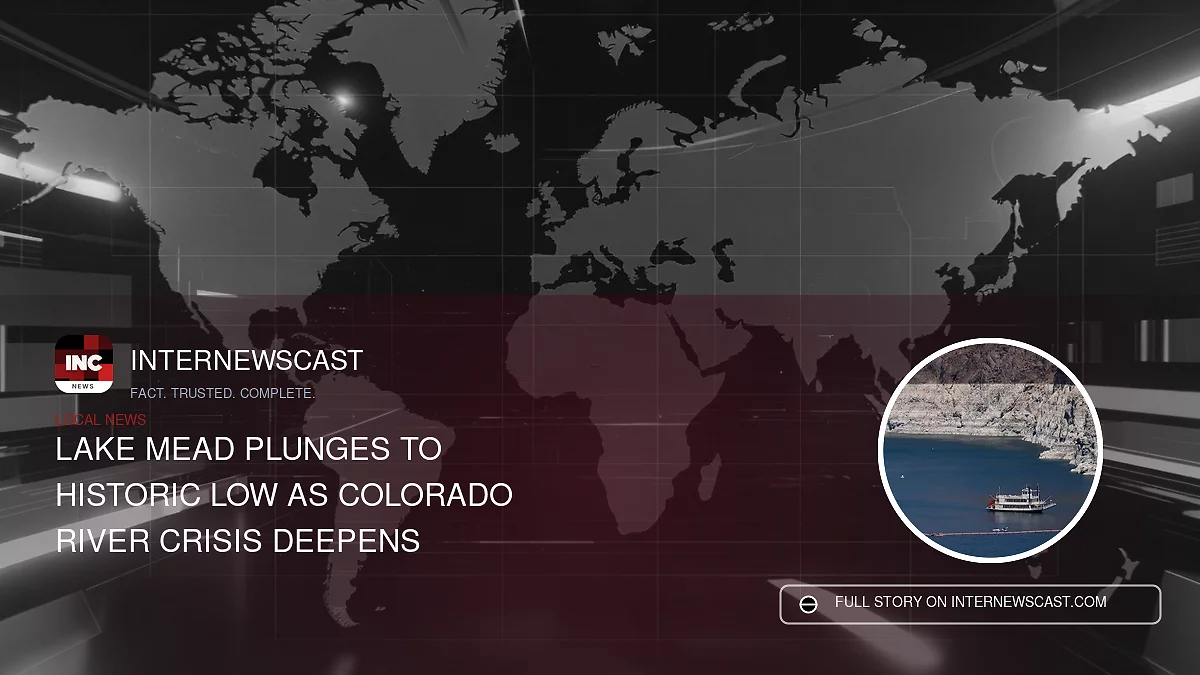


BOULDER CITY, Nev. – Lake Mead, the nation’s largest reservoir, has fallen to its lowest level since it was filled roughly nine decades ago, underscoring the deepening water crisis gripping the Colorado River system.
Federal data shows Lake Mead’s water level reached 1,040.4 feet (317.1 meters) above sea level on Friday. That mark slipped just under the previous low of 1,040.58 feet (317.27 meters), recorded on July 28, 2022, at the massive reservoir along the Arizona-Nevada line near Las Vegas.
The new record comes after a winter that delivered the weakest snowpack ever measured in the Colorado River Basin. Snowmelt is a crucial source of water for the river, which supports farms, businesses, ecosystems, hydropower generation and more than 40 million people across seven Western states, tribal nations and Mexico.
The milestone also follows a federal announcement last week outlining a short-term plan aimed at preventing a broader breakdown along the stressed river. Washington moved in after the states dependent on the Colorado River — California, Colorado, Arizona, Nevada, New Mexico, Wyoming and Utah — were unable to reach a long-term agreement over how to divide a shrinking supply. The proposal calls for California, Nevada and Arizona to share reductions in water use.
Decades of heavy demand, coupled with persistent drought and hotter temperatures, have steadily drained Lake Mead and Lake Powell, the second-largest reservoir in the United States. Combined, the two key Colorado River reservoirs are now at their lowest levels in nearly 70 years.
In another sign of the system’s strain, federal officials said Thursday they will not release cold water from Lake Powell through Glen Canyon Dam in northern Arizona to aid a threatened native fish whose habitat lies between the two reservoirs. Officials said the decision is intended to help preserve the river system’s ability to generate hydropower.
Lake Mead, impounded by Hoover Dam, offered a stark preview of the crisis during the severe drought of 2022, when receding waters revealed human remains and forced Las Vegas water managers to draw from deeper intakes to keep supplies flowing to millions of residents.
___
The Associated Press receives support from the Walton Family Foundation for coverage of water and environmental policy. The AP is solely responsible for all content. For all of AP’s environmental coverage, visit