
Share this @internewscast.com
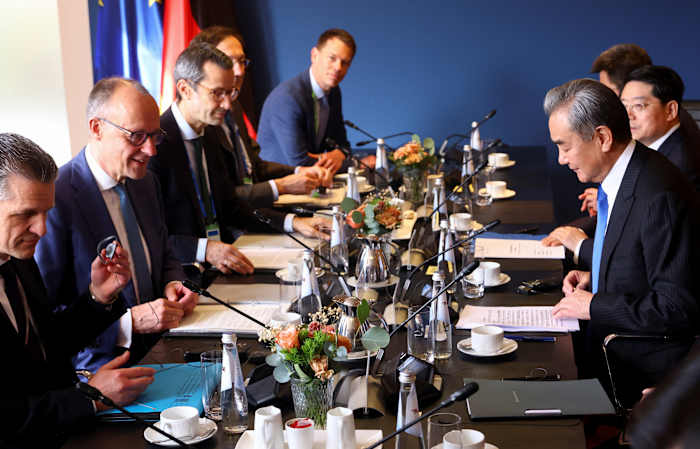
BEIJING – German Chancellor Friedrich Merz is embarking on his inaugural visit to China at a pivotal moment for his nation’s industrial sector, which is grappling with mounting challenges from Chinese competitors. This visit also coincides with a period of global uncertainty, as U.S. President Donald Trump continues to disrupt the post-World War II international framework that Europe has relied upon for decades.
Merz is scheduled to land in Beijing on Wednesday for a two-day diplomatic engagement. His visit is part of a series of high-profile international trips to China, setting the stage for President Trump’s visit in approximately five weeks.
During his trip, Merz is anticipated to address Germany’s increasing trade imbalance with China. Additionally, he will likely broach the topic of China’s support for Russia amidst the ongoing conflict in Ukraine, though it is doubtful that China’s stance will shift significantly.
Amidst these discussions, China is actively seeking international allies to counter President Trump’s challenges to existing global norms and institutions. However, Merz has expressed caution regarding China’s vision for the 21st-century world order. The success of his visit may lie in identifying areas of collaboration amidst these substantial disagreements.
“As the world’s second and third largest economies, sound China-Germany relations serve the interests of both sides and meet the expectations of the international community,” remarked Mao Ning, spokesperson for the Chinese Foreign Ministry, on Tuesday.
Mao further stated that “the Ukraine crisis is not and should not become an issue between China and Europe.” This position highlights a divergence from Germany and much of Europe, as China maintains what it describes as “an objective and impartial position” on the matter.
German imports from China rise while exports to China fall
Merz opens his trip with talks Wednesday with China’s Premier Li Qiang and top leader Xi Jinping, whose reduced international travel means foreign leaders must travel to Beijing if they want to meet him. On Thursday, the German chancellor plans to visit a Mercedes-Benz facility and travel to Hangzhou, a high-tech city that is home to e-commerce giant Alibaba and leading robot developer Unitree Robotics.
He is bringing a delegation of business leaders looking to expand sales. China has long been an important market for Germany, a major exporter of manufactured goods. But advances by Chinese companies in recent years have turned them into formidable competitors, notably in the automobile industry, where new electric vehicle makers are challenging Volkswagen and other leading brands.
Last year’s foreign trade figures underlined concern over the imbalance in economic ties. German imports from China rose 8.8% to 170.6 billion euros ($201 billion), helping Chinese manufacturers offset a decline in U.S. imports because of Trump’s tariffs. Meanwhile, German exports to China fell 9.7% to 81.3 billion euros.
The growing imbalance has stepped up longstanding German demands that China reduce its trade barriers and open its markets further to foreign competitors.
Merz says Germany should have no illusions about China
Merz’s visit follows French President Emmanuel Macron in December and the leaders of Ireland, South Korea, Canada, Finland and Britain last month.
In an address to the German parliament in January, Merz said Europe needs to “learn the language of power politics” to assert itself in a changing world and become stronger economically and militarily. The emerging world order also opens opportunities for Europe, he said, as democracies with open and growing markets “seek what we have to offer them, namely partnerships on the basis of mutual respect, trust and reliability.”
He also said recently that Germany should have no illusions about China, which he said “asserts the claim to define a new multilateral order according to its own rules.”
Shortly after this week’s China trip, Merz plans to make his second visit to Washington since taking office in May.
While some countries — notably Canada and the U.K. — seek to repair ties with China, Germany’s goal is to maintain a relationship that has become more complicated in recent years.
Germany still recognizes China as a vital economic partner but now also sees it as a competitor. The government, in what has become known as de-risking, has sought to reduce the country’s dependence on China as an export market and for strategic products such as rare earths, which are widely used in the automotive, tech and defense industries.
On a visit to Beijing in December, German Foreign Minister Johann Wadephul discussed his government’s concerns over Chinese government subsidies to targeted industries, the manufacturing overcapacity that has boosted exports, restrictions on the export of rare earths and the Russia-Ukraine war.
___
Moulson reported from Berlin.
Copyright 2026 The Associated Press. All rights reserved. This material may not be published, broadcast, rewritten or redistributed without permission.