
Share this @internewscast.com

PORT-AU-PRINCE – The ripple effects of conflict in Iran have reached as far as Haiti, where a factory worker now finds himself traversing a grueling two-hour walk to and from work due to unaffordable transport costs.
Under the bright morning sky, 35-year-old Alexandre Joseph voiced his concerns loudly on the bustling streets of Port-au-Prince, capturing the curiosity of those passing by in Haiti’s capital city.
“With the government hiking the prices of gasoline, diesel, and kerosene, my family’s well-being is in jeopardy. My current income no longer supports feeding my two children,” Joseph lamented.
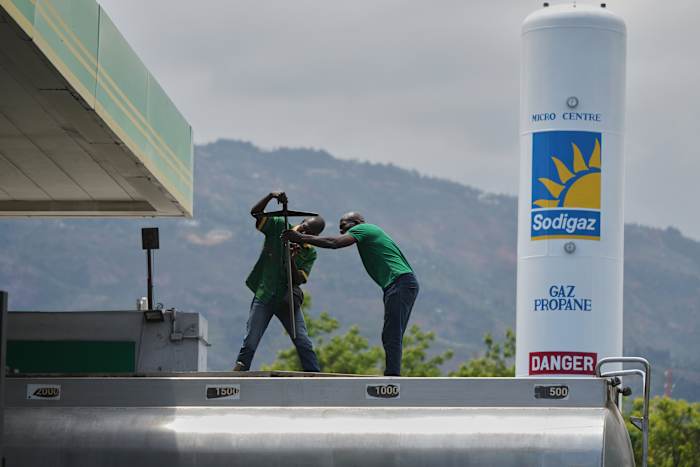
The turmoil in Iran has triggered a surge in oil prices in Haiti, severely disrupting essential supply chains. This has led to a doubling of transportation expenses, forcing many already struggling families to further reduce their meager food consumption.
As the poorest nation in the Western Hemisphere, Haiti bears the brunt of escalating fuel costs, a situation experts warn could exacerbate the country’s ongoing humanitarian challenges.
Known as “one of the most fragile countries in the world,” Haiti faces an increasingly dire situation.
On April 2, Haiti’s government announced a 37% increase in the cost of diesel and a 29% increase in the cost of gasoline.
“The consequences are huge,” said Erwan Rumen, deputy country director for the United Nations World Food Program in Haiti. “It’s one of the most fragile countries in the world.”
Almost half of Haiti’s nearly 12 million inhabitants already face high levels of acute food insecurity. In recent months, Rumen noted, about 200,000 people dropped from the emergency phase to the acute one, a significant milestone.
“What is a bit frightening is to see that so many efforts could be basically wiped out by things that are completely out of our control,” he said. “This part of the population is extremely fragile. They’re on the verge of collapsing completely.”
Gang violence has exacerbated hunger, with armed men controlling key roads and disrupting the transportation of goods. An increase in food prices will only worsen hunger in a country where gangs easily recruit children whose families need food and money.
Emmline Toussaint, main coordinator of Mary’s Meals’ BND school-feeding program in Haiti, said that gas stations in some regions are selling fuel 25% to 30% higher than even what the government stipulated because of gang violence and difficulties with trucks trying to access certain areas.
She said the U.S.-based nonprofit is forced to use boats and take longer and multiple roads to feed the 196,000 children they serve across Haiti to avoid armed groups.
“The humanitarian crisis that we’re facing right now is at its worst,” she said. “So far, we are doing our best not to step back. Now, more than ever, the kids need us. … Most of them, it’s the only meal they receive.”
‘Everything will go up’
Fedline Jean-Pierre, a soft-spoken mother of a 7-year-old boy, sat under the shade of a tattered beach umbrella as she mulled increasing the prices of carrots, tomatoes and other produce she sells at an outdoor market in Port-au-Prince.
“People are not buying now because they don’t have money,” she said, noting she likely won’t have a choice but to increase prices to survive. “I have a child to feed.”
The 35-year-old mother said she and her son have lived for two years in a cramped and unsanitary shelter, among the record 1.4 million Haitians displaced by gang violence in recent years.
“The government doesn’t do anything for me,” she said. “Gas is up now, meaning everything will go up.”
Street vendor Maxime Poulard buys charcoal from suppliers to resell at a higher price. Occasionally he sells two bags of charcoal a day, but he thinks he soon will only be able to afford to buy half a bag to resell.
“Traveling is expensive; eating is expensive; everything is expensive,” he said. “I’m not sure if I will be able to hold on much more.”
Nearly 40% of Haitians are surviving on less than $2.15 a day, according to the World Bank. Meanwhile, Haiti’s economy contracted for the seventh consecutive year, with inflation reaching 32% at the end of fiscal year 2025.
Joseph, the factory worker, said he plans to sell soft drinks at night out of his home to try and earn more money, but even then, that won’t be enough: “We’re also going to reduce the way we normally eat.”
‘Impossible tradeoffs’
On April 6, Haitians dragged burning tires and other debris to block streets and protest the increase in fuel prices in Port-au-Prince, of which an estimated 90% is controlled by gangs.
Local media reported gunfire as some Haitians forced the drivers of small colorful buses known as tap-taps to disembark their passengers.
Marc Jean-Louis, a 29-year-old tap-tap driver, said passengers are increasingly bartering fares, but he can’t afford to offer discounts.
“All the money is going toward gas,” he said as he called on the government to reduced prices “so that everyone can breathe.”
Haitians fear more violence as the country’s poverty and hunger deepens.
Rumen, with the U.N.’s World Food Program, said they’ve been unable to reach 60,000 people in Haiti’s central region who are awaiting aid. A powerful gang recently attacked the area, killing more than 70 people, according to the U.N.
“We’re going to have more needs and less resources,” he warned.
Allen Joseph, program manager for Mercy Corps in Haiti, said rising oil prices are crushing the country’s fragile economy: “The families already spending most of their income on food will face impossible tradeoffs.”
He warned the increase will affect access to basic services, including potable water.
“This is not an abstract inflation,” he warned. “It will directly impact survival.”
___
Coto reported from San Juan, Puerto Rico.
Copyright 2026 The Associated Press. All rights reserved. This material may not be published, broadcast, rewritten or redistributed without permission.