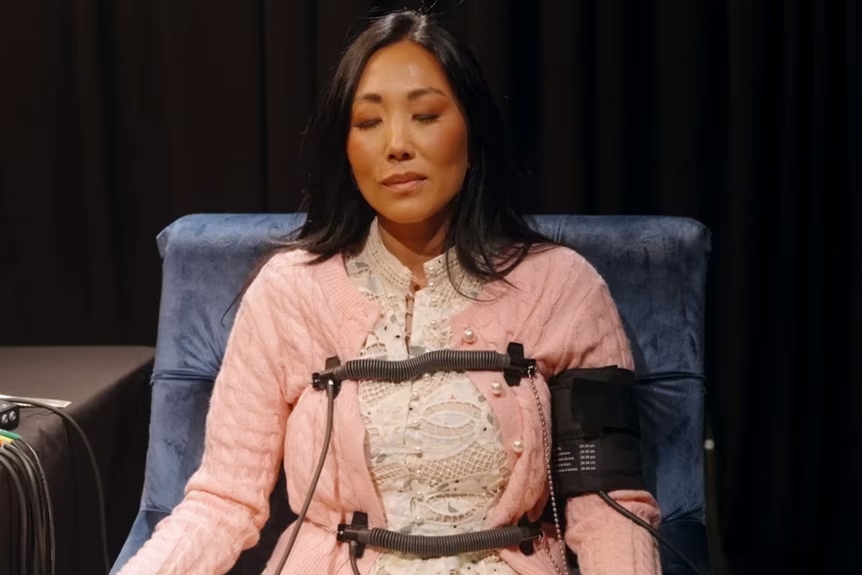

(NEXSTAR) — A polygraph test taken on Bravo’s “The Real Housewives of Orange County” has sparked debate about the reliability of polygraphs, commonly known as “lie detector tests.” Despite their use by some police departments and counterintelligence units, these tests generally aren’t accepted in court.
So what does the research say?
Polygraph machines, which register minor changes in a person’s physiological responses, have been around in various forms since the late 1800s but gained popularity in the 1920s and ’30s. Modern polygraphs track bodily changes such as respiration, blood pressure, and sweating, which some believe can indicate stress or deception.
Although polygraphs have become more sophisticated, the underpinning science remains unproven, leading the scientific community to commonly view the practice as pseudoscience.

Leading studies on polygraphs include numerous works by Dr. Leonard Saxe, who extensively researched the subject in the 1980s and ’90s. In his 1983 study, “Scientific Validity of Polygraph Testing,” Saxe found limited practical uses for polygraphs but noted they are highly prone to errors.
Saxe described the error rate in polygraph testing as “significant,” stating that successful administration of the tests depends on numerous factors aligning correctly. Recent studies continue to support Saxe’s conclusions.
The National Research Council’s comprehensive 2003 report, referenced by Vox, titled “The Polygraph and Lie Detection,” highlighted similar doubts about the ability of polygraphs to detect truth reliably, citing several reasons.
- the physical responses that polygraphs measure don’t necessarily reflect deception. A person could merely be nervous about taking a test, feel pressured by the test administrator, suffer from anxiety or be affected by various medications and/or drugs
- Testing can be skewed to elicit specific results. For instance, an administrator could be asking specific/loaded questions to get a desired result. Alternatively, administrators can have biases toward certain individuals and/or situations, in addition to incorrectly believing that certain behaviors indicate deception
- Research testing can be consciously or subconsciously skewed to favor a certain result by test takers, meaning that even observing tests can be difficult and affect results
Another point that these two expansive research projects touch upon, as do others, is the possibility that stories of “confessions,” or else, anecdotal evidence of testers being caught in lies could merely have been brought upon by the pressure of taking a test. For instance, someone may not know that the science on polygraphs is flimsy, so they may think, “I might as well tell the truth since they’ll be able to tell anyway.” In other words, the test brought about the truth but it did not detect it.
Many researchers also point out that polygraph research is a subject of study that has not benefitted from technological advancements and time, which is unusual.
In 2002, the National Research Council of the National Academies of Sciences, Engineering and Medicine researched polygraphs at the behest of the U.S. Department of Energy, with the council ultimately recommending the Department should not use polygraphs because they aren’t reliable.
The council wrote: “Almost a century of research in scientific psychology and physiology provides little basis for the expectation that a polygraph test could have extremely high accuracy.”
Despite a failed polygraph test being considered a “smoking gun” on this season of “RHOC,” the science would appear to be on the side of “Real Housewife” Katie Ginnella, who was accused by castmates of spilling cast rumors and secrets to bloggers.