MINNEAPOLIS – A federal immigration officer is facing felony assault charges after allegedly pointing a firearm at individuals in a vehicle while driving on a highway near Minneapolis. This announcement came from Minnesota prosecutors on Thursday.
Hennepin County Attorney Mary Moriarty highlighted the significance of the case, stating it might be the first of its kind against a federal immigration officer amidst the Trump administration’s intensified immigration enforcement efforts. This crackdown saw federal agents being deployed to various cities, including Los Angeles, Chicago, and New Orleans.
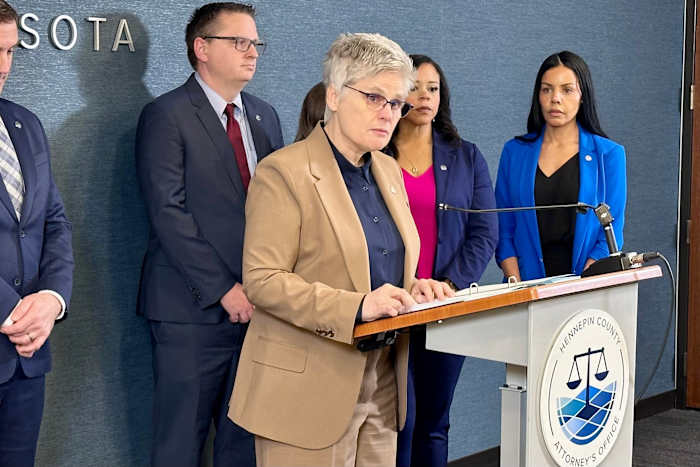
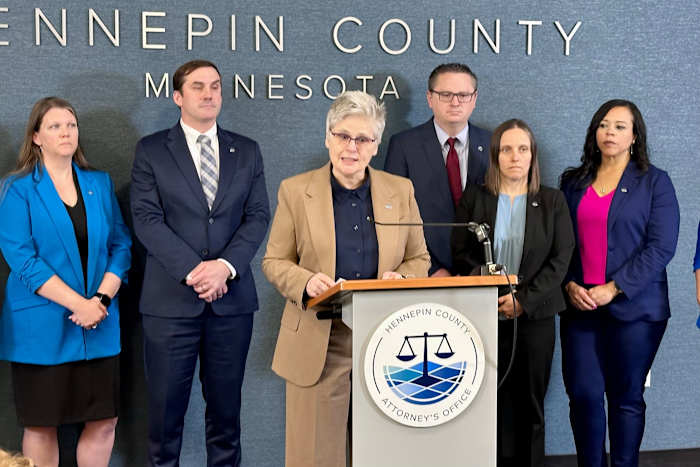
“In Minnesota, federal agents are not above the law,” Moriarty stated during a press briefing, emphasizing that the officer’s actions fell beyond the legal boundaries of a federal official’s duties.
An arrest warrant has been issued in Hennepin County for Gregory Donnell Morgan Jr., who is facing two charges of second-degree assault. According to Minnesota authorities, Morgan, 35, was on duty as an Immigration and Customs Enforcement (ICE) agent when the incident unfolded on February 5.
The situation escalated when the driver and a front-seat passenger of a car called 911. They reported that the driver of an unmarked SUV drove alongside them, rolled down his window, and brandished a handgun at them. The driver recounted to investigators their fear that the assailant was a “crazy person driving down the road aiming guns at people,” as detailed in the warrant.
Moriarty’s office confirmed that no arrangements have been made for Morgan’s surrender, and a nationwide arrest warrant remains active. If found guilty, Morgan could face up to seven years in prison for each assault count.
Department of Homeland Security and Justice Department officials didn’t immediately respond to emails seeking comment.
A person returning a call to a possible phone listing for Morgan said it was a wrong number for him. A message sent to a possible email address for Morgan bounced back as undeliverable. No one immediately returned a phone message left at a number for a person listed as sharing an address with Morgan. It was not immediately known if he had an attorney who could speak for him.
Accused agent told state investigators he ‘feared for his safety’
Moriarty said during a news conference that Morgan was driving a rented, unmarked SUV on the shoulder of the highway when a car also moved into the shoulder to try to slow Morgan down, its driver not knowing he was an officer. After the car returned to the legal lane, she said, Morgan pulled up alongside and pointed his service weapon at the two people in the car.
According to the warrant, Morgan then merged his SUV back into traffic ahead of the victims, who took cellphone photos of the SUV’s license plate.
The warrant does not identify the victims.
Morgan and his partner, who was not charged, told investigators they were returning at the end of their shift to the federal building being used to stage officers. The arrest warrant says Morgan “made no claim that he was conducting any law-enforcement operation or activity or responding to any emergency situation.”
Morgan told investigators with the Minnesota State Patrol that the other vehicle “swerved over in front of him and cut him off,” the warrant said. Investigators wrote that Morgan said “he feared for his safety and the safety of others” when he drew his gun and yelled: “Police! Stop!”
The warrant says the victims couldn’t tell Morgan was a law enforcement officer and couldn’t hear him because their windows were up.
Trump administration has warned against arresting federal agents
The charges could intensify a clash between the Trump administration and Minnesota officials over the crackdown. Todd Blanche, the acting attorney general, has warned that the Justice Department could investigate and prosecute state or local officials who arrest federal agents for performing their official duties.
Moriarty said she is not concerned about blowback from federal authorities and that her office will “hold people accountable if they violate the laws of the state.”
Michael Gerhardt, a constitutional law professor at the University of North Carolina at Chapel Hill, said federal officers are granted immunity for actions within the scope of their official responsibilities.
He said the actions described in the arrest warrant don’t seem relevant to the officer’s duties. But because he was on-duty at the time, the officer could petition to move the charges to federal court and make a claim for immunity.
“When you look at it more closely, flashing a gun is a serious threat,” Gerhardt said. “And there’s a good argument that isn’t part of his official duties … it’s abusing his powers.”
Minnesota still investigating killings of 2 US citizens by federal officers
DHS deployed about 3,000 federal officers to the Minneapolis-St. Paul area from December through February in what the department called its “ largest immigration enforcement operation ever.” The Minnesota operation led to thousands of arrests, angry mass protests and the fatal shootings of two U.S. citizens.
Backlash over the officers’ aggressive tactics mounted, and two of the crackdown’s most high profile leaders were soon gone. Trump fired Homeland Security Secretary Kristi Noem in March shortly after the Minnesota surge ended. That same month, Gregory Bovino, the Border Patrol sector chief who led immigration operations in several large cities, announced his retirement.
Minnesota authorities continue to investigate the conduct of federal officers during the immigration crackdown, insisting they can’t trust the federal government to investigate itself. Minnesota sued the Trump administration last month for access to evidence in three cases involving shootings by federal officers, including the killings of Renee Good and Alex Pretti.
___
Lauer reported from Philadelphia and Bynum reported from Savannah, Georgia. Associated Press reporters Alanna Durkin Richer in Washington and Hannah Fingerhut in Des Moines, Iowa, contributed.
Copyright 2026 The Associated Press. All rights reserved. This material may not be published, broadcast, rewritten or redistributed without permission.


