
Share this @internewscast.com

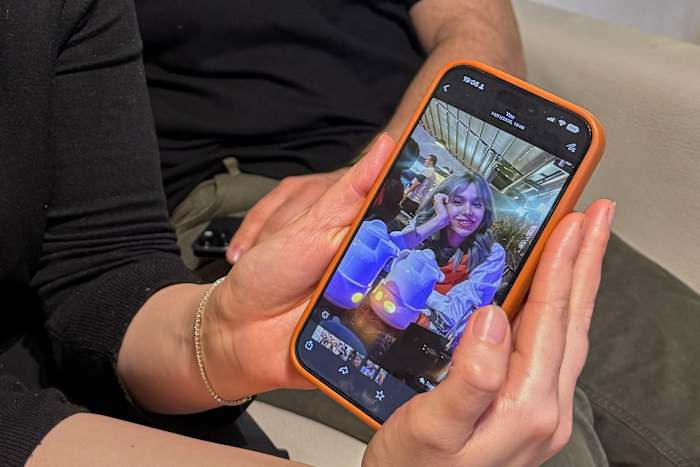
BEIRUT – The family of Robina Aminian, a college student, believes she was tragically shot at point-blank range by Iranian security forces, with a bullet piercing the back of her head.
Her death, amid widespread protests against the Islamic Republic’s leadership, marked only the beginning of her family’s ordeal. Following the tragedy, Aminian’s mother was forced to sift through numerous bloodied bodies to locate her daughter. The family then hurriedly fled to avoid potential demands from authorities for a fee to release the body, ultimately laying her to rest in an unmarked grave by the roadside.
Their harrowing experience epitomizes the despair inflicted by Iran’s violent crackdown on demonstrators, leaving grieving families to navigate overcrowded morgues in search of their loved ones. This loss is further exacerbated by the challenge of mourning and ensuring a respectful burial.
Over a week has passed since Aminian’s death, yet her family has not been able to hold a funeral for the young Kurdish woman, who was studying fashion in Tehran.
“She aspired for a promising future,” shared her uncle, Nezar Minoei, speaking from Oslo. “Regrettably, that future has been snatched away.”
The exact circumstances surrounding her death remain uncertain.
Details about what happened to Aminian are scant. After her death, her mother called relatives outside the country, recounting what she learned from Aminian’s friends, who were present when she was killed.
The Associated Press spoke to three relatives, who all described similar details from the mother’s account. An Oslo-based human rights organization, Iran Human Rights, released a report about her killing, citing witness testimony. They verified there was a shooting on the night of Jan. 8 around the campus of the Shariati Technical and Vocational College for Girls.
With communications greatly limited in Iran, the AP has been unable to independently confirm the family’s account or the wounds to Aminian’s body or to verify its location. The Iranian mission to the United Nations in New York did not respond to questions about the death.
The U.S.-based Human Rights Activists News Agency, which relies on a network of activists on the ground and has been accurate during previous unrest in Iran, said at least 3,090 people have been killed. Iran’s government has not offered any overall casualties figures.
Friends called mother to report daughter’s shooting
Everything that Aminian’s relatives abroad know about her death comes from a brief phone call her mother was able to make Jan. 10 to relatives in Oslo.
They say the mother, Amina Norei, got a call Jan. 8 from Aminian’s friends, who said she had been gunned down by security forces. The friends told Norei they were walking away from campus in Tehran after dark when they saw a protest and joined in.
A bullet fired by security forces struck the back of Aminian’s head, her friends told the mother.
Videos shared on social media, verified by the AP, and statements by rights groups, doctors and survivors, describe Iranian agents using rifles and shotguns to disperse protesters across the country.
Iran’s theocracy, which has used violence in previous rounds of unrest, increasingly refers to demonstrators as “terrorists.” Authorities allege some demonstrators were armed, but there are no allegations that anyone was armed in Aminian’s vicinity at the time of her death.
Aminian’s relatives said she was not an activist or involved in politics.
Mother ‘looked through so many beautiful faces’
Aminian’s mother was in Kermanshah, a western city in the Kurdish region of Iran nearly 460 kilometers (230 miles) from Tehran, when she learned about her daughter’s death.
She rushed to Tehran in the middle of the night, she told family. Norei recalled to them how she began unzipping body bag after body bag, looking for Aminian.
“She looked through so many beautiful faces, trying to find her girl,” Hali Norei, Amnian’s aunt, said from Oslo. ”And what is so horrifying for me is imagining what my sister feels as she searches for her daughter.”
Many other Iranian families are searching overflowing morgues for loved ones, according to rights group Amnesty International. Bodies have piled up in trucks, freight containers and warehouses, the group said.
When Norei found her daughter, she was joined by her husband, daughter and son, and the family rushed out with the body, fearing authorities would block their way and insist on a payment to release the corpse, according to Minoei, Aminian’s uncle.
“She actually stole the body,” Minoei said.
In a statement to the AP, the New York City-based Center for Human Rights in Iran said it has received multiple accounts of intelligence forces demanding money from families in exchange for the return of protesters’ bodies. The group called the levies “a well-known, standard practice” in Iran to scare families into not publicly mourning their dead.
Other families reported to the center that they were forced to sign papers falsely declaring that their dead relatives were members of the security forces in order to retrieve the bodies.
Iranian state television recently aired a statement saying mortuary and burial services were free, after repeated allegations of the practice.
Minoei said the mother told him that she and her oldest daughter spent the seven-hour ride back to Kermanshah clutching the body in the backseat, blood and tears staining their clothes. When they got home, the mother told him, security forces had surrounded their house.
Amina Norei told her family they had only one option: They drove out of town and dug a pit on the side of the road. They placed the body inside and drove away. Aminian is still believed to be buried there, in an unmarked grave.
Relatives said they have not heard from Amina Norei or other relatives in Iran since Sunday.
___
Frankel reported from Jerusalem.
Copyright 2026 The Associated Press. All rights reserved. This material may not be published, broadcast, rewritten or redistributed without permission.