
Share this @internewscast.com
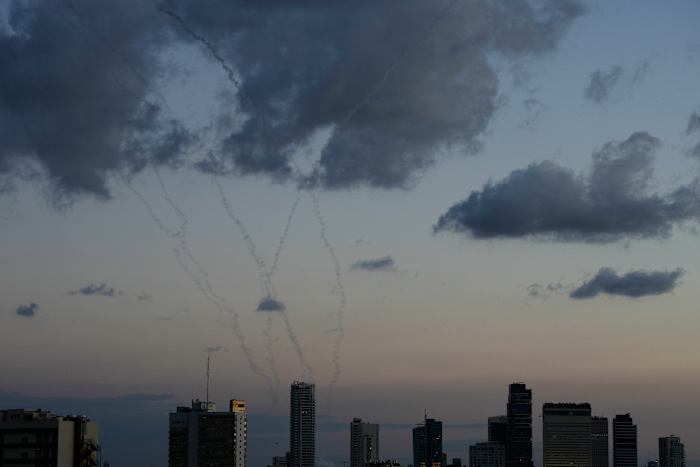
TEL AVIV – On Saturday, central Israel experienced relentless missile strikes originating from Iran, prompting residents to repeatedly seek refuge in shelters. This escalation followed a significant joint offensive by the U.S. and Israel against Iran.
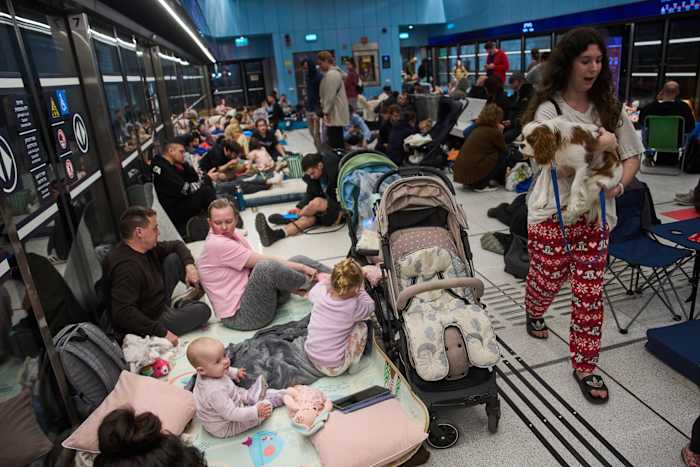
In Jaffa, a culturally diverse neighborhood in Tel Aviv, many residents found themselves without adequate personal shelters. Consequently, over 100 individuals, including Muslim families with children, religious Jews from a nearby seminary, and even several dogs, crowded into a communal shelter beneath a local park.
Inside the shelter, some groups spread out on brought-in mattresses, engaging in card games, while others shared snacks. Meanwhile, observant Muslims, observing their Ramadan fast, kept tabs on the latest developments via their phones as alarm after alarm echoed throughout the area. As evening approached, they had to break their fast, known as iftar, amid the safety of bomb shelters.
Idit Cohen, a resident close to the park, shared, “We anticipated this, though we hoped it wouldn’t come to pass.” She remarked on how such situations often bring the community closer together.
In a gesture of solidarity, a stranger in the shelter, a religious Jew who typically refrains from driving on the Sabbath, offered to transport Cohen’s son, who had been urgently called to reserve military service, to his base.
Expressing the collective sentiment, Cohen added, “I hope this ends soon. It’s a nightmare. People are growing increasingly weary and frustrated. We have families with young children here, but also elderly individuals who can’t keep making these frantic trips all day.”
For the past 2 1/2 years, Israelis have become familiar with the routine after fighting with Hamas in the Gaza Strip, Hezbollah in Lebanon, Houthi rebels in Yemen and a 12-day war last June against Iran.
Igor Libenson, a construction worker and father of two sons, said his family was mostly tired from the constant moving back and forth. “The kids aren’t scared, we were here also in June in the same situation,” said Libenson, whose sons are 4 and 7 years old.
Some of the religious Jews sang psalms with their arms slung around each others’ shoulders.
“We look at this in the long term. We suffer today but we do hope that it will resolve the problems of tomorrow,” said Maya Tutian, a resident of Tel Aviv, who was in a public shelter in the northern part of the city. “The Iranian regime is not just a threat of us, people who live here in Tel Aviv, but for the entire world.”
During last year’s war with Iran, some people without access to shelters in their homes took to sleeping in Tel Aviv’s underground light rail stations and underground mall parking lots.
While new buildings in Israel are required to have reinforced safe rooms meant to withstand rockets, Iran is firing much stronger ballistic missiles. And shelter access is severely lacking in poorer neighborhoods and towns, especially in Arab areas and in rural parts of the country.
More than two thirds of Israel’s Bedouin minority have no access to shelters, according to the Negev Coexistence Forum, a local advocacy group. Last summer, many Bedouin families resorted to building DIY shelters out of available material: buried steel containers, buried trucks, repurposed construction debris.
Iran began striking shortly after a joint attack by Israel and the U.S. early Saturday. By nightfall, the Israeli army said dozens of missiles had been launched at Israel.
Israeli police and emergency services said several people were lightly wounded in missile strikes, while the military intercepted many of the incoming missiles.
Israel issued a nationwide warning and put the country on high alert, canceling school and most gatherings across the country.
Copyright 2026 The Associated Press. All rights reserved. This material may not be published, broadcast, rewritten or redistributed without permission.