
Share this @internewscast.com
In a discreet move, Larry Page has joined the ranks of South Florida’s elite property owners, acquiring two expansive estates in Miami’s Coconut Grove for a total of $173.4 million within days. This acquisition places Page among a growing number of tech magnates expanding their real estate portfolios in Florida, especially as California considers imposing a wealth tax on its affluent residents.
Page initiated his purchases in late December by acquiring Banyan Ridge, a 4.5-acre waterfront estate, for $101.5 million. This transaction marks one of Florida’s most notable residential sales. Shortly after, he secured another waterfront mansion nearby for $71.9 million in a private deal, though the properties are not contiguous. Together, these estates offer Page a unique combination of vast space, seclusion, and direct access to Biscayne Bay.
Despite the lack of public statements from Page or his representatives, these acquisitions have generated buzz in both the tech and real estate sectors. The timing aligns with reports of Page reducing his California presence and restructuring some business operations outside the state, actions perceived as strategic in light of California’s proposed wealth tax on billionaires.
A $101.5 Million Legacy Estate
The centerpiece of these acquisitions is Banyan Ridge, a private compound nestled in one of Coconut Grove’s most prestigious areas. The estate, which sold in December after being listed as high as $135 million, makes Page only the second owner of this exclusive property.
Previously belonging to the estate of Jonathan Lewis, a noted Miami restaurateur and son of the late Progressive Insurance CEO Peter B. Lewis, Banyan Ridge resembles more of a personal resort than a single residence. It boasts multiple buildings interconnected by winding paths through lush tropical landscapes, along with expansive terraces, meditation gardens, and luxurious amenities. Here is a video tour of Banyan Ridge, provided via YouTube (a platform owned by Page and ironically, unlikely to disappear anytime soon):
One of the main residences on the estate dates back to the 1920s, originally designed for William Jennings Bryan, the former U.S. Secretary of State and thrice presidential candidate. A second significant residence was later constructed for Lewis’ father. Together, these structures comprise approximately 11,800 square feet, set within grounds that are nearly impossible to replicate in today’s Miami due to zoning and land limitations.
One of the main residences dates back to the 1920s and was originally designed for William Jennings Bryan, the former U.S. Secretary of State and three-time presidential candidate. A second primary home was built decades later for Lewis’ father. Together, the structures total roughly 11,800 square feet, spread across grounds that are almost impossible to replicate in modern Miami due to zoning and land constraints.
Despite its size and prestige, Banyan Ridge is notable for what it does not offer: direct water frontage. That gap appears to have been filled almost immediately by Page’s second acquisition.
A Second Home With Waterfront Access
On January 5, Page closed on a second Coconut Grove property for $71.9 million, purchasing the home in an off-market deal from heiress Sloan Lindemann Barnett and her husband, Roger Barnett, the CEO of health-supplement company Shaklee.
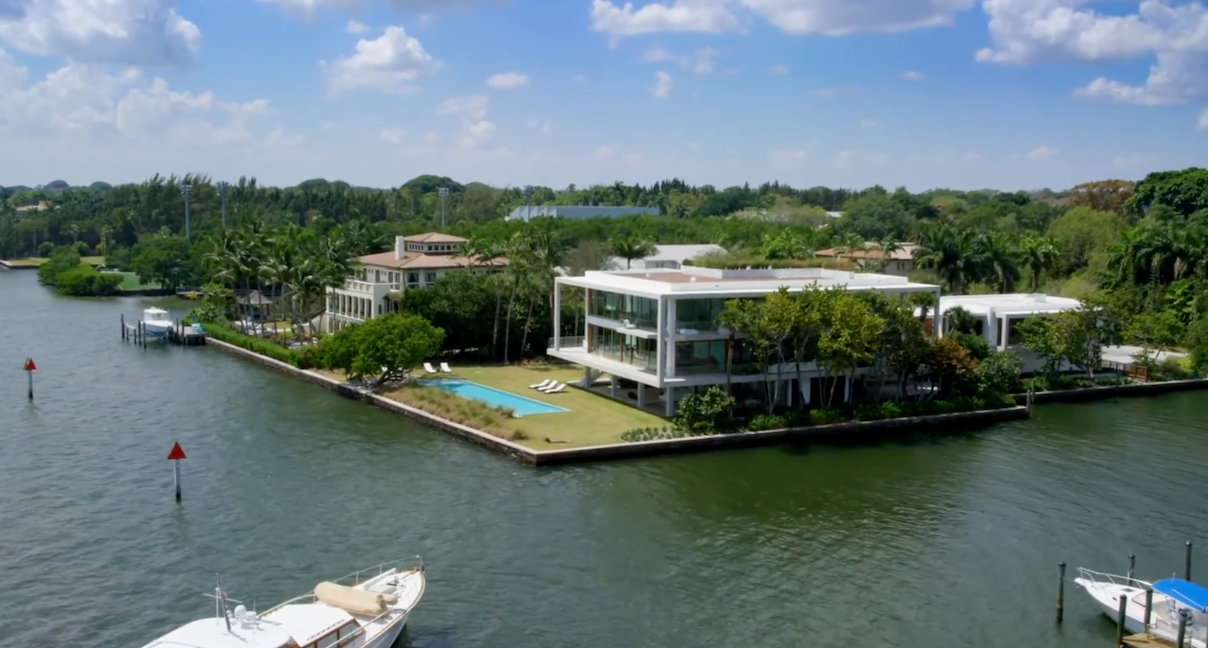
Built around 2015, the contemporary mansion spans roughly 17,000 square feet and sits on a corner lot with water frontage on two sides, directly on Biscayne Bay. The home features a distinctly modernist design, with clean lines, expansive glass walls, and an emphasis on blending indoor and outdoor living. Previous listing descriptions said the structure appears to “float” above the surrounding greenery and water. Here is a video tour, once again, courtesy of YouTube:
The Barnetts had purchased the home in 2021 for $45.9 million, meaning Page paid nearly $26 million more, less than five years later. The deal was never publicly marketed.
Together, the two purchases give Page both scale and shoreline: a sprawling private compound and a sleek waterfront residence, separated by just a short drive.
Why Miami, Why Now?
Larry Page and Sergey Brin currently rank as the #2 and #3 richest people on earth, with respective net worths of $285 billion and $266 billion. The vast majority of their respective net worths comes because they each own roughly 6% Alphabet (Google’s parent company name). At the current market cap of $4 trillion, a 6% stake is worth $240 billion. The roughly $45 billion and $26 billion differences in their net worths come from assets and wealth built from stock sales and other investments.
California is currently proposing a so-called “Billionaire Tax” where anyone who owns a stake in a business that’s worth more than $1 billion would have to pay 5% of the value of that fortune as a tax. You may be thinking, “5% of $240 billion is $12 billion. That’s not soooooo bad…” but there’s a catch. Alphabet’s dual-class structure gives their shares 10× voting power, translating into roughly 30% of the company’s voting control for each founder.
That distinction is crucial.
Under Section 50303(c)(3)(C) of the proposed 2026 Billionaire Tax Act, ownership for tax purposes is presumed to be no less than a taxpayer’s percentage of voting or control rights, regardless of their actual economic interest. In practice, that means Page and Brin would not be taxed as 6% owners. They would be taxed as 30% owners.
That assumption inflates each founder’s taxable wealth from roughly $240 billion to $1.2 trillion. Apply the proposed 5% one-time wealth tax, and the result is a $60 billion tax bill for each founder.
In other words, a tax branded as 5% would effectively wipe out a quarter of their actual Alphabet holdings, forcing massive stock sales or the surrender of control. For founders whose wealth is inseparable from governance, the math makes remaining a California resident economically irrational.
The Paper Trail Is Already Moving
The real estate purchases are only the most visible part of a broader repositioning.
In late December, an LLC tied to Page and Brin called T-Rex, formed in 2006 and long registered in California, was converted into a Delaware entity and renamed T-Rex Holdings. The conversion was completed on December 24, 2025, just days before the proposed tax’s residency cutoff. The new filing lists a principal office in Reno, Nevada, with both founders remaining as managers.
Around the same time, Page also converted his family office out of California and into Delaware. Additional entities linked to Page, including vehicles tied to advanced aviation projects and medical research, have likewise been reincorporated outside the state.
None of these moves, on their own, constitute proof of a permanent relocation. But taken together, they form a familiar pattern to tax attorneys and wealth managers: reduce California nexus, establish alternative residency options, and create defensible distance before a retroactive tax takes effect.
The proposed ballot measure would apply to anyone deemed a California resident as of January 1, 2026, making the final weeks of December effectively a high-stakes deadline. California residency is determined by a constellation of factors, including time spent in the state, business operations, and personal ties. Owning major residences elsewhere and shifting control entities out of state materially changes that analysis.
(function() {
var _fbq = window._fbq || (window._fbq = []);
if (!_fbq.loaded) {
var fbds = document.createElement(‘script’);
fbds.async = true;
fbds.src=”
var s = document.getElementsByTagName(‘script’)[0];
s.parentNode.insertBefore(fbds, s);
_fbq.loaded = true;
}
_fbq.push([‘addPixelId’, ‘1471602713096627’]);
})();
window._fbq = window._fbq || [];
window._fbq.push([‘track’, ‘PixelInitialized’, {}]);