A young girl from Colorado finds herself trapped within her own body due to a rare genetic disorder that has rendered her nearly immobile.
Up until she turned two, Everly Green seemed like any other child her age.
However, her life took a drastic turn when she was diagnosed with a condition known as early infantile epileptic encephalopathy type 37, or FRRS1L. This illness results from a genetic mutation that interferes with crucial brain receptors responsible for cellular communication.
When these mutated cells fail to communicate effectively, it leads to epilepsy, abnormal movements, developmental delays, and a severe loss of overall function, posing significant health risks.
Shortly after receiving her diagnosis, Everly lost all control over her head and body, now only able to communicate through her eyes.
Nicknamed ‘Frizzle,’ this condition is extraordinarily rare, impacting just over 100 families worldwide. With no known cure, many affected families struggle to hold onto hope.
‘We were told to just go home, love her, take care of her,’ her mom Chrissy Green told the Daily Mail.
But Everly’s family has taken matters into their own hands and are working to raise millions of dollars in hopes of covering the cost of developing a treatment after pharmaceutical companies deemed it too expensive to create one.

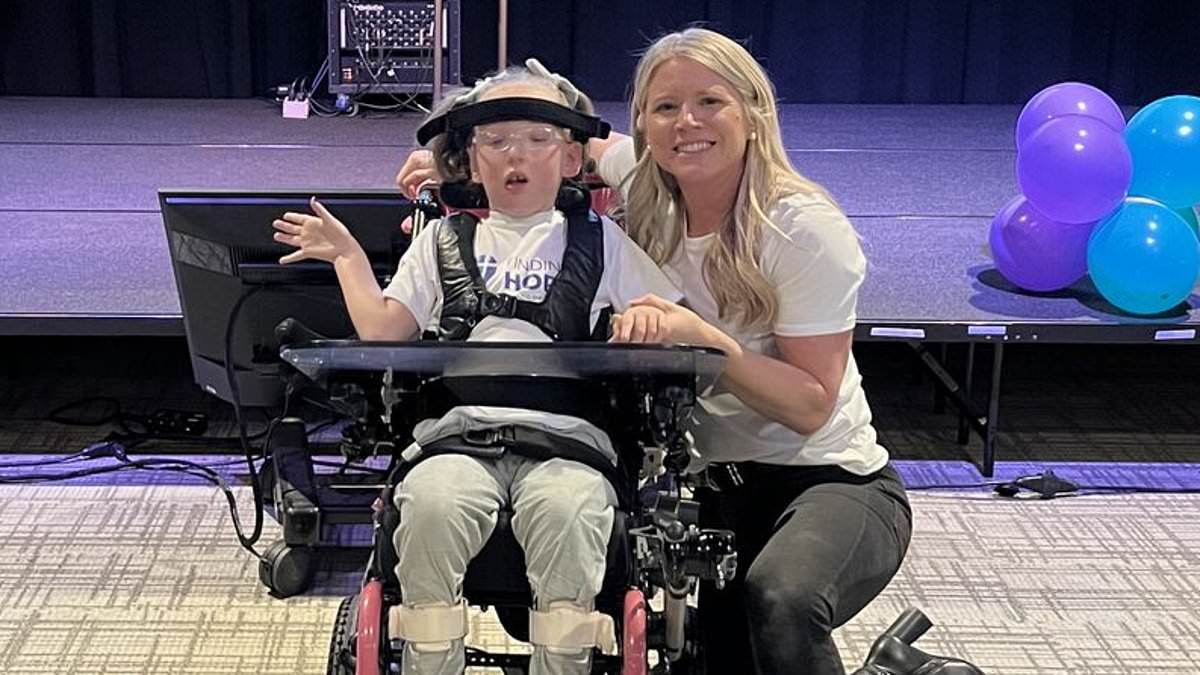
Everly Green, 8, was born with a genetic mutation that caused her to lose movement throughout her entire body

Chrissy Green co-founded a foundation that raises money to fun treatment for the FRRS1L mutation
‘Even before we knew that there was an option for treatment, we were like, we’re going to give her the best quality of life we can.’
Everly’s parents noticed that she was behind on some of her milestones at 18 months but thought she was slowly but surely catching up.
She could crawl, play with toys, sit up and even say a few words.
But after she turned two, she had her first seizure and rapidly began losing function. Just six weeks later, she had been stripped of all mobility.
Three months after that, she lost the ability to speak and eat and was given a feeding tube.
Now, at eight years old, she requires a wheelchair, a feeding tube and constant supervision. She can’t hold up her head or move on her own, and experiences frequent seizures.
To communicate, Everly uses a gaze machine computer system.
The software uses a camera to track eye movement. It calibrates to the user’s eyes and coordinates where they look on the screen to what words or phrases they wish to say.

Green said her daughter loves to read, dance and participate in crafts
Her mother told the Denver Post that Everly loves to learn and has lots of friends at school. She loves books, crafts and dancing.
Green described her daughter as a normal, silly, playful kid trapped in a functionless body.
‘These kids are in there, they want to play like other kids, they just can’t move,’ Green told the outlet.
Currently, patients are limited to ‘ineffective’ seizure medications. Everly relies on carefully sought out symptom treatments, including physical therapy and the Keto diet.
Green said there are no known medications that can completely stop epilepsy caused by Frizzle or halt the rapid regression that comes with the disease.
Everly requires 24-hour care and attention from a nurse or family member. Green said her two sons love to assist, but it can still be challenging for the family.
‘It is really hard on the families because we love our kids so much. And we know when we do stuff with them, they love it and they’re so excited,’ she explained.
‘But no parent can stand with their kid nonstop and like constantly move their hands and fingers for them. That’s just not realistic. So you kind of have parent guilt.’
In 2021, Green teamed up with other FRRS1L families across the globe to start the Finding Hope for FRRS1L Foundation.
The foundation is a parent-led non-profit that is hard at work raising money to develop a life-altering treatment for the tragic mutation.
Families are working with researchers and small-scale developers, but it will cost millions to find, test and administer a cure.
For academic entities and drug companies, this process could take years.
‘That’s where parent organizations are really trying to take control,’ Green explained.
‘Because we can move so much faster and we have the urgency because we’re looking at our kid every day and seeing them experience immense struggle.’
A four-step mission is outlined on their website. So far, they have raised $1.5 million, which went toward beginning research and pre-clinical work.
During phases one and two in 2023, the foundation raised $400,000 to do a round of gene therapy testing on mice with the help of a doctor at the University of Texas Southwestern.

Green said her daughter is a normal eight-year-old trapped in a motionless body
The experiment was based on another by a German scientist who bred mice with the FRRS1L mutation and administered gene therapy to treat their symptoms.
Much like the German scientist’s experiment, the foundation saw major recovery and increased movement in the mice, giving them hope for their kids.
According to the Cleveland Clinic, gene therapy changes a ‘disease-causing’ gene by delivering a replacement gene through a harmless virus.
‘We as an organization are pursuing gene replacement therapy as our treatment mechanism because we believe that if we can get good copies of the FRRS1L gene into their brain cells, that the receptors will be rebuilt, the messaging will come back, and they will regain function,’ Green explained.
Currently, they are working on toxicology testing, which costs $1 million. After that, the non-profit must raise enough for manufacturing and clinical trials.
Neil Hackett, who researches the mutation, told the Post that it just isn’t profitable for big pharma to treat rare diseases that affect so few patients.
Because of that, drug companies have little interest in developing drugs to treat it.
So families have had to take matters into their own hands, though it’s a challenging undertaking.

She was given a feeding tube and recently began communicating with an eye tracking device
‘They need specific expertise, which is not easy to find, and they need massive amounts of money,’ said researcher Neil Hackett.
The foundation must get permission from the FDA to manufacture and sell the treatment. Then, convince insurance companies to front the cost for patients.
Hackett said eventually families may have to turn the drug over to a ‘commercial entity’ which will make a profit from their hard-earned research.
But, Green said, they want to maintain control of the treatment.
‘We’re committed to making sure Frizzle treatment gets fully developed as a drug that can be accessible to all patients and doesn’t get put on a shelf,’ she said.
‘We’ve learned from the hardship of other genetic disease groups that were involved with institutions and therapeutic companies, where the company gained control of the treatment, didn’t find it to be profitable, and then put their treatment on a shelf.
‘Those groups had to fight to get it back, then developed, and sadly, the patients who were waiting every day for treatment are the ones who paid the price in that situation.’
Finding Hope for FRRS1L is currently at stage four of their fundraising goal, according to the website.
They have to raise $4 million to start manufacturing the treatment, which they aim to do by the spring.
Next, a hopeful $2 million in donations will go toward clinical trials of the newly manufactured drug.
The non-profit relies completely on donations from loved ones, supporters and generous companies.
Their goal is to dose the first round of Frizzle patients by September 2026.
While there are risks, Green said spending their time and resources to find a cure is ‘the most loving thing’ they can do for Frizzle kids.
‘Frizzle disease is so devastating,’ said Green. ‘But treatment holds so much hope and potential recovery, and people have rallied behind us and are excited to see this move forward.’


