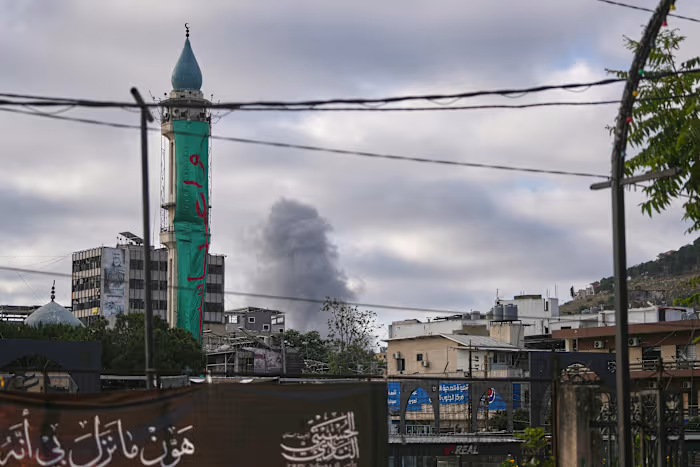

NABATIYEH – Shiite Muslims gathered in large numbers Friday in Iran, Iraq, Lebanon and communities around the world to observe Ashoura, one of the most solemn dates in their religious calendar, commemorating the seventh-century killing of Hussein, the grandson of Islam’s Prophet Muhammad.
Observed on the 10th day of Muharram, the first month of the lunar Islamic calendar, Ashoura brings to a close a 10-day period of mourning. It marks the day Hussein was killed in battle, along with members of his family and companions, after refusing to pledge allegiance to Caliph Yazid.
For Shiite Muslims, Hussein’s death remains a defining moment in Islamic history, deepening the split between Sunni and Shiite Islam and enduring as a potent symbol of resistance to oppression and injustice.
This year’s Ashoura comes in the aftermath of a war involving predominantly Shiite Iran and the United States and Israel, which launched strikes on the country on Feb. 28. The attacks killed senior officials, including Supreme Leader Ayatollah Ali Khamenei. Khamenei, 86, was not only Iran’s highest political authority but also held final say over religious matters and was revered by millions of Shiites worldwide.
A funeral procession for Khamenei is expected to be held in early July.
In Iraq, large crowds filled the Shiite holy city of Karbala, where Hussein is buried and where he was killed in the battle of 680. His shrine remains one of the most important pilgrimage sites for Shiites, drawing millions of visitors from across the world each year.
In Baghdad, thousands of mourners marched through the streets. Some participants cut their heads with razors and took part in other acts of self-flagellation, traditional expressions of grief performed by some devotees during the commemoration.
In Lebanon, where a fragile ceasefire between Israel and the Iran-backed Hezbollah remains in effect, thousands of mourners dressed in black gathered in Beirut’s southern suburbs at a shrine dedicated to Hezbollah’s former longtime leader, Hassan Nasrallah, who was killed in a series of major Israeli strikes in 2024.
Women clutched photographs of sons and brothers killed in the war — many of them fighting for Hezbollah — while others held photographs of Nasrallah or Iran’s Khamenei, who was killed in February in an attack by the U.S. and Israel.
Many of them sobbed. Expressions of grief for the death of the Imam Hussein are traditional during Ashoura, but many of the mourners were also grieving more personal losses.
Nagham Jaber said her fiance was killed in the war.
“This war was truly harsh on all of us, and now we are feeling the meaning of Ashoura more than usual,” she said.
In the southern Lebanese city of Nabatiyeh, that is usually a major center to commemorate Ashoura, dozens of people gathered near the main square, much of which was destroyed by Israeli airstrikes over the past weeks, with some of them inflicting head injuries on themselves to express their mourning. The practice is widely opposed by many Shiites, including Hezbollah.
Earlier on Friday, state media and Associated Press journalists on the ground reported two Israeli airstrikes on the nearby village of Nabatiyeh al-Fawqa. It was not immediately clear if the strike inflicted any casualties.
“Despite all the hardships, everything happening to the Shiite Muslim community, and the wars we are facing, we came to reaffirm our loyalty, our love and our unwavering passion for Imam Hussein,” said Khader Kamal.
To Shiites, who make up the second-largest branch of Islam after the Sunni majority, the killing of Hussein holds deep religious and historical resonance and plays a key role in shaping identity.
Hezbollah’s leader, Naim Kassem, said in a speech Friday that Ashoura is being repeated again by the U.S. and Israel, adding that his group and its supporters were subjected to a “war of elimination.”
“America and Israel also wanted to eliminate Iran by removing the regime and controlling the country,” Kassem said. “The memorandum of understanding is a declaration of defeat for America and Israel,” Kassem said of the deal reached this month between Washington and Tehran.
____
Sewell reported from Beirut. Associated Press writer Bassem Mroue contributed to this report from Beirut.