

BUNIA – Amidst a challenging landscape, urgent medical supplies are being dispatched to the heart of a unique Ebola virus outbreak in Congo. Health workers in the area are facing significant challenges, including equipment shortages, community distrust, and the presence of armed groups in a region fraught with instability.
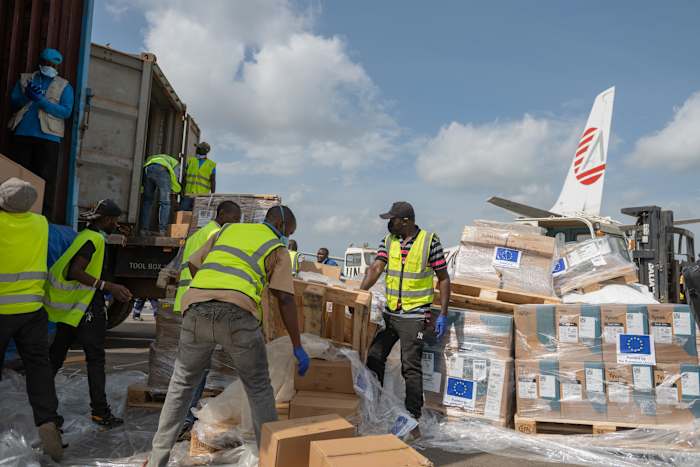
On Thursday morning, a white cargo plane touched down in Bunia, delivering much-needed masks, gloves, boots, and medications. These supplies, provided by the European Union, are critical for the response effort. U.N. forklifts were seen loading these vital shipments onto trucks for distribution.
Reporters from the Associated Press visiting Bunia observed deserted emergency treatment facilities, while in Bambu, nearby medical professionals were forced to use out-of-date masks while treating individuals suspected of having Ebola.
In Ituri province, health centers have been attacked at least three times as locals resist medical protocols that conflict with traditional burial practices, heightening the risks for medical personnel.
According to Jérôme Kouachi, who oversees emergency operations for UNICEF in Congo, the EU’s aid will continue to arrive in installments over the next week.
The World Health Organization’s director-general, Tedros Adhanom Ghebreyesus, announced on Thursday his departure for Congo to observe efforts against the Bundibugyo virus firsthand. This virus currently lacks any approved treatment or vaccine, and the WHO has declared the situation a public health emergency of international concern to encourage more support.
The Congolese government has confirmed more than 1,000 suspected cases, with at least 220 deaths, since it declared an outbreak on May 15. But the virus had been spreading undetected for weeks, and the WHO suspects it is much larger than what has been reported.
The virus has also reached neighboring Uganda, which has confirmed seven cases and one death. On Wednesday, the Congolese government said the first survivor to recover from the virus had left a health center.
“We are trying to catch up,” Congo Foreign Minister Thérèse Kayikwamba Wagner said earlier this week. “It is a race against the clock.”
The response on the ground has been hampered by multiple challenges, including customs’ red tape, insufficient storage facilities, bad roads and weak telecommunications, humanitarian agencies said in a report on Thursday.
Tedros on Wednesday called for a ceasefire in a region where armed groups have staged violent attacks for decades. “We cannot build community trust or isolate the sick while bombs are falling,” he said.
Tucked in the northeastern part of Congo close to the Ugandan border, Ituri province has been reeling from attacks by the Allied Democratic Force, a rebel group allied with the Islamic State group, and a coalition of ethnic militias. In early May, the ADF killed at least 40 people and burned several homes in Ituri.
The illness has also been reported in two Congolese provinces south of Ituri — North Kivu and South Kivu, where the Rwanda-backed M23 rebel group controls many key cities, including Goma and Bukavu. The rebels have reported two cases. The region’s main airport in Goma, which doubles as a staging ground for humanitarian efforts into the region, has been closed since January 2025, when M23 seized the city.
The conflict has precipitated one of the world’s largest humanitarian crises, with at least 7 million people displaced in eastern Congo.
—-
Ope Adetayo reported from Lagos, Nigeria.


