Share this @internewscast.com

ORLANDO, Fla. – While sandhill cranes might not express affection with typical Valentine’s Day tokens, these stately gray birds embody romance with enduring partnerships that often last a lifetime. As the day of love approaches, these cranes are on the brink of their yearly courtship period, characterized by intricate dances, synchronized calls, and the iconic sight of cranes gracefully moving in pairs, as noted by the Brevard Zoo.
Florida hosts two sandhill crane subspecies: the resident Florida sandhill crane, which remains year-round, and the migratory greater sandhill crane, which spends the winter in Florida before heading north to nest. Both subspecies are recognized for their strong pair bonds, with both partners actively participating in every phase of reproduction.
Their courtship rituals are a spectacle, reminiscent of a romantic performance. Engaging in leaps, bows, wing flaps, and harmonious calls, these cranes reinforce their bond. Once a pair is established, they collaborate to construct a nest in open wetlands, preferring shallow waters.
The Florida Fish and Wildlife Conservation Commission notes that sandhill cranes typically begin nesting in late winter, continuing into the spring.
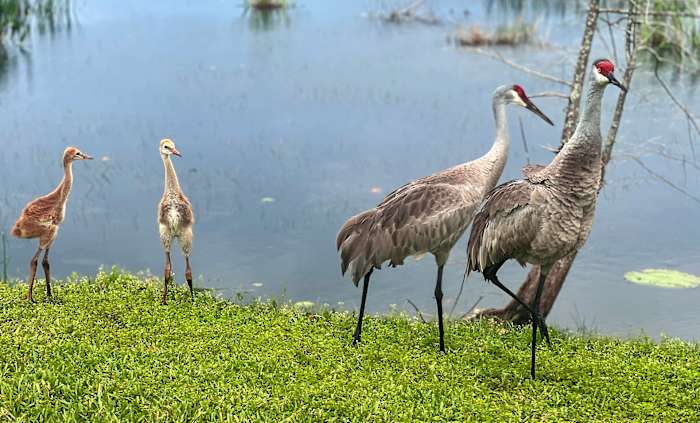
During the incubation period, both parents alternate in warming the eggs over approximately 30 days. Remarkably, the young, known as colts, are able to accompany their parents just a day after hatching.
The commitment of these cranes extends well beyond nest-building, as observed by the Smithsonian’s National Zoo. Adults nurture their offspring for several months, foraging together and protecting their domain. Florida’s resident cranes are frequently observed in pairs or small clusters, reflecting their monogamous instincts and enduring connections. With some cranes living over two decades, many share this time with a single mate.
Around 10 months old, juveniles are able to leave their parents and bonding between pairs begins at two years old.
While their courtship displays may draw attention from curious onlookers, wildlife officials and conservation groups urge residents to give cranes space, especially during nesting season. Habitat loss remains a threat to the species, which relies on wetlands, prairies and open spaces to breed and forage.
Still, for many Floridians, spotting a pair of sandhill cranes strolling through a neighborhood or calling overhead has become a familiar sign of the season — and a reminder that some of nature’s strongest partnerships don’t need a holiday to endure.
Copyright 2026 by WKMG ClickOrlando – All rights reserved.