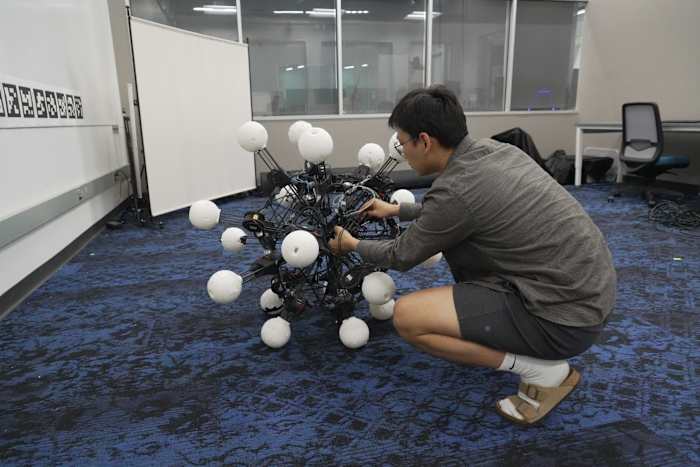


DURHAM, N.C. – At Duke University, a groundbreaking robotic creation is on the cusp of making its debut, ready to tackle the world from any angle.
Eschewing traditional robotic designs that mimic the symmetry found in humans, animals, or insects, engineering professor Boyuan Chen and his team have centered their efforts on achieving what they term “dynamic symmetry” through uniform movement capabilities.
This innovative approach has given rise to Argus, a spherical robot inspired by the mythological giant with many eyes. Equipped with depth-sensing cameras and 20 extendable legs arranged around a central hub, Argus boasts the unique ability to perceive and travel in any direction without a defined front, back, or top.
“We are shifting the focus from the arrangement of a robot’s limbs to its capability to move quickly in any direction,” Chen explained. “Who says a robot has to resemble us to be the most effective helper?”
In practical tests, Argus has demonstrated its versatility by traversing sandy beaches and dense forest floors, effortlessly rolling over obstacles and regaining balance when nudged. It can scale between two parallel walls by alternating its leg movements to brace and push itself upward. Remarkably, Argus remains operational even if a motor fails or a leg is damaged.
“Observing Argus in motion is a distinct experience compared to any other robot we’ve worked on,” remarked Jiaxun Liu, a graduate student and co-author of a study on Argus published in the journal Science Robotics. “The moment we watched it navigate through trees and rough terrain, enduring significant impacts, we realized we had something truly unique.”
As part of their work, researchers developed a new design principle called dynamic isotropy that rates robots on a scale of 0 to 1 based on how uniformly they can accelerate in every direction. Most robots in use today, including humanoids and drones, score below 0.6. Argus scores 0.91.
“When a robot can accelerate equally well in every direction, it stops needing to face the world in any particular way,” said Chen, who hopes the same principle could guide the development of search and rescue robots, underwater or aerial vehicles or robots with the ability to grip objects.
“Instead of building a robot hand that looks like a human hand … one idea is to think about having Argus be the hand itself, and it can manipulate objects in any direction,” he said. “The knowledge we can transfer to the rest of the world is much more deeper than building an existing robot or copying an existing species.”
____
Ramer reported from Concord, New Hampshire.