
Share this @internewscast.com

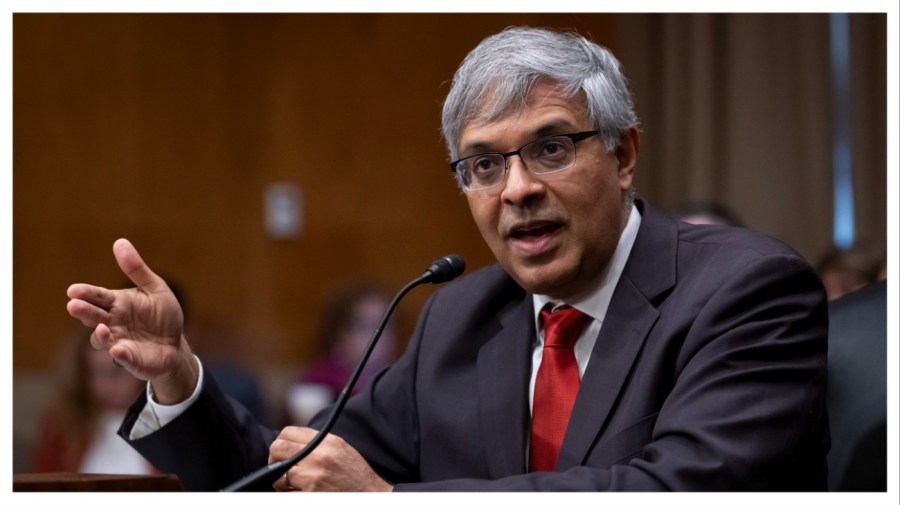
() National Institutes of Health director Jay Bhattacharya believes mRNA vaccine technology is “promising” but has failed at “earning public trust,” speaking one week after the federal government canceled $500 million for its development.
Once hailed as a “medical miracle” by then-President Trump during the onset of the COVID-19 pandemic, mRNA vaccines are the latest innovation put on the chopping block by Bhattacharya’s boss, Health and Human Services Secretary Robert F. Kennedy Jr.
Kennedy last week announced HHS would begin a “coordinated wind-down” of its mRNA vaccine development activities. His reasoning that the vaccines were unsafe contradicted Bhattacharya’s, outlined in a recently published op-ed for The Washington Post.
NIH director blames Biden’s ‘overreach’ for vaccine skepticism
Bhattacharya’s piece did not portray mRNA vaccines as dangerous, but rather still in progress: “Still, I do not believe the mRNA vaccines caused either mass harm on the one hand or saved 14 million lives on the other. Those estimates swing wildly based on speculative modeling, not concrete evidence.”
He also refuted the idea that reluctance to get vaccinated or vaccinate children is due to an increased “anti-vax” sentiment.
Instead, the NIH director placed the blame on the Biden administration for mandating COVID-19 vaccines in 2021. Notably, most of those mandates were overturned through legal means or pulled by the administration only a mandate for certain health care workers was upheld.
“The failure was thus not a communications problem. It is a trust problem due to the Biden administration’s scientific overreach, public pressure and, frankly, arrogance,” he wrote.
mRNA technology enabled the development of those COVID-19 vaccines, which experts like former U.S. Surgeon General Jerome Adams credit as saving millions of lives.
Bhattacharya acknowledged its usefulness in the op-ed, writing: In the future, it may yet deliver breakthroughs in treating diseases such as cancer, and HHS is continuing to invest in ongoing research on applications in oncology and other complex diseases.”
Vaccination rates dropping, but experts vouch for mRNA safety
It’s true that fewer people in the U.S. are getting mRNA vaccines, especially children.
The latest Centers for Disease Control and Prevention data, published in April, showed that 13% of children between six months and 17 years old had already received an updated COVID-19 vaccine. That means a large majority hadn’t and likely won’t.
Similarly, a Pew Research Center poll published in October 2024 found that 60% of Americans said they likely wouldn’t get an updated COVID-19 vaccine.
That same poll found that two reservations stood out as “major reasons” for those opting out: they didn’t think they needed it (61%) or were concerned about side effects (60%).
They remained the top two reasons regardless of age, race, political party or ethnicity.
While Kennedy and other top health officials have not yet commented on Bhattacharya’s op-ed, HHS’ decision to cut mRNA development funding has gotten plenty of feedback.
Infectious disease experts say the mRNA technology used in vaccines is safe, and they credit its development during the first Trump administration with slowing the 2020 coronavirus pandemic. Future pandemics, they warned, will be harder to stop without the help of mRNA.
“I don’t think I’ve seen a more dangerous decision in public health in my 50 years in the business,” said Mike Osterholm, a University of Minnesota expert on infectious diseases and pandemic preparations.
He noted mRNA technology offers potential advantages of rapid production, crucial in the event of a new pandemic that requires a new vaccine.
The Associated Press contributed to this report.