
Share this @internewscast.com

NEW YORK – In Rhode Island, snowplows worked tirelessly to ensure ambulances and fire trucks could navigate through the heavy snowfall. Meanwhile, in New York City, teams prepared to tackle the snow and ice with extensive operations involving large amounts of warm water. Boston officials faced the challenge of clearing sidewalks, which were encased in dense snow, posing significant obstacles for wheelchair users.
This week’s massive snowstorm swept across the Northeast, from Maryland to Maine, leaving behind thick blankets of snow. Cities were in a race against time on Wednesday, trying to manage the towering snowbanks that showed no signs of melting soon.
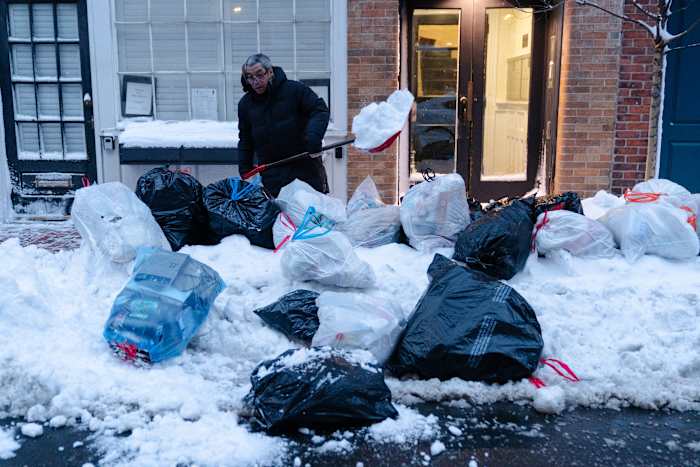
By Tuesday night, New York City had deployed 143 million pounds (65 million kilograms) of salt, Mayor Zohran Mamdani reported, and enlisted over 3,500 emergency workers to shovel snow. These workers, earning $30 per hour, were tasked with clearing thoroughfares and bus stops.
However, with another storm looming on Wednesday, the efforts were far from complete, especially impacting those with disabilities.
Jeff Peters, representing the Center for Independence of the Disabled, New York, likened parts of the city to isolated islands, difficult to traverse.
“You might find a stretch of sidewalk that’s clear, but then encounter a narrow, 6-inch (15-cm) strip that forces you to walk single file, leaving no space for strollers, rollators, walkers, or crutches,” Peters explained. “At intersections, you’ll often face unshoveled pathways leading to what can only be described as a glacier blocking your path.”
Tina Guenette, who uses a motorized wheelchair, had to shovel out her yard this week after more than 33 inches (84 centimeters) fell in Harrisville, Rhode Island, a town about 17 miles (27 kilometers) northwest of Providence.
“I really have no choice if my service dog wants to go outside,” Guenette said Tuesday. Harrisville has a volunteer snow-shoveling program, but it hasn’t had volunteers for the last few years, she said.
The National Weather Service warned another storm originating in the Great Lakes could push into the Northeast on Wednesday. The clipper storm brings the prospect of a combination of rain and some snow, though it’s not forecast to be nearly as severe.
NYC Emergency Management warned Wednesday morning commuters that the forecast light snow and freezing temperatures could bring slick roads and sidewalks as well as black ice.
Monday’s storm blanketed the region with snow, canceled flights, disrupted transit, downed power lines and killed at least one person. More than 3 feet (0.9 meters) fell in Rhode Island — surpassing snow totals from the historic Blizzard of 1978 that struck the Northeast, the National Weather Service said.
Meteorologist Ryan Maue, former chief scientist at the National Oceanic and Atmospheric Administration, said if all of the snow that fell from Maryland to Maine fell just on Manhattan, the snow would tower over a mile high.
In Newport, Rhode Island, Joseph Boutros, 21, was found unconscious inside a vehicle covered in snow Monday night, the city’s police department said in a statement. The Salve Regina University student was taken to a hospital and pronounced dead due to carbon monoxide poisoning, police said.
Some large school districts moved back to in-person classes on Wednesday, including Philadelphia, which had switched to online learning during the first two days of the week.
In New York City, more than 900,000 students in the nation’s largest public school system had a regular day Tuesday. Many students and their caregivers scrambled over mountainous snow banks and dodged salt spreaders during the morning drop-off.
Power had returned for many of the hundreds of thousands who had lost electricity in Massachusetts, New Jersey, Delaware and Rhode Island. But about 173,000 customers in Massachusetts were still without power early Wednesday.
Thousands of flights in and out of the U.S. have been canceled in recent days. By Wednesday, the disruptions seemed to be subsiding, with only around 150 grounded, according to the flight tracking website FlightAware.
When Jamie Meyers’ flight landed in New York from Buenos Aires, Argentina, Tuesday evening, the cabin full of relieved passengers burst into applause. The Manhattan resident was supposed to arrive home Sunday but faced a cancellation and significant delay.
The weather service referred to Monday’s storm as a “classic bomb cyclone/nor’easter off the Northeast coast.” A bomb cyclone happens when a storm’s pressure falls by a certain amount within a 24-hour period.
___
Golden reported from Seattle and Boone reported from Boise, Idaho. Associated Press writers Jennifer Peltz, Michael R. Sisak and Philip Marcelo in New York; Mike Catalini in Morrisville, Pennsylvania; Mark Scolforo in Harrisburg, Pennsylvania; Kathy McCormack in Concord, New Hampshire; and Audrey McAvoy in Honolulu contributed.
Copyright 2026 The Associated Press. All rights reserved. This material may not be published, broadcast, rewritten or redistributed without permission.