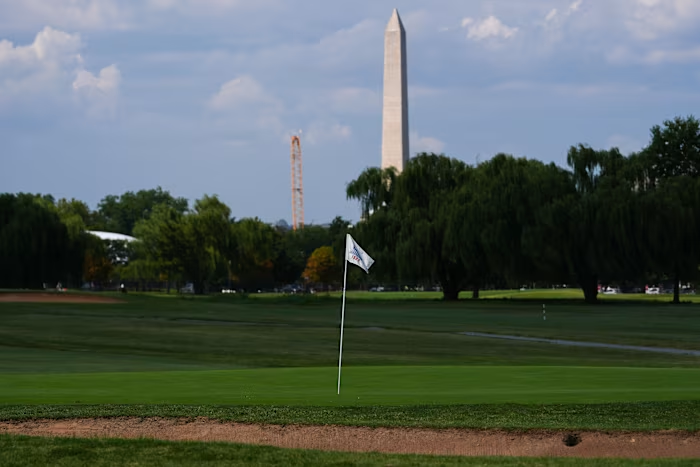
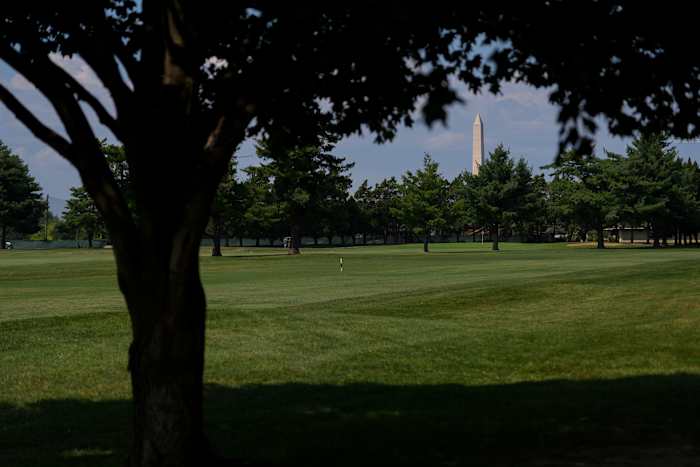
WASHINGTON – The Trump administration has awarded contracts to launch work on President Donald Trump’s proposed takeover and redevelopment of East Potomac Golf Links in Washington, Democrats on the House Natural Resources Committee said Wednesday.
Rep. Jared Huffman of California, the committee’s top Democrat, said during a hearing that the National Park Service hired a civil engineering firm to begin work on the historic public course without publicly announcing the decision or notifying Congress. A lawsuit challenging Trump’s proposal contends that the redevelopment would violate the congressional law that established the park more than a century ago.
“Now, this is not just any old golf course. This is a beloved public space with huge historic significance,” Huffman said.
Huffman accused Trump of “systematically moving to take this historic, publicly accessible resource and turn it into another gilded private golf club for the mega-rich.” He described the effort as “a methodical, deliberate effort to take a public park away from the people,” while taxpayers cover the cost.
Huffman said a contract approved last week provides nearly $400,000 for a Massachusetts-based company to conduct environmental and historic-preservation compliance work at the course. The Park Service has also posted a projected construction contract valued at up to $49 million, with solicitation expected to begin Jan. 31, 2027.
“Democrats on this committee are tracking all of this. We’re going to keep dragging it all into the daylight until the public gets the answers we deserve,” Huffman said in a statement. “We’re not going to let Donald Trump walk off with our public lands. That park belongs to the American people, and I’m not willing to sit here and watch him simply steal it.”
The $389,355 award went to Vanasse Hangen Brustlin Inc., which has offices in Washington, D.C., Massachusetts and other locations. It follows months of activity at the park. The administration said this spring that it had reached an agreement with Fazio Golf Design to develop renovation plans. Trump has said he wants to create a world-class golf venue as part of his broader vision for Washington, D.C., where he has demolished historic structures, altered or renamed others and deployed the National Guard for more than a year.
Huffman, Maryland Reps. Jamie Raskin and Glenn Ivey, District of Columbia Del. Eleanor Holmes Norton and Virginia Rep. Don Beyer sent a letter to Interior Secretary Doug Burgum and acting Park Service Director Jessica Bowron. They are seeking all documents, communications and records related to the project.
“East Potomac Park does not belong to Donald Trump,” the lawmakers wrote. “It belongs to the American people, and it has for more than a century.”
Spokespeople for the Interior Department and the National Park Service did not immediately respond to requests for comment.
East Potomac Park, which includes East Potomac Golf Links, was created under a 1897 congressional act establishing the area for the “recreation and the pleasure of the people.” The golf course opened in 1919.
Trump, who has several projects underway in the capital—including a $400 million White House ballroom and the coming construction of a triumphal arch—began discussing Washington’s public golf courses late last year.
Debris from the demolished East Wing of the White House was dumped at East Potomac, creating a three-story mound near one of the park’s three golf courses. The mound remains in place. The National Park Service has said tests found lead, chromium and other toxic metals in the debris.
“When completed, this Course will have the ability to host Major Golf Tournaments, including The U.S. Open, The Ryder Cup, The PGA Championship, and other top PGA Tour events,” Trump wrote on social media in June. He said at the time that work was scheduled to start Sept. 1.
Some residents worry the proposed changes could transform a place that has served Washingtonians from across the city for more than 100 years. They fear converting the park into a high-end golf destination would bring higher fees and reduce access to public space.


