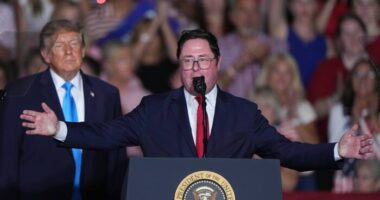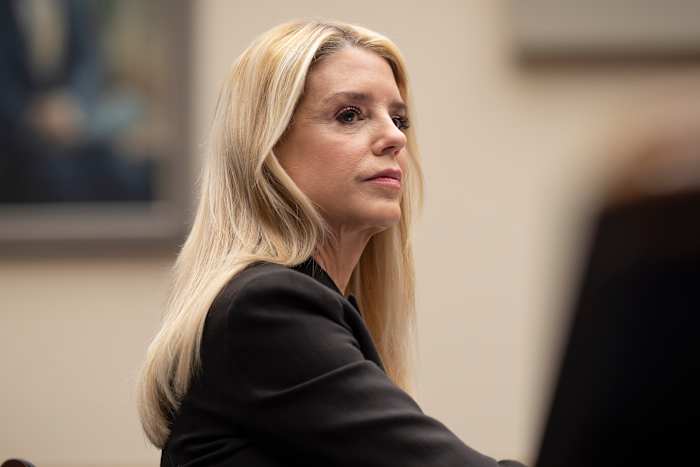


WASHINGTON – Former Attorney General Pam Bondi is set to testify before House lawmakers concerning the sexual abuse cases linked to Jeffrey Epstein. This much-anticipated testimony promises to cast a new light on the mishandling of Epstein’s case files by the administration.
Previously, Bondi took a firm stance when lawmakers questioned her about the Epstein investigation during public testimonies. As she is no longer at the helm of the Justice Department, it remains uncertain if she will maintain the same posture in Friday’s closed-door session.
The transcribed session offers lawmakers an opportunity to delve into the Trump administration’s management of the Epstein files. It will also touch on related issues, such as the incarceration of Epstein’s close associate, Ghislaine Maxwell, who was transferred to a Texas prison camp last August.
Rep. Yassamin Ansari, a Democrat from Arizona serving on the House Oversight Committee, commented, “If she chooses to, she can certainly clarify many of the missing details. The real question is whether she will be forthcoming.”
Lawmakers are keen to uncover the decisions made by prosecutors regarding Epstein’s associates, the Justice Department’s compliance with congressional demands to release Epstein’s files, and any potential involvement by President Donald Trump in these matters.
Despite being dismissed from her role in early April, Bondi, who recently disclosed her battle with thyroid cancer, continues to be closely aligned with Trump.
Trump appointed her to a White House panel on artificial intelligence this week, and Bondi will be accompanied Friday by Justice Department officials, including Harmeet Dhillon, who heads the department’s Civil Rights Division, acting as her counsel.
Democrats say that arrangement is a conflict of interest.
A spokesperson for the Justice Department said the officials were there to help lawmakers understand the department’s process for releasing the case files.
Bondi was central to the Epstein saga
Bondi has been central to the political firestorm over Epstein, initially raising expectations for the full release of what’s known as the Epstein files, only to later backtrack. That reversal prompted Congress to step in and pass a law requiring the release.
Bondi faced even more backlash when the Justice Department’s release of the files was delayed and then included personal information of several potential victims. She has insisted in congressional hearings that she was trying to follow the law.
The House Oversight Committee, meanwhile, has been conducting a wide-ranging investigation into Epstein that spans multiple presidential administrations.
The interview format is already contentious
Bondi was subpoenaed by the committee in March in a bipartisan vote, but she tried to head off that demand by holding a closed-door meeting with lawmakers that same month. The maneuver only added to the enmity between Bondi and Democrats on the committee.
Bondi’s departure from the Justice Department also raised doubts about the enforcement of the congressional subpoena. After the committee’s Democrats maneuvered to press for a civil contempt of Congress resolution against Bondi, she agreed to sit for a transcribed interview rather than a sworn deposition.
Democrats on the Oversight panel have criticized that arrangement, saying that it allows Bondi to decline to answer questions. They have also pressed the Republican chair of the committee, Rep. James Comer, to record the interview on video.
“A failure to film and release a video of Ms. Bondi’s testimony would present a grave injustice to the American people and survivors of Epstein’s crimes,” the committee’s top Democrat, Rep. Robert Garcia, wrote to Comer.
Comer has said he is allowing Bondi to sit for a transcribed interview rather than a deposition as an incentive to cooperate. Previously, he had enforced a subpoena on former President Bill Clinton and former Secretary of State Hillary Clinton after they resisted the demand. Both of their depositions were video-recorded.
Still, Comer said Bondi could face prosecution if she lies to Congress. He said the committee would also release a transcript of the interview.
“Hopefully that will be good enough,” he said.