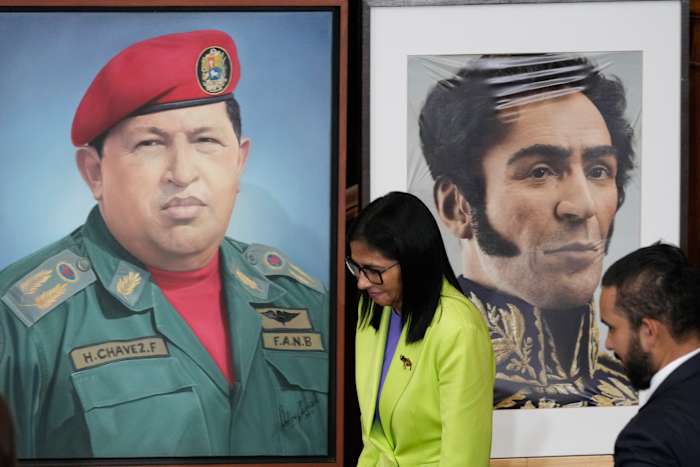


The slogan “United, we will win!” has long symbolized the enduring strength of Hugo Chávez’s nationalistic revolution, which has held sway in Venezuela for over 27 years. This rallying cry is ubiquitous at official gatherings, street protests, and on state television, echoing the loyalty to a socialist government known for its traditional opposition to the United States.
From young activists to seasoned party leaders and media figures, this diverse group has consistently demonstrated allegiance to Chávez’s vision. Even when faced with undeniable challenges, the coalition of military allies, ideological supporters, and opportunists has historically moved in unison.
However, this unity is showing signs of strain following a dramatic U.S. military operation that led to the capture of then-President Nicolás Maduro in January. Long-standing loyalists are beginning to voice their disagreements with the current administration under acting President Delcy Rodríguez. There are even whispers of an internal betrayal that may have facilitated Maduro’s ousting.
The evolving relationship with the United States has fueled criticism among Chávez’s followers. Rodríguez has distanced herself from some of Chávez’s policies, accommodating U.S. demands, and reshaping the government to her preferences. These changes include removing ministers, pushing legislative reforms in the oil sector, and releasing political prisoners.
Supporters of Chavismo are increasingly vocal in their disapproval of Rodríguez’s rapprochement with the U.S., which contrasts sharply with the movement’s historical view of the White House as its primary adversary, regardless of who occupies it.
Supporters of Chavismo are making their disapproval known. Many criticize the warming relationship between Rodríguez’s government and the White House, whose occupant, regardless of party, Chavismo has historically seen as its main adversary.
May’s deportation of a former minister to face criminal investigations in the U.S. and Rodríguez’s recent authorization for the U.S. military to conduct a training exercise in Venezuela’s capital laid bare internal divisions.
Mario Silva spent years spreading pro-government propaganda as the host of a program on state TV before being removed from the airwaves after Maduro’s capture. Silva questioned the legality of the deportation of Alex Saab, a close ally of Maduro’s, arguing that it violated a constitutional ban.
He contended that Rodríguez is not governing freely, as some decisions “are being made in the U.S. Embassy.”
“The imperialists don’t negotiate. They conquer, test and probe — until our country shatters,” Silva said in a livestream. “Nobody is safe right now. And that is a concrete, terribly dangerous fact.”
On May 23, a few dozen people in Caracas protested the training that saw two Marine Corps Osprey aircraft land at the U.S. Embassy. They held a Venezuelan flag with the message, “No to the Yankee drill” written over it. Participation was minimal, which stood out in a city used to frequent demonstrations with attendance in the thousands.
Elías Jaua, who served as Chávez’s vice president and in Maduro’s cabinet in his first years in office, repudiated the exercise on social media. He later told The Associated Press he was speaking up to raise awareness among Venezuelans of the “humiliating” situation facing the country.
“At this stage, the most important thing is to prevent this occupation and this colonial administration to which a nation like Venezuela is being subjected from becoming normalized,” Jaua said.
Chávez and Maduro — as well as Rodríguez, in her previous roles as vice president and communications and foreign affairs minister — had long prophesied that the U.S. would use force to take control of Venezuela’s oil industry, which has opened up to private capital after Maduro’s capture. The Trump administration oversees oil sales and administers revenues as part of its phased plan to turn the troubled South American country around.
Maduro’s ouster prompts power struggle
The social, political and economic crisis that took hold when Maduro became president in 2013 drove more than 7.7 million people to leave Venezuela and pushed millions of others into poverty. It also led to rounds of anti-government protests and U.S. economic sanctions, both of which the ruling party survived.
Party stalwarts celebrated a Maduro victory in a 2024 election despite overwhelming evidence showing he had lost. They also echoed the party leadership’s denial of a surge of migration. Their loyalty was often rewarded, be it with food and basic goods for the poor or multimillion-dollar contracts and bodyguards for the better-off.
Andrés Izarra, a communications minister under Chávez and tourism minister under Maduro, said the fractures are not based in ideology or a defense of Chavismo, which he believes ended when its founder died in 2013. Maduro’s interest, he said, was in enriching himself and remaining in power at all costs..
Self-interest, he said, is creating division.
“Since there is no ideological foundation, it is simply a struggle for power, money, positions, and survival. Do you think (he) would be protesting if he’d kept his bodyguards, or if they’d kept his little salary, or his share of power?” Izarra, who lives in exile since becoming a government target last decade, said of one critic of change under Delcy. “If they had an ideological interest, they would have spoken much earlier.”
Loyalists discuss possible betrayal of Maduro
Criticism even aired on state television last month, when a Colombian leftist leader sitting in the audience of Interior Minister Diosdado Cabello’s show stood up and questioned Venezuela’s efforts to free Maduro and first lady Cilia Flores from U.S. custody.
“We’ve seen a very weak campaign for Cilia and Nicolás’s freedom,” Manuel Caicedo said before a visibly stunned Cabello.
Another devout Chavista, lawmaker Iris Varela, told a podcaster she believed a government insider had helped the U.S. oust Maduro. The idea has widely rumored since President Donald Trump announced that the authoritarian leader had been captured on Jan. 3, but no evidence has emerged.
Of course there’s a betrayal,” Varela said. “I say that every Christ has a Judas. If our Lord Jesus Christ knew he was going to be betrayed and yet he let Judas kiss him on the cheek, … won’t a traitor emerge for Maduro?”


