
A private car ride with Vladimir Putin may not be the exclusive treatment that President Donald Trump thought.
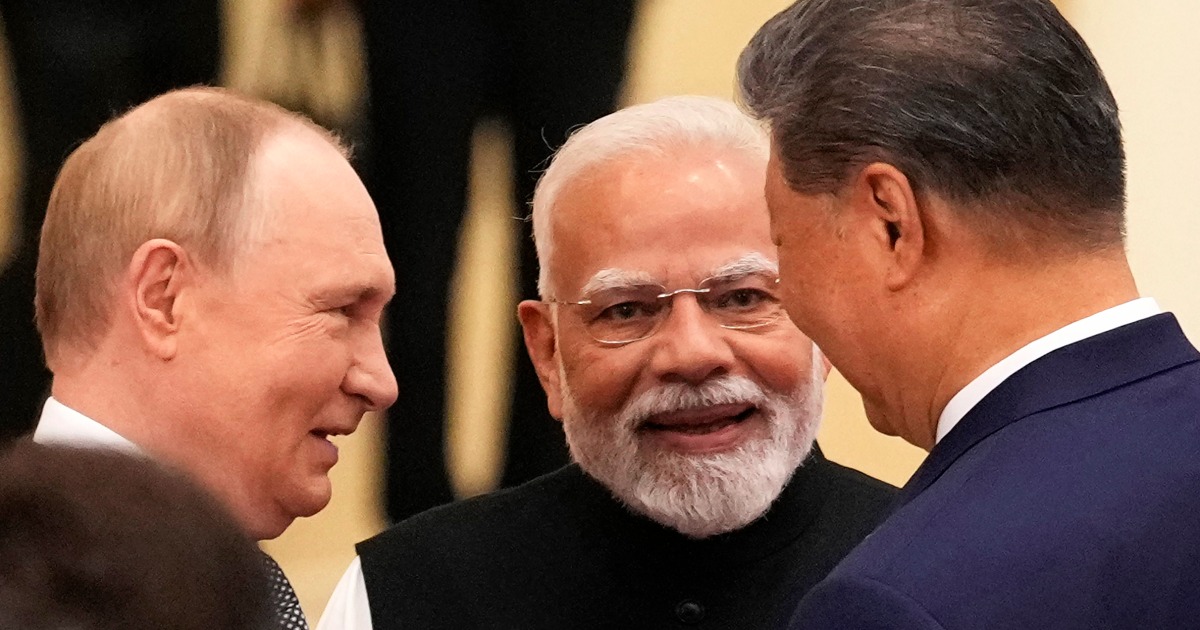
Exuding camaraderie with gestures like hand-holding and hugs, Russian leader Vladimir Putin and Indian Prime Minister Narendra Modi, accompanied by their host, Chinese leader Xi Jinping, orchestrated a display on Monday seemingly intended to catch Washington’s attention.
During a pivotal regional summit in Tianjin, a northern Chinese port city, the three leaders reiterated their enduring positions, yet it was the atmosphere and timing of their unity that stood out strikingly.
India, which has been assiduously wooed by the West as a vital Asian ally against China, finds itself unsettled by U.S. tariffs; the Kremlin has openly disregarded Washington’s peace overtures in Ukraine; and Beijing persists in clashing with the U.S. over trade, Taiwan, and international influence.
Amid these strained relations, the congenial optics at the Shanghai Cooperation Organization meeting sent a palpable message against U.S. pressure.
Just weeks after Trump and Putin drew attention with a non-traditional ride in “The Beast” at their Alaska summit, Modi joined Putin for a drive in his armored limo — a deliberate signal of defiance following the U.S. increasing tariffs on India to 50% due to its purchase of Russian oil.
According to Russian state media reporter Pavel Zarubin, the duo spent nearly an hour conversing in the car before transitioning to formal talks.
“I always feel that meeting you has been a memorable experience,” Modi said to Putin later during the talks.
The Russian leader called Modi his “dear friend,” espousing Russia and India’s “friendly and trusting” relations.
Whether the theatrics in Tianjin were spontaneous or carefully planned, “the message remains the same,” Keir Giles, a senior fellow at London-based think tank Chatham House told NBC News.
“The close relationship that Trump sought with Putin is now on display between Putin and others,” he said.
In a speech to delegates, Putin did say that “understandings” reached at his summit with Trump could form the basis for peace in Ukraine, but he gave little indication of shifting his position and issued his customary rebuke blaming the West’s “constant attempts to drag Ukraine into NATO” for causing the war.
Xi, for his part, criticized the “bullying behavior” from unnamed countries, a veiled reference to the U.S.
He outlined his longstanding ambition to challenge the U.S.-led global economic and security order. “We must continue to take a clear stand against hegemonism and power politics, and practise true multilateralism,” he said, while laying out a new “Global Governance Initiative” that was short on concrete policies.
The Tianjin meeting was the biggest SCO summit since the organization’s founding in 2002, part of Beijing’s long-running effort to challenge U.S. dominance.
That push has only been amplified by global upheaval from Trump-era policies and other foreign policy shifts.
India and China have long sparred over a Himalayan border dispute, trade tensions, and Beijing’s support for India’s rival, Pakistan.
But shared grievances — including Trump’s tariffs, which in China’s case have reached as high as 145% — have helped carve out common ground.
Against that backdrop, Modi’s first visit to China in seven years and his apparent camaraderie with Xi and Putin appeared especially striking.
While Modi joyously clasped Trump’s hand during a massive rally in Texas in 2019 during, Indian media on Monday seized on his friendship with Putin as a message of defiance against the U.S.
Indian television channel Republic World called it a “big diplomatic win” for India, while a headline on new channel Aaj Tak ran “Trump’s dictator vs. Modi-Putin’s friendship.”
In the wake of the Tianjin summit, the U.S. embassy in India highlighted that the partnership between the two nations “continues to reach new heights,” spanning “innovation and entrepreneurship, defense, and broader bilateral ties.”
But the message, from Modi as well as Xi and Putin, seemed clear: They may have differences but they are ready to stand — or sit — together.