
CAIRO – The United Arab Emirates remains a major destination for gold smuggled from conflict zones, despite regulations introduced by the government after mounting international pressure, according to a new report.
Many gold refiners and traders in the UAE are failing to comply with the rules, while enforcement remains weak, the report by Swissaid, a Switzerland-based aid and development organization, said. It recommended that the UAE be returned to an international watchlist over potential financial wrongdoing.
The UAE refines and processes gold for major markets including Switzerland, India and China. In 2024, the year after its new rules took effect, it ranked as the world’s second-largest gold exporter after Switzerland. Gold smuggled from Russia, Yemen and Sudan continues to enter the country, the report said.
The UAE adopted the guidelines to regulate the gold trade, including responsible sourcing and supply-chain checks. The measures followed warnings from a global anti-money laundering body that the country was not doing enough to prevent criminals and militant groups from concealing their wealth there.
Even after the regulations were introduced, the UAE imported at least 591 tons of illicit gold worth $74 billion, according to the report. Gold smuggled from conflict zones, Russia or African countries represented 42% of the UAE’s total gold imports in 2024, it said.
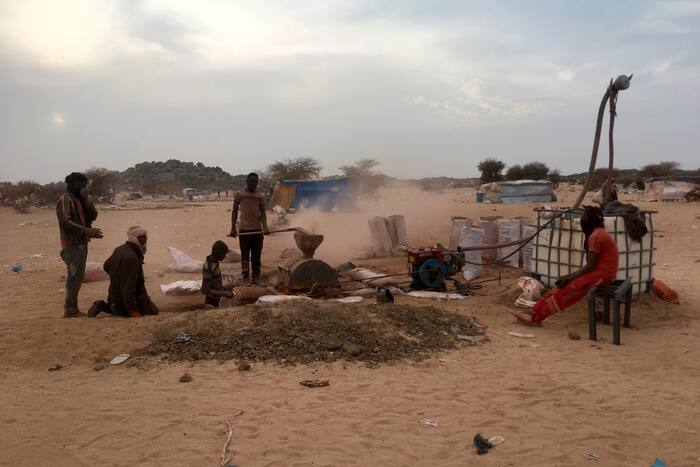
Gold mined in Africa and smuggled out of the continent accounted for nearly half of the metal the UAE imported from Africa, Swissaid said. Some of that gold entered the UAE through official channels after passing through third countries. That trade increased slightly in 2024, according to the report.
“The UAE remains by far the main destination for gold linked to armed conflicts in Africa. And it continues to be a major destination for gold exports from countries subject to international sanctions,” the report said.
The UAE did not immediately respond to a request for comment on the report’s findings.
Swissaid said most of the gold smuggled in 2024 — about 453 tons worth more than $56 billion — reached Dubai’s refineries from African gold-producing countries, including Guinea, Mali and Sudan, which is under international sanctions. Nearly 29 tons originated in Sudan, according to Swissaid. The findings drew on data from the United Nations, official trade statistics, and civil society and international organizations. The report’s authors said 2025 data remained incomplete, but available figures indicated that the upward trend was continuing.
“We had hoped that with the new regulations, conflict gold from countries subject to international sanctions would be stopped,” Marc Ummel of Swissaid told The Associated Press.
The illicit gold trade has played a central role in Sudan’s war between the military and the paramilitary Rapid Support Forces. Since the conflict began in 2023, large quantities of gold have been smuggled out of Sudan to help finance the RSF, which controls gold-producing areas in the Darfur and Kordofan regions, according to U.N. experts.
The RSF has carried out mass killings, sexual violence and widespread destruction in northern Darfur in what U.N. experts described as a “campaign of destruction” bearing the “hallmarks of genocide.”
“From our point of view, since April 2023, all gold from (Sudan) should be considered as conflict gold,” Ummel said.
The Swissaid report found that the UAE imported an additional 137.7 tons of gold worth nearly $17 billion from Russia and Yemen in 2024. Both countries are subject to international sanctions.
Despite the risks linked to sourcing gold from the UAE, Switzerland was the largest importer of gold from the country. The report said Swiss gold imports from the UAE rose sharply between 2024 and 2025, increasing from 155 tons to 420 tons.
The Swiss government did not immediately respond to a request for comment.
The report’s authors called for the UAE to be placed again on the “gray list” maintained by the Paris-based Financial Action Task Force, an international body that works to combat money laundering and terrorist financing. Countries on the gray list face increased monitoring, while the FATF’s “black list” recommends countermeasures against jurisdictions with the most serious deficiencies.
The FATF added the UAE to its gray list in 2022, then removed it in 2024 after the country introduced new gold supply-chain regulations.


