
Share this @internewscast.com

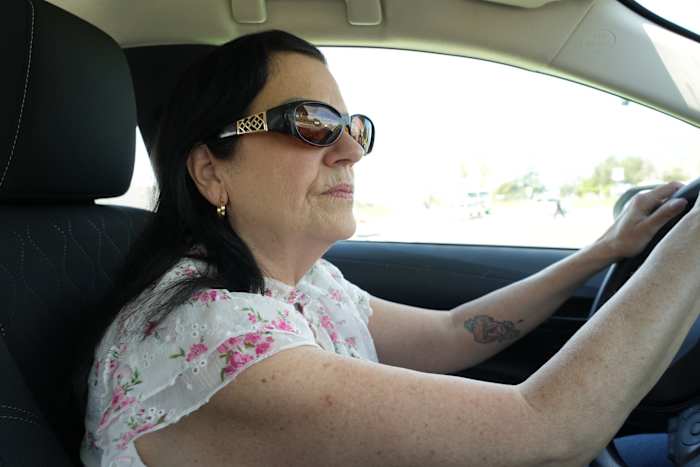
Leslie Sherman-Shafer, an Uber driver navigating the bustling streets of the San Francisco Bay Area, prefers to kick off her workday with a completely filled gas tank.
Previously, refueling her Toyota Corolla set her back around $25. However, following the onset of conflict in Iran, which has driven up U.S. gas prices by a dollar per gallon, she’s now paying nearly $40. As a retired dental office assistant who drives for Uber five days a week, Sherman-Shafer has found herself putting in extra hours to bridge this financial gap.
“We don’t get reimbursed for gas. We depend on the generosity of the tip,” she remarked. While some riders have increased their tips to help with the rising fuel costs, she noted that most passengers do not tip at all.
For many Americans, driving is an integral part of their professional lives. The U.S. Bureau of Labor Statistics reported that almost 27% of civilian workers identified driving as a key physical requirement of their jobs last year. This includes millions who use personal vehicles for work purposes, such as delivery drivers, rideshare operators like Sherman-Shafer, and self-employed professionals like electricians, nannies, home healthcare workers, and real estate agents.
As the conflict continues into its fifth week, disrupting global oil supplies, many of these workers are finding it increasingly challenging to make ends meet. According to AAA, the national average price of gas has surged to $3.99 per gallon, marking a 34% increase from just a month ago.
“With costs rising across the board, saving any money feels impossible,” Sherman-Shafer expressed.
Some companies compensate employees for using their own vehicles, including the cost of gas. In the U.S., the Internal Revenue Service sets a standard mileage rate every year that businesses and private contractors can use to calculate tax deductions. Alpine Maids, a housekeeping company based in Denver, pays cleaners the 2026 federal reimbursement rate of 72.5 cents per mile for the distance they drive to clients’ homes.
But with gas prices spiking, that money is not going as far, said Chris Willatt, a former geologist who now runs Alpine Maids.
“Our maids drive their own cars, so it’s kind of like their paycheck got smaller,” Willatt said. “They’re all upset.”
Willatt said he reduced how often maids must report to the office, from daily to once a week, and rejiggered cleaning assignments so employees aren’t driving as far between clients. If gas prices climb further, he said he might increase what he charges customers so he can pay workers more.
Molly Kenefick, the owner of Doggy Lama Pet Care Inc. in Oakland, California, said she recently raised her gas reimbursement rate to 80 cents per mile for 15 employees who use their own vehicles to pick up dogs and take them for hikes around the Bay Area. The rate increase will stay in place until gas prices in their area drop below $5 for at least a month, she said.
Kenefick said she planned to raise prices for the company’s services in May. But she doesn’t want to increase them too much because she’s worried she’ll lose clients. So Kenefick is also dipping into her savings to pay for gas.
“The economy is hard for people. Everybody’s under strain,” she said. “I can take some of the load and the company can take some of the load, provided this doesn’t go on too long.”
Ride-hailing and food delivery platforms that rely on gig workers don’t reimburse drivers for gas, but some are offering temporary incentives in response to rising gas prices. DoorDash, Uber, Lyft and Instacart are providing more than the usual cash back on gas purchases for drivers who use company-branded debit cards. DoorDash and Instacart are giving a weekly fuel payment to drivers who travel 125 miles or more making deliveries.
Sarah Noell, who spends about 20 hours a week making deliveries for DoorDash in Lynchburg, Virginia, said the measures help somewhat. But she said she’s noticed more customers declining to add tips to their orders as gas prices have increased.
Noell has started refusing any order that won’t average out to $1 per mile, including the $2.50 per order she gets from DoorDash. That cancels out many users who aren’t tipping or give only small tips.
“It takes nearly double the cost to fill my tank,” Noell said. “Ten dollars used to get me a decent amount. Now it only gets me 3 gallons.”
Owners of diesel-powered vehicles have seen even steeper fuel price increases since the war started on Feb. 28, affecting drivers around the world.
Drivers of diesel-powered “jeepneys” in the Philippines, went on strike for two days last week to protest their higher costs. In France, dozens of buses and trucks drove slowly on the Paris ring road Monday to demonstrate their concerns about rising diesel prices. Drivers and businesses want the French government to provide aid to mitigate the impact.
“The major difficulty right now is finding our balance on our business since we sold services with the vehicles at a certain price for diesel that was much cheaper. And we’re not going to ask customers to pay that difference,” Sarah Bahezre, manager of the bus transportation company Ulysse Cars, told The Associated Press.
Average U.S. diesel prices climbed 44% over the last month, according to AAA.
A few weeks ago, Rachel Hunter paid $3.62 a gallon to fill the single diesel truck used by Cactus Crew Junk Removal & Thrift Store, a Phoenix business she and her husband co-founded. The same fuel now costs $6.09 per gallon in Phoenix, according to AAA.
The truck carries all kinds of heavy cargo, from slabs of solid maple bowling lanes to loads of concrete paver tiles. So fuel costs quickly add up, Hunter said, particularly with a truck that only gets 12 or 13 miles to the gallon.
Hunter has started quoting prices that reflect the jump in prices. She worries she’s in a “vicious circle” that could hurt the business if oil prices remain high.
“We don’t want to get a bad name for being overpriced,” she says. “I’ll be able to explain it where people can understand, but it doesn’t mean they can afford it.”
Copyright 2026 The Associated Press. All rights reserved. This material may not be published, broadcast, rewritten or redistributed without permission.