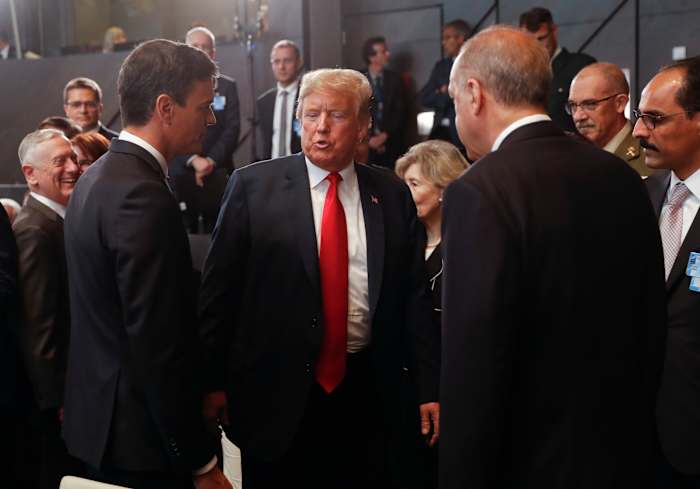


BRUSSELS – The outcome of a critical NATO summit was uncertain on Friday after Spain announced it could not secure the financial resources to meet the new defense spending target proposed by U.S. President Donald Trump.
Trump and NATO leaders are scheduled to convene for a two-day meeting in the Netherlands starting next Tuesday. He argues that allied nations should allocate at least 5% of their gross domestic product to defense, which would require unprecedented investments.
Trump has cast doubt over whether the U.S. would defend allies that spend too little.
Establishing this spending benchmark would be a historic move. It would align defense contributions from all 32 member countries equally for the first time. Just last week, NATO Secretary-General Mark Rutte was optimistic about the members’ endorsement of this initiative.
But in a letter to Rutte on Thursday, Prime Minister Pedro Sánchez wrote that “committing to a 5% target would not only be unreasonable, but also counterproductive.”
“It would move Spain away from optimal spending and it would hinder the (European Union’s) ongoing efforts to strengthen its security and defense ecosystem,” Sánchez wrote in the letter, seen by The Associated Press.
Spain is not entirely alone
Belgium, Canada, France and Italy would also struggle to hike security spending by billions of dollars, but Spain is the only country to officially announce its intentions, making it hard to row back from such a public decision.
Beyond his economic challenges, Sánchez has other problems. He relies on small parties to govern, and corruption scandals have ensnared his inner circle and family members. He’s under growing pressure to call an early election.
In response to the letter, Rutte’s office said only that “discussions among allies on a new defense investment plan are ongoing.” NATO’s top civilian official had been due to table a new proposal on Friday to try to break the deadlock.
The U.S. and French envoys had also been due to update reporters about the latest developments ahead of the summit but postponed their briefings.
Rutte and many European allies are desperate to resolve the problem by Tuesday so that Trump does not derail the summit, as he did during his first term at NATO headquarters in 2018.
Budget boosting
After Russia’s full-scale invasion of Ukraine in 2022, NATO allies agreed that 2% of GDP should be the minimum they spend on their military budgets. But NATO’s new plans for defending its own territory against outside attack require investment of at least 3%. Spain agreed to those plans in 2023.
The 5% goal is made up of two parts. The allies would agree to hike pure defense spending to 3.5% of GDP. A further 1.5% would go to upgrade roads, bridges, ports and airfields so that armies can better deploy, and to prepare societies for future attacks.
Mathematically, 3.5 plus 1.5 equals Trump’s 5%. But a lot is hiding behind the figures and details of what kinds of things can be included remain cloudy.
Countries closest to Russia, Belarus and Ukraine have all agreed to the target, as well as nearby Germany, Norway, Sweden and the Netherlands, which is hosting the June 24-25 summit.
The Netherlands estimates that NATO’s defense plans would force it to dedicate at least 3.5% to core defense spending. That means finding an additional 16 billion to 19 billion euros ($18 billion to $22 billion).
Supplying arms and ammunition to Ukraine, which Spain does, will also be included as core defense spending.
NATO estimates that the U.S. spent around 3.2% of GDP on defense last year.
Dual use, making warfighting possible
The additional 1.5% spending basket is murkier. Rutte and many members argue that infrastructure used to deploy armies to the front must be included, as well as building up defense industries and preparing citizens for possible attacks.
“If a tank is not able to cross a bridge. If our societies are not prepared in case war breaks out for a whole of society approach. If we are not able to really develop the defense industrial base, then the 3.5% is great but you cannot really defend yourselves,” Rutte said this month.
Spain wanted climate change spending included, but that proposal was rejected. Cyber-security and counter-hybrid warfare investment should also make the cut. Yet with all the conjecture about what might be included, it’s difficult to see how Rutte arrived at this 1.5% figure.
The when, the how, and a cunning plan
It’s not enough to agree to spend more money. Many allies haven’t yet hit the 2% target, although most will this year, and they had a decade to get there. So an incentive is required.
The date of 2032 has been floated as a deadline. That’s far shorter than previous NATO targets, but military planners estimate that Russian forces could be capable of launching an attack on an ally within 5-10 years.
The U.S. insists that it cannot be an open-ended pledge, and that a decade is too long. Still, Italy says it wants 10 years to hit the 5% target.
Another issue is how fast spending should be ramped up. “I have a cunning plan for that,” Rutte said. He wants the allies to submit annual plans that lay out how much they intend to increase spending by.
The reasons for the spending hike
For Europe, Russia’s war on Ukraine poses an existential threat. A major rise in sabotage, cyberattacks and GPS jamming incidents is blamed on Moscow. European leaders are girding their citizens for the possibility of more.
The United States also insists that China poses a threat. But for European people to back a hike in national defense spending, their governments require acknowledgement that the Kremlin remains NATO’s biggest security challenge.
The billions required for security will be raised by taxes, going into debt, or shuffling money from other budgets. But it won’t be easy for many, as Spain has shown.
On top of that, Trump has made things economically tougher by launching a global tariff war — ostensibly for U.S. national security reasons — something America’s allies find hard to fathom.
Copyright 2025 The Associated Press. All rights reserved. This material may not be published, broadcast, rewritten or redistributed without permission.