

NASHVILLE, Tenn. – Drew Greenblatt is fully on board with the Trump administration’s use of tariffs to rebalance a global trading system that it says favors foreign companies over U.S. manufacturers.
Greenblatt is the president and owner of Marlin Steel Wire Products in Baltimore, Maryland, which makes baskets and racks for medical device manufacturers, aerospace companies, food processing companies and others. It has 115 employees and makes its products in three locations in Maryland, Indiana and Michigan. The steel is sourced from Tennessee, Illinois and Michigan.
Currently, it’s hard to compete with baskets made overseas., Greenblatt says, because the countries he competes against have an “unfair advantage.” For example, due to European tariffs and taxes, it costs much more for a German consumer or company to buy Marlin wire baskets than it does for Americans to buy a German-made basket, creating an uneven playing field, Greenblatt said.
“It’s wildly unfair to the American worker,” he said. “And this has, by the way, been going on for decades.”
What Trump is doing
The Trump administration has called U.S. manufacturing an “economic and national security” priority. U.S. manufacturing has been declining for decades. In June 1979, the number of manufacturing workers peaked at 19.6 million. By January of 2025, employment was down 35% to 12.8 million, according to the Bureau of Labor Statistics. Small manufacturers, which make up 99% of all American manufacturing, have been hit particularly hard.
The administration has implemented some tariffs against major U.S. trading partners, while putting a hold on other tariffs pending negotiations. The Trump administration says tariffs will force companies to have more products made in the U.S. to avoid steep price increases on their imports, which will mean “better-paying American jobs,” for people making cars, appliances and other goods.
Greenblatt agrees, saying he could double his staff if “parity” in tariffs becomes a reality.
Uncertainty for businesses
While other small manufacturing businesses also support the tariffs, other owners have concerns. The Trump tariffs threaten to upend the existing economic order and possibly push the global economy into recession. And the uneven rollout of the policy has created uncertainty for businesses, financial markets and U.S. households.
For Corry Blanc, the injection of uncertainty around the economy outstrips any potential benefit.
He started his business, Blanc Creatives in Waynesboro, Virginia, in 2012. He makes handcrafted cookware such as skillets and other kitchenware and bakeware with American steel and wood and employs 12 staffers. He gets his steel from a plant in South Carolina and a distributor in Richmond. Wood comes from local regional sawmills near the company’s headquarters in Waynesboro, Virginia.
He said he’s been fielding worried calls from customers in Canada and overseas. And he says the infrastructure isn’t in place to increase production if more people do start buying American-made goods.
Blanc said he survived the pandemic and other tough times, but conditions now are the hardest they’ve ever been.
“There’s so much uncertainty and not a lot of direction,” he said.
Michael Lyons is the founder of Rogue Industries, a company that makes wallets and other leather goods in a workshop in Standish, Maine, with a staff of nine. He uses leather from Maine and the Midwest. About 80% of his products are made in Maine and 20% are imported.
He said the uncertainty around the tariffs is outweighing any potential long-term benefit. A long-time customer from Canada recently told Lyons that he would no longer be buying from Rogue Industries because of the friction between the two countries.
“Hopefully this will pass, and he’ll be able to come back,” he said. “But I did think that was kind of an interesting indicator for him to reach out.”
Lyons would like to expand his business, but says, “at the time being, it’s probably going to be, we hold with what we have.”
Hoping for more American-made products
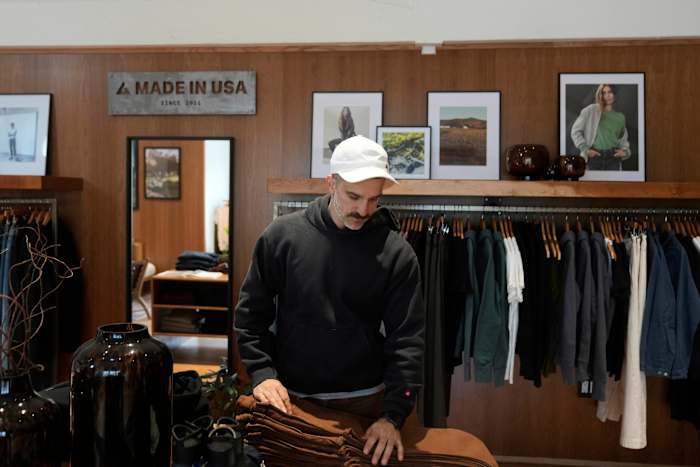
American Giant CEO Bayard Winthrop takes a more positive view. He founded his clothing company in 2011 after watching the textile industry go offshore, and seeing a lack of quality, affordable American-made clothing. He started by selling one sweatshirt, and now sells a wider range of clothing, mostly direct-to-consumer, but he also has a contract with Walmart.
He sources cotton from Southeastern states like Georgia, Florida and North Carolina and has a factory in North Carolia and a joint partnership facility in Los Angeles.
“People forget that in about 1985 that all the clothing that Americans bought was made in America,” he said. “It is only in the last 40 years that that we really pursued as a country a very aggressive approach to globalization.”
In 1991, more than half of U.S. apparel, about 56%, was made in the U.S., according to statistics from the American Apparel and Footwear Association. By 2023 that number had shrunk to less than 4%.
Winthrop hopes the tariffs will bring about a return to more American-made products.
“The imbalances between our trading, in particularly with China, particularly the textiles, it’s just shocking, to be honest with you,” he said, adding that he hopes Trump’s policies “put domestic manufacturers on a bit more of a competitive footing.”
Winthrop understands people’s concerns but said it’s important to think longer term.
“Americans are worried about tariffs, and I think there’s a lot of justification for the worry because I think the administration can be volatile and unpredictable,” he said. But he added that people should put that aside.
“The idea that we’re going to be more protective of our domestic marketplace and have an industrial policy that includes manufacturing jobs is, an old idea. It’s not a new idea,” he said.
Copyright 2025 The Associated Press. All rights reserved. This material may not be published, broadcast, rewritten or redistributed without permission.