
Share this @internewscast.com
KYIV – Ukraine’s military intelligence is gearing up for more sophisticated sea-drone strikes on Russian forces next year, following the success of its uncrewed fleet in disrupting the once-dominant Russian Black Sea navy.
Speaking with The Associated Press, the leader of Ukraine’s Group 13, a specialized maritime drone unit, shared that their operations have compelled Russia to change tactics, thereby reducing the frequency of significant Black Sea assaults seen earlier in the conflict.
Referred to only by the call sign “13th” due to military protocol, the commander stated, “We’ve likely hit a plateau at present.”
He continued, “While we have effectively restricted enemy movements, we haven’t witnessed the dramatic strikes of the past for some time, as the adversary has learned to adapt.”
Ukrainian officials recently reported using sea-attack drones against vessels in Russia’s so-called “shadow fleet” of oil tankers aimed at evading sanctions. The commander, however, refrained from discussing these operations.
The officer noted that Russian naval ships now operate with caution, rarely venturing beyond 25 miles (40 kilometers) from port before launching missiles and returning. He remarked, “They are in constant hiding. This scenario is partly due to our unit’s efforts, as maintaining an inactive fleet at sea is costly.”
The officer spoke in uniform, his face covered and eyes obscured by tinted glasses. For security reasons, the intelligence agency asked that the location and other details of the interview not be disclosed.
Drone technology has become vital to Ukraine’s military, offering inexpensive tools for reconnaissance and strikes in countering Russia’s invasion. Its two sea-drone programs are run separately by its military and domestic intelligence services.
Group 13 operates the Magura family of sea drones, which Ukraine credits with multiple strikes on Russian ships.
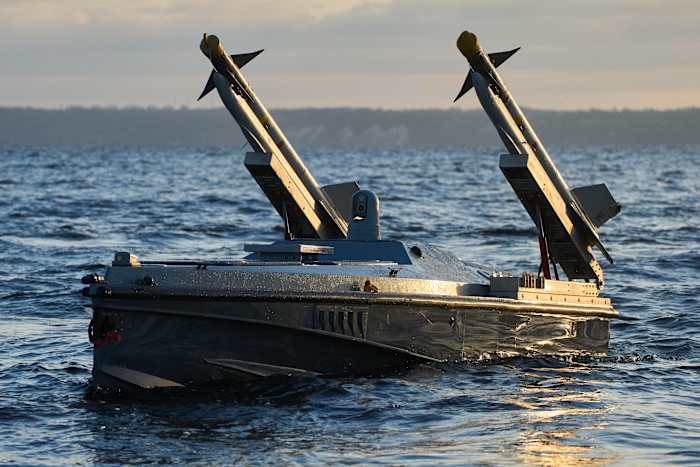
The unit currently deploys two variants — the V5, a smaller ramming drone, and the larger V7, a weapons platform. Both are controlled remotely using suitcase-sized consoles equipped with joysticks, screens and safety switches.
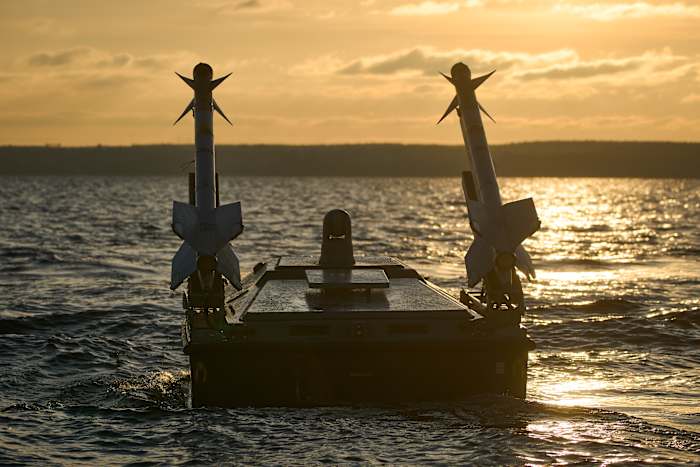
At a recent demonstration, operators showed a V7 fitted with modified U.S.-made Sidewinder air-to-air missiles. In May, the intelligence agency said a Magura drone shot down a Russian fighter jet — a development the commander called a “breakthrough” in maritime warfare.
He said the next stage of Ukraine’s drone evolution will rely on deeper integration of artificial intelligence, using a growing archive of operational video and sensor data to improve targeting and reduce operator workload.
“Right now, target search is a combined process — part operator, part AI,” he said. “In the future, you’ll launch the drone and it will independently search for a target, distinguish civilian vessels from military ones, and make more of the decisions.”
Ukraine’s military, he added, had a “huge amount” of operational data available to further train AI models.
Although he did not comment on specific development plans within the intelligence agency, 13th said countries exploring longer-range strike options, submersible drones and more complex mixed-fleet operations see such systems as a logical next step.
Ukraine is also seeking to expand co-production of drones with several NATO countries next year.
During a visit by President Volodymyr Zelenskyy to Athens last month, Kyiv and Greece announced plans for joint work on maritime uncrewed aerial vehicles (UAVs), expanded training and exercises, and information-sharing on maritime threats.
Despite Russia’s adjustments, the commander said Ukraine’s sea-drone program remains effective.
“We’re working on many fronts to change this situation and create a turning point,” he said. “For now, I can say this: We haven’t lost effectiveness. We’ve simply reached a point where we’re holding the enemy in check.”
___
Oleksii Yeroshenko contributed to this report.
Copyright 2025 The Associated Press. All rights reserved. This material may not be published, broadcast, rewritten or redistributed without permission.