

ISLAMABAD – Cloudbursts are wreaking havoc in the mountainous regions of India and Pakistan, where sudden torrential rains are hitting small areas intensively. These abrupt downpours have had deadly effects in both nations.
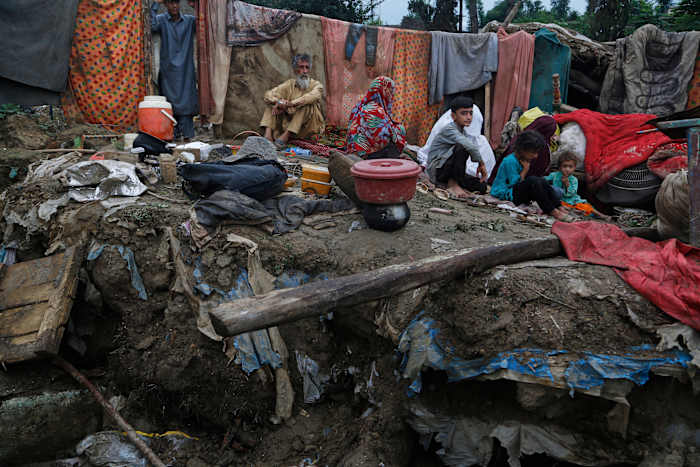
In the Buner district of northwestern Pakistan, a cloudburst resulted in the death of around 300 people. The massive rainfall induced flash floods, landslides, and mudslides. Massive rocks from the slopes were carried down by the water, demolishing homes and obliterating villages.
Earlier this month, a cloudburst struck Uttarakhand, a northern Indian state. Television broadcasts displayed water from flooded areas rushing down the mountainside and overwhelming the Himalayan village of Dharali. A similar incident in 2013 led to the deaths of over 6,000 people and affected 4,500 villages in the state.
Here’s what to know about cloudbursts:
They are complex and extreme weather events
Cloudbursts are defined by an enormous amount of rainfall occurring in a brief period, typically exceeding 100 millimeters (about 4 inches) in an hour over a limited area of approximately 30 square kilometers (11.6 square miles).
These phenomena are forceful and abrupt, bringing about severe damage equivalent to several hours or more of standard rainfall. They manifest as a sudden cloud rupture, releasing its content explosively, akin to a rain bomb.
Multiple elements contribute to the formation of a cloudburst, such as rising warm, moist air, high humidity levels, low-pressure zones, atmospheric instability, and the development of convective clouds.
Moist air is forced to rise after encountering a hill or mountain. This rising air cools and condenses. Clouds that are large, dense and capable of heavy rainfall form.
Hills or mountains act like barriers and often trap these clouds, so they cannot disperse or move easily. Strong upward currents keep moisture suspended inside the clouds, delaying rainfall.
When the clouds cannot hold the accumulated moisture anymore, they burst and release it all at once.
India and Pakistan have ideal conditions
Cloudbursts thrive in moisture, monsoons and mountains. Regions of India and Pakistan have all three, making them vulnerable to these extreme weather events.
The Himalayas, Karakoram and Hindu Kush mountain ranges are home to the world’s highest and most famous peaks, spanning multiple countries including India and Pakistan.
The frequency of cloudbursts in these two South Asian nations has been steadily rising due to a warming atmosphere, because a warmer air mass can hold more moisture, creating conditions for sudden and intense downpours.
The South Asian region has traditionally had two monsoon seasons. One typically lasts from June to September, with rains moving southwest to northeast. The other, from roughly October to December, moves in the opposite direction.
But with more planet-warming gases in the air, the rain now only loosely follows this pattern.
This is because the warmer air can hold more moisture from the Arabian Sea and Indian Ocean, and that rain then tends to get dumped all at once. It means the monsoon is punctuated with intense flooding and dry spells, rather than sustained rain throughout.
The combination of moisture, mountains and monsoons force these moisture-laden winds upward, triggering sudden condensation and cloudbursts.
They are hard to predict, but precaution is possible
It’s difficult to predict cloudbursts because of their size, duration, suddenness and complex atmospheric mechanisms.
Asfandyar Khan Khattak, a Pakistani official from the northwest province of Khyber Pakhtunkhwa, said there was “no forecasting system anywhere in the world” that could predict the exact time and location of a cloudburst.
The Pakistani government said that while an early warning system was in place in Buner district, where hundreds of people died after a cloudburst, the downpour was so sudden and intense that it struck before residents could be alerted.
Community organization SOST, which is also the name of a border village in Pakistan’s northern Gilgit-Baltistan region, says precautions are possible.
It advises people to avoid building homes right next to rivers and valleys, to postpone any travel to hilly areas if heavy rain is forecast, to keep an emergency kit ready, and to avoid traveling on mountainous roads during heavy rain or at night.
It recommends afforestation to reduce surface runoff and enhance water absorption, and regular clearing and widening of riverbanks and drainage channels.
Climate change is fueling their frequency
Experts say cloudbursts have increased in recent years, partly due to climate change, while damage from associated storms has also increased due to unplanned development in mountain areas.
Climate change has directly amplified the triggers of cloudbursts in Pakistan, especially. Every 1°C rise allows the air to hold about 7% more moisture, increasing the potential for heavy rainfall in short bursts.
The warming of the Indian Ocean and Arabian Sea pushes more moisture into the atmosphere. Melting glaciers and snow alter local weather patterns, making rainfall events more erratic and extreme. Environmental degradation, in the form of deforestation and wetland loss, reduces the land’s ability to absorb water, magnifying flash floods.
Climate change has been a central driver in the destruction seen in Pakistan’s northern areas.
“Rising global temperatures have supercharged the hydrologic cycle, leading to more intense and erratic rainfall,” said Khalid Khan, a former special secretary for climate change in Pakistan and chairman of climate initiative PlanetPulse.
“In our northern regions, warming accelerates glacier melt, adds excessive moisture to the atmosphere, and destabilizes mountain slopes. In short, climate change is making rare events more frequent, and frequent events more destructive.”
___
Associated Press writers Munir Ahmed and Riaz Khan contributed to this report from Islamabad and Peshawar, Pakistan, respectively.
Copyright 2025 The Associated Press. All rights reserved. This material may not be published, broadcast, rewritten or redistributed without permission.