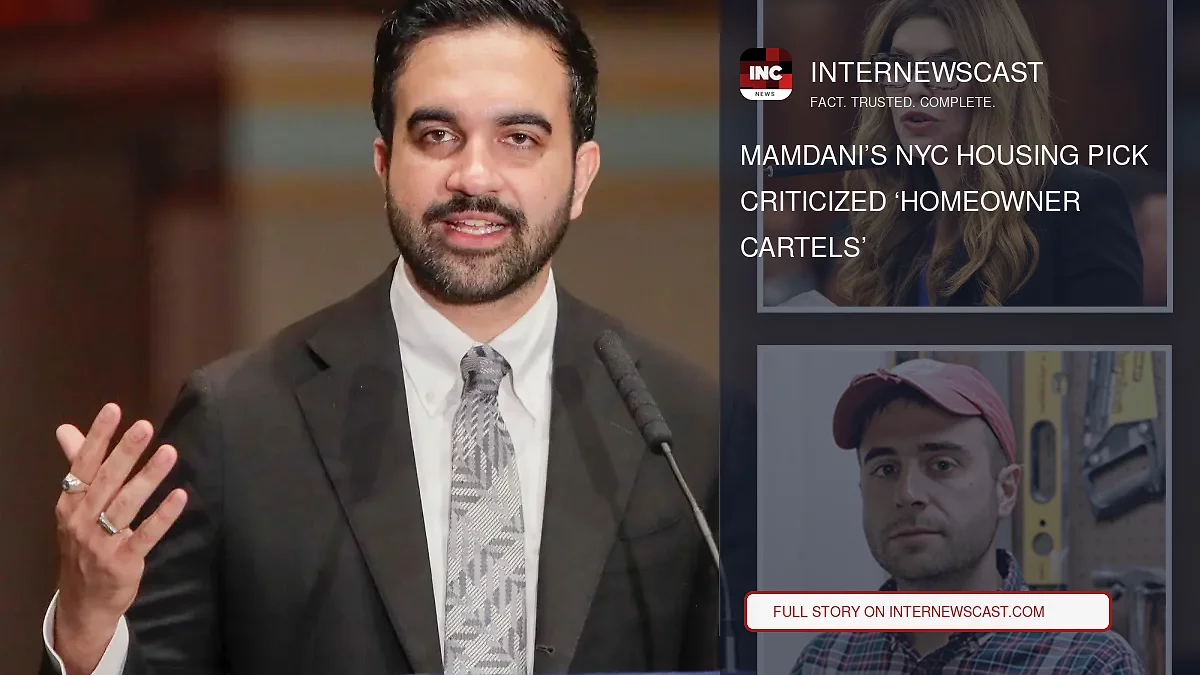

A housing nominee selected by Mayor Zohran Mamdani is facing scrutiny from some New York City Council members after past writings resurfaced in which he compared affluent homeowners to “cartels.”
John Mangin, who currently serves as housing director at the Department of City Planning, was chosen by Mamdani in June to lead the Board of Standards and Appeals. The independent city body plays a powerful role in New York City real estate, with authority to approve exemptions from the city’s rigid zoning regulations for certain development projects.
Council Speaker Julie Menin acknowledged Thursday that Mangin’s record has raised alarms inside the chamber, saying during an unrelated news conference, “Many council members are concerned about some of his prior statements.”
Menin, however, also sought to frame the debate in broader terms, adding, “I want to be clear: we are a pro-housing council.”
The controversy stems in part from a 2014 article Mangin wrote for the Stanford Law and Policy Review, where he criticized what he described as “wealthy homeowner cartels.” In the piece, he argued that well-off residents in expensive, high-demand neighborhoods often resist new housing construction out of fear that development could affect property values or increase taxes.
Mangin, a Yale Law School graduate, also took aim at portions of the housing advocacy movement, writing that advocates often support a “kludgy” mix of policies that can slow or block construction and, in turn, drive housing costs even higher.
His critique extended to common land-use tools such as “community benefit agreements,” which are negotiated between developers and local neighborhoods. He also criticized “downzoning,” a zoning approach that limits development capacity for reasons that can include preserving neighborhood character, protecting historic streetscapes or curbing urban sprawl.
Mangin’s appointment must win support from at least 26 of the City Council’s 51 members to move forward. But several council members have already expressed resistance, arguing that his views clash with their own housing priorities, a divide first reported last week by Politico.
“We represent these communities. We have to go back to these communities and we realize what our communities need,” said Bronx Councilman Kevin Riley, who also serves as Chair of the Land-Use Committee.
“When you have such a high opposition to that, that’s going to be a concern to a lot of members within the council,” he said.
Community benefit agreements are typically legal contracts between developers and local community groups. Companies agree to provide benefits like monetary contributions, local amenities, or even jobs in neighborhoods affected by their large-scale construction.
Mangin, as a policy director, played a crucial role in then-Mayor Eric Adams’ Charter Revision Commission, that got a series of pro-housing ballot measures on the ballot in November 2025.
Voters approved those measures to speed up construction of affordable development citywide — despite vehement opposition from the council, which claimed their and community voices in the process would be undermined as a result.
The Board of Standards and Appeals gained more power this year as a result of the measures, with the five-member agency now being able to bypass certain zoning laws for affordable housing projects.
“On the face of it, a majority of members would be uncomfortable voting for him as it stands now,” one lawmaker told Politico.
Queens Councilwoman Shanel Thomas-Henry — who helped pass a 12,000-unit neighborhood plan in Jamaica last year — echoed the apprehension at Thursday’s press conference.
“I think a lot of the things he has been involved in, I personally see as a direct conflict with how the council sees its powers, and we are a pro-housing council,” she argued.
Mamdani stood by his controversial pick when pressed by reporters on the tension.
“I believe we’ve made the best possible pick for this position. We’re speaking about someone who has all of the requisite experience to combat the affordability crisis and build the kind of housing the city has not seen for a long time,” he said last week.
Hizzoner isn’t alone in his support of Mangin, pro-housing groups like Open New York have celebrated the nomination, along with City Comptroller Mark Levine.
“We are in the midst of a housing affordability crisis, we desperately need a leader like John Mangin,” Levine said.
Menin said Mangin has not reached out to her or members for a meeting, and neither a hearing for his appointment or a final vote has been scheduled.