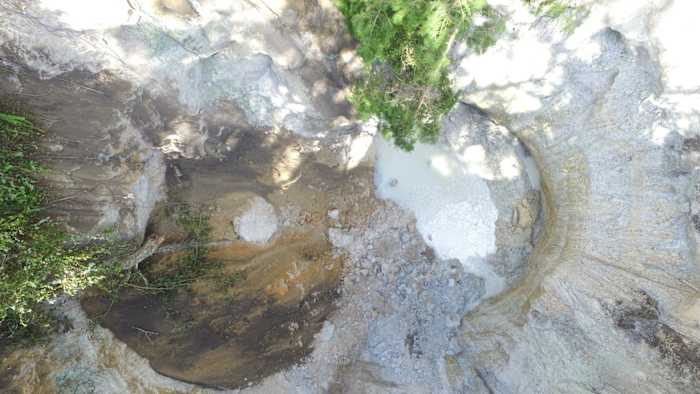


ORLANDO, Fla. — Central Florida is known for many things, but if there’s one issue that keeps homeowners on edge, it’s the threat of sinkholes.
But what makes sinkholes so prevalent in this part of Florida?
Imagine a multi-layered cake.
Not an actual cake, of course.
The foundation of this “cake” is limestone, composed of countless tiny, fragmented shells from millions of years ago. The challenge with limestone is its softness and porosity. As rainwater and groundwater flow through it, they gradually erode the material, forming larger tunnels and eventually leading to significant problems.
This might not be a significant concern if it weren’t for the fact that a layer of sand lies directly atop this limestone, a material not known for its stability.
Now, since sand doesn’t hold up very well on its own, the moment that limestone gets a hole big enough, the sand eventually collapses. And that is where we have problems.
This is especially true for much of western Central Florida. Pasco, Hillsborough, and Hernando counties even make up an area known as “Sinkhole Alley.”
While most sinkholes tend to be small, like around roadways, we still have some bigger, notorious sinkholes that can eat up cars and homes. Did you know our most notorious sinkhole? Lake Eola, in the City Beautiful.
The sinkhole began forming in 1873, filling with groundwater from the aquifer, 200 feet below the surface, to form a lake. The owner of the property, Jacob Summerlin, the “Cattle King of Florida,” donated the land around the lake to the city in 1883.
More recently, in 1981, “Lake Rose” formed in Winter Park. The sinkhole swallowed the home of Mae Rose Owens, part of a Porsche dealership, parts of several businesses, and a community swimming pool.
[WATCH: Flashback: 1981 Winter Park sinkhole]
Because sinkholes can form anywhere in Florida, not just in “Sinkhole Alley,” it’s important to know your risk and to know what’s covered in the event your home is damaged. Not all insurance policies cover damages to your home due to a sinkhole, but Florida Law does require insurance companies to cover “catastrophic ground cover collapse.”


