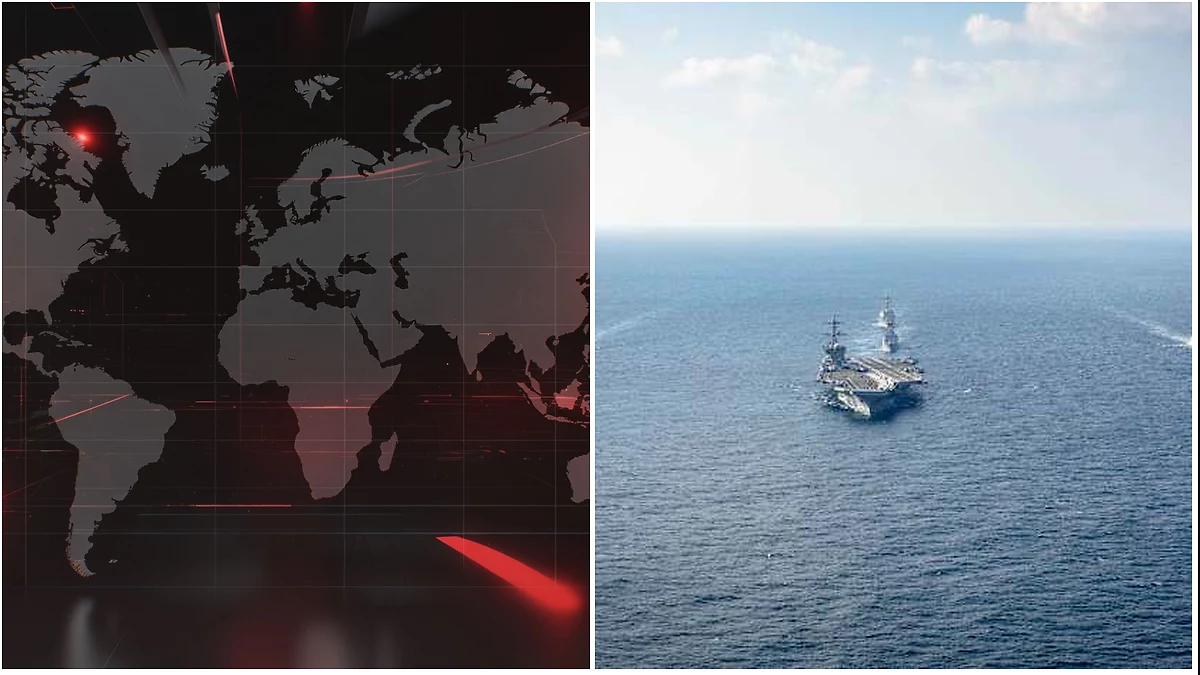


SEOUL – South Korea, the United States and Japan plan to proceed with a trilateral military exercise next month aimed at strengthening their response to North Korea’s nuclear threats, officials in Seoul said Friday. The announcement came a day after Pyongyang threatened retaliation over what it described as hostile U.S. actions.
The move is likely to further narrow the chances of an early return to North Korea-U.S. diplomacy, even after President Donald Trump recently scaled back a major joint military drill with South Korea in what appeared to be a gesture of goodwill toward Pyongyang.
South Korea’s military said in a statement that the Freedom Edge exercise will begin Sept. 7 and run for five days in waters near the country’s southern Jeju Island.
According to the statement, the drill is defensive in nature and is intended to counter North Korean nuclear and missile threats while supporting regional peace and stability.
North Korea has sharply criticized the three-way exercise in the past, calling it a “reckless show of strength” and evidence of what it says is a confrontational posture by its adversaries. Pyongyang has also claimed the drill reflects a U.S. effort to encircle China and increase pressure on Russia.
Freedom Edge, involving the U.S., South Korea and Japan, was first launched in 2024. The exercise is meant to build on earlier drills by combining air and naval operations designed to improve joint ballistic missile defense, anti-submarine warfare, surveillance and other military capabilities.
Last week, U.S. and South Korean forces ended their annual Ulchi Freedom Shield exercise six days ahead of schedule after Trump said he had directed the Pentagon to “substantially reduce” the drill, which North Korea portrays as a rehearsal for invasion. Trump pointed to what he described as a good relationship with North Korean leader Kim Jong Un.
North Korea, however, rejected Trump’s overture, saying a shorter exercise would not alter its “provocative, aggressive nature.” Pyongyang later fired about 10 short-range ballistic missiles toward the sea, in what appeared to be a follow-through on its earlier warning that it would respond to the U.S.-South Korea drill.
Pyongyang has previously said it won’t resume diplomacy with the U.S. unless it drops its demand for a North Korean denuclearization as a precondition for talks.
Since his earlier diplomacy with Trump collapsed in 2019, Kim has boosted his military and diplomatic credentials by enlarging his nuclear arsenal and aligning with Russia over its war against Ukraine. With greater leverage now, experts say Kim would likely aim to win big U.S. concessions like an international recognition of North Korea as a nuclear state and sweeping sanctions relief in return for a partial surrender of his nuclear arsenal.
On Thursday, North Korea’s Foreign Ministry accused the U.S. of engaging in “a series of hostile moves” targeting the North, including a possible sale of air-to-air missiles and related equipment to South Korea. It said North Korea “will make a serious, immediate and powerful response to the hostile acts in different spheres.”


