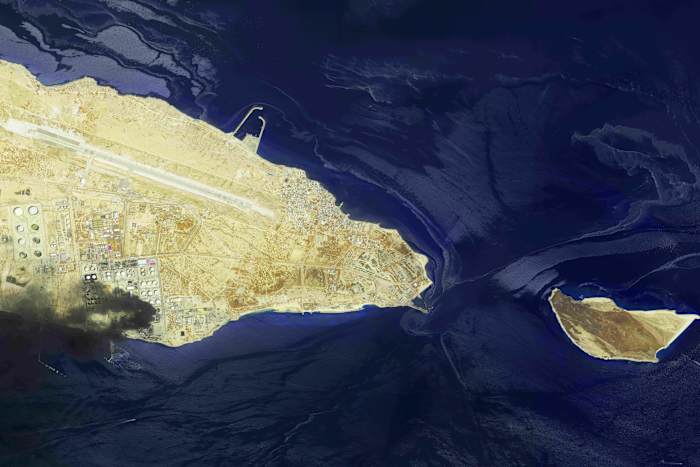


DUBAI – A puzzling assault on an Iranian oil refinery during the ongoing conflict has resulted in a significant oil spill, impacting a nearby Persian Gulf island renowned as a protected haven for wildlife, as revealed by recent video footage and satellite imagery.
The oil-saturated waves now washing ashore on Shidvar Island—a previously untouched sanctuary—underscore the environmental devastation brought about by the war. In addition to this, Tehran, the capital of Iran, has experienced oily precipitation following airstrikes on its oil facilities. Moreover, Iranian offensives targeting vessels traversing the Persian Gulf, the Strait of Hormuz, and the Gulf of Oman have exacerbated the ecological damage.
Footage captured on April 9 by Iranian resident Ehsan Jalali shows dense black smoke billowing from an oil refinery on Lavan Island, situated near Shidvar and just off Iran’s mainland. The video aligns with the geographical features of both islands and was recently shared by Jalali on Instagram, amid Iran’s ongoing internet restrictions imposed by its theocratic regime.
Additional footage by Jalali depicts oil-soaked wildlife, including a bird and a crab, as well as a man holding a deceased swordfish.
“These poor birds are trapped in oil. Look at this pod of dolphins, struggling to breathe while ingesting oil,” narrates Jalali. “Witness the devastation inflicted on this island. Fish carcasses are surfacing one by one.”
Satellite images taken on April 10 from the high-resolution Airbus DS Pléiades Neo and reviewed by The Associated Press on Tuesday confirm that the refinery fire continued to burn two days post-attack. The surrounding waters of the Persian Gulf are marred by an oil slick, encircling Shidvar Island, also referred to locally as Maroo Island.
“Oh my God, the sea is full of oil, oh my God, Maroo Island,” Jalali recounts in the footage. “The sea is full of oil, the beautiful Maroo Island is ruined now.”
Shidvar Island, only some 870 hectares (3.3 square miles) large, is designated as a wetland of international importance under the Ramsar Convention on Wetlands. It had been known as one of the most important breeding grounds for terns, a seabird, in Iran. Iran has considered the island as a wildlife refuge since 1972.
Iranian officials have not acknowledged any environmental damage caused by the attack at the Lavan oil refinery, which came hours after the United States and Israel agreed to a ceasefire in the war with Iran. The U.S. also had asked Israel to halt its attacks on oil infrastructure after earlier striking facilities associated with Iran’s offshore South Pars natural gas field. That attack sparked major Iranian assaults targeting oil and gas facilities across the Gulf Arab states, with Qatar being particularly hard hit.
Iranian media outlets have alleged the United Arab Emirates carried out the attack, something not acknowledged by Emirati officials. However, the UAE faced more missile and drone fire than any other country in the war and has sharpened its rhetoric against Iran as Tehran maintains its chokehold on the Strait of Hormuz.
The Emirates’ Barakah nuclear power plant also came under attack Sunday in a drone assault resembling others launched by Iran and Iranian-backed militias in Iraq during the war.
___
Associated Press writers Nasser Karimi and Mehdi Fattahi in Tehran, Iran, contributed to this report.