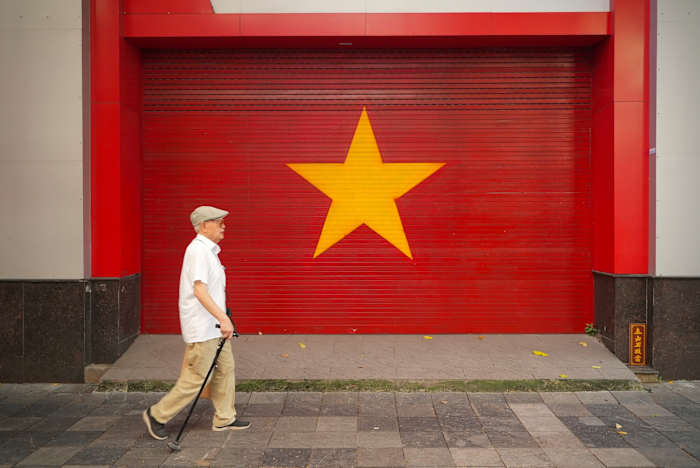

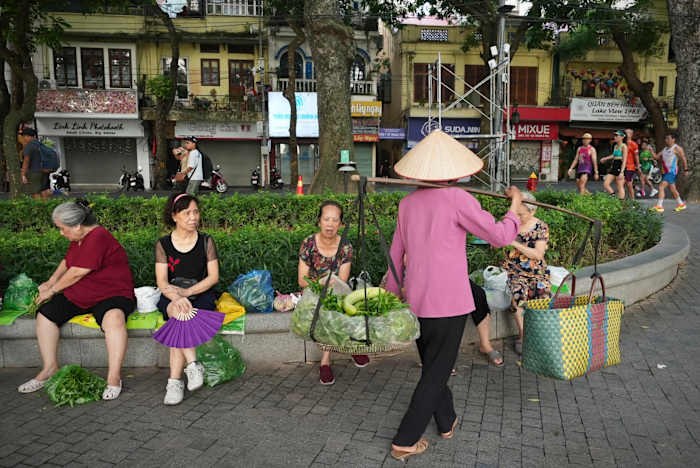
HANOI – In the heart of Hanoi’s central party school, beneath the red banners and the iconic gold bust of the revolutionary leader Ho Chi Minh, Communist Party chief To Lam announced the dawn of “a new era of development” last year. This statement was not just ceremonial but marked the kickoff of potentially the most significant economic transformation Vietnam has seen in decades.
By 2045, Vietnam aspires to achieve prosperity and join the ranks of Asia’s “tiger economies,” akin to the earlier economic booms seen in South Korea and Taiwan.
The road ahead poses challenges: balancing economic growth with essential reforms, managing an aging population, addressing climate risks, and updating outdated institutions. Complicating matters further is the pressure from President Donald Trump concerning Vietnam’s trade surplus with the United States, a testament to the country’s remarkable economic rise.
Back in 1990, the typical Vietnamese could purchase approximately $1,200 in goods and services annually, adjusted for local prices. Today, that purchasing power has skyrocketed to $16,385.
Similar to China’s development, Vietnam has evolved into a global manufacturing powerhouse, boasting modern highways, burgeoning skyscrapers, and a thriving middle class, lifting millions out of poverty. However, its once vibrant low-cost, export-driven economy is slowing, as the nation pushes for reforms like bolstering private industries, enhancing social safety nets, and investing in technology and green energy, all while grappling with the formidable challenge of climate change.
“It’s all hands on deck…We can’t waste time anymore,” said Mimi Vu of the consultancy Raise Partners.
The export boom can’t carry Vietnam forever
Investment levels have surged, driven in part by the trade tensions between the United States and China, with the U.S. now standing as Vietnam’s largest export market. Formerly quiet suburban areas have transformed into industrial parks where trucks navigate vast logistics hubs catering to worldwide brands.
Vietnam ran a $123.5 billion trade surplus with the U.S. trade in 2024, angering Trump, who threatened a 46% U.S. import tax on Vietnamese goods. The two sides appear to have settled on a 20% levy, and twice that for goods suspected of being transshipped, or routed through Vietnam to avoid U.S. trade restrictions.
During negotiations with the Trump administration, Vietnam’s focus was on its tariffs compared to those of its neighbors and competitors, said Daniel Kritenbrink, a former U.S. ambassador to Vietnam. “As long as they’re in the same zone, in the same ballpark, I think Vietnam can live with that outcome,” he said. But he added questions remain over how much Chinese content in those exports might be too much and how such goods will be taxed.
Vietnam was preparing to shift its economic policies even before Trump’s tariffs threatened its model of churning out low-cost exports for the world, aware of what economists call the “middle-income trap,” when economies tend to plateau without major reforms.
To move beyond that, South Korea bet on electronics, Taiwan on semiconductors, and Singapore on finance, said Richard McClellan, founder of the consultancy RMAC Advisory.
But Vietnam’s economy today is more diverse and complex than those countries were at the time and it can’t rely on just one winning sector to drive long-term growth and stay competitive as wages rise and cheap labor is no longer its main advantage.
It needs to make “multiple big bets,” McClellan said.
Vietnam’s game plan is hedging its bets
Following China’s lead, Vietnam is counting on high-tech sectors like computer chips, artificial intelligence and renewable energy, providing strategic tax breaks and research support in cities like Hanoi, Ho Chi Minh City, and Danang.
It’s also investing heavily in infrastructure, including civilian nuclear plants and a $67 billion North–South high-speed railway, that will cut travel time from Hanoi to Ho Chi Minh City to eight hours.
Vietnam also aspires to become a global financial center. The government plans two special financial centers, in bustling Ho Chi Minh City and in the seaside resort city of Danang, with simplified rules to attract foreign investors, tax breaks, support for financial tech startups, and easier ways to settle business disputes.
Underpinning all of this is institutional reform. Ministries are being merged, low-level bureaucracies have been eliminated and Vietnam’s 63 provinces will be consolidated into 34 to build regional centers with deeper talent pools.
Private business to take the lead
Vietnam is counting on private businesses to lead its new economic push — a seismic shift from the past.
In May, the Communist Party passed Resolution 68. It calls private businesses the “most important force” in the economy, pledging to break away from domination by state-owned and foreign companies.
So far, large multinationals have powered Vietnam’s exports, using imported materials and parts and low cost local labor. Local companies are stuck at the low-end of supply chains, struggling to access loans and markets that favored the 700-odd state-owned giants, from colonial-era beer factories with arched windows to unfashionable state-run shops that few customers bother to enter.
“The private sector remains heavily constrained,” said Nguyen Khac Giang of Singapore’s ISEAS–Yusof Ishak Institute.
Again emulating China, Vietnam wants “national champions” to drive innovation and compete globally, not by picking winners, but by letting markets decide. The policy includes easier loans for companies investing in new technology, priority in government contracts for those meeting innovation goals, and help for firms looking to expand overseas. Even mega-projects like the North-South High-Speed Rail, once reserved for state-run giants, are now open to private bidding.
By 2030, Vietnam hopes to elevate at least 20 private firms to a global scale. But Giang warned that there will be pushback from conservatives in the Communist Party and from those who benefit from state-owned firms.
A Closing Window from climate change
Even as political resistance threatens to stall reforms, climate threats require urgent action.
After losing a major investor over flood risks, Bruno Jaspaert knew something had to change. His firm, DEEP C Industrial Zones, houses more than 150 factories across northern Vietnam. So it hired a consultancy to redesign flood resilience plans.
Climate risk is becoming its own kind of market regulation, forcing businesses to plan better, build smarter, and adapt faster. “If the whole world will decide it’s a priority…it can go very fast,” said Jaspaert.
When Typhoon Yagi hit last year, causing $1.6 billion in damage, knocking 0.15% off Vietnam’s GDP and battering factories that produce nearly half the country’s economic output, roads in DEEP C industrial parks stayed dry.
Climate risks are no longer theoretical: If Vietnam doesn’t take strong action to adapt to and reduce climate change, the country could lose 12–14.5% of its GDP each year by 2050, and up to one million people could fall into extreme poverty by 2030, according to the World Bank.
Meanwhile, Vietnam is growing old before it gets rich.
The country’s “golden population” window — when working-age people outnumber dependents — will close by 2039 and the labor force is projected to peak just three years later. That could shrink productivity and strain social services, especially since families — and women in particular — are the default caregivers, said Teerawichitchainan Bussarawan of the Centre for Family and Population Research at the National University of Singapore.
Vietnam is racing to pre-empt the fallout by expanding access to preventive healthcare so older adults remain healthier and more independent. Gradually raising the retirement age and drawing more women into the formal workforce would help offset labor gaps and promote “healthy aging,” Bussarawan said.
___
The Associated Press’ climate and environmental coverage receives financial support from multiple private foundations. AP is solely responsible for all content. Find AP’s standards for working with philanthropies, a list of supporters and funded coverage areas at AP.org.
Copyright 2025 The Associated Press. All rights reserved. This material may not be published, broadcast, rewritten or redistributed without permission.