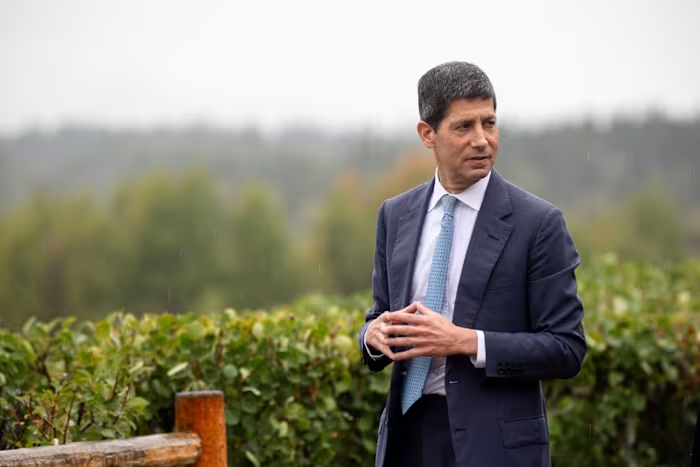


WASHINGTON – Federal Reserve Chair Kevin Warsh sharpened his inflation-fighting message Friday, using a closely watched speech to signal that interest rate increases could be back on the table in the months ahead.
The remarks add pressure on the central bank to consider lifting interest rates at its mid-September meeting if inflation fails to show meaningful progress. A government price report due just days before policymakers gather could carry unusual weight in shaping that decision.
Warsh’s headline speech at the Fed’s annual Jackson Hole economic conference drew broad praise from economists and several Fed officials in attendance. But the opening day also brought some skepticism and criticism, underscoring the debate still surrounding the central bank’s next move. The conference concludes Saturday.
Here are five takeaways from the conference so far:
Hawkish tone increases focus on a possible September rate hike
Warsh made clear that higher borrowing costs remain a possibility, but he stopped short of tying the Fed to a specific timetable. That caution was not unexpected: He has long been wary of the kind of forward guidance used by some predecessors, arguing that it can lock policymakers into a path before the data justify it.
Even so, some analysts heard a clear signal that a September increase remains firmly in play. Warsh said he and other officials who favored leaving rates unchanged at the July 28-29 meeting “thought the wiser course was to await new information in the intermeeting period … before deciding whether a change in interest rate policy was advisable.”
That framing suggests Warsh was looking for convincing signs after July that inflation was cooling enough to justify staying put. But in other parts of his speech, he argued that such confirmation has not arrived: Gas prices have eased somewhat, yet underlying inflation, he said, has not “meaningfully improved.”
By sending such signals, Warsh has raised expectations for a hike next month, which could erode his credibility if inflation stays high and he doesn’t follow through.
“You are basically setting yourself up so that if you don’t hike in September, people may ask what’s going on,” said Adam Posen, president of the Peterson Institute for International Economics.
A Fed rate hike may — or may not — lift your mortgage rate
When the Fed raises its benchmark interest rate, it often over time can also boost interest rates for mortgages, auto loans, credit cards and business borrowing.
Yet in this case it isn’t as clear. Longer-term interest rates — including those on the 10-year Treasury note, which strongly influence mortgage rates — barely rose after Warsh’s comments. Analysts said that suggested that investors were reassured that the Fed would bring down inflation over time. Otherwise, they would have pushed longer rates higher.
In short, longer-term rates don’t always follow the Fed’s lead, so even if there is a rate hike in September, it may not push up consumer borrowing costs. As it is, the average rate for a fixed 30-year mortgage is 6.66%, according to Freddie Mac, slightly higher than a year ago.
All-in on AI
Much of Warsh’s speech actually focused on the potential for artificial intelligence to strongly boost the economy. He has spoken previously about the possibility that AI could increase the economy’s efficiency, which would enable it to expand without creating inflationary pressures. That would, in turn, reduce pressure on the Fed to lift rates.
“We’ve come to a hinge point in history,” Warsh said. “The potential for substantially higher growth is on the rise.”
But in a luncheon speech Friday, Kenneth Rogoff, a Harvard economist and former chief economist at the International Monetary Fund, expressed a much more cautious take on AI’s potential. He wasn’t responding to Warsh’s comments specifically.
“I think the idea that AI magically solves everything is a bit overblown,” he said, adding that if it does sharply boost growth, that would likely lead to higher interest rates, which typically rise in a healthy economy.
Fed independence worries remain but have cooled since last year
A year ago, then-Fed Chair Jerome Powell received a standing ovation from the roughly 120 or so attendees before he even delivered his speech. It was a clear sign of support as President Donald Trump ramped up its attacks on Powell and the Fed for not cutting rates as much as he wanted.
Trump tried to fire Fed governor Lisa Cook last year on the first day of the conference, in an effort to gain a majority on the Fed’s board. Cook sued to keep her job and the Supreme Court ruled in June she could do so while the case played out in court.
Cook attended this year’s conference, just days after her lawyers argued the administration has no legal basis for removing her.
Some attendees last year were worried that Trump would seek to remove presidents of the Fed’s regional banks, after critical comments by Treasury Secretary Scott Bessent. Yet those worries have faded as the administration hasn’t made any moves in that direction.
Rogoff, in his remarks, expressed concern about Fed independence but didn’t get into details.
Warsh suggests inflation is broad and stubborn
Since taking office in late May, Warsh has largely avoided commenting on where inflation might be headed or what is keeping it elevated. On Friday, he provided his most extensive comments yet about an inflation surge that has soured most Americans on the economy and kept price increases above the Fed’s 2% target.
He noted that inflation has been broad and not just a result of higher gas prices stemming from the Iran war. More than half the goods and services the government tracks have seen their prices rise 3% or more from a year ago, he said. That’s “well above” the roughly one-third that saw such increases in the two decades before the pandemic.
Warsh also argued that inflation wouldn’t necessarily fall back to 2% on its own, a comment that suggests he doesn’t consider inflation to be a result of just one-time shocks, such as tariffs, that will fade over time.
That is a view shared by the three Fed officials who voted in favor of rate hikes at the central bank’s last meeting in July.