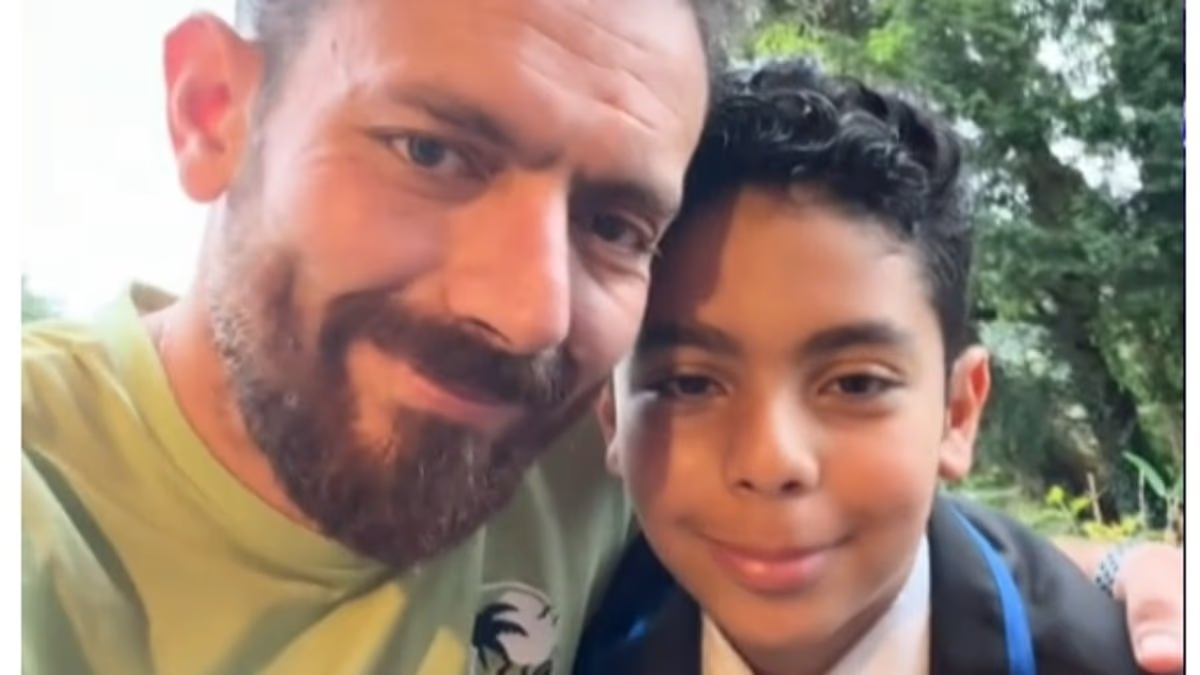

An 11-year-old schoolboy who was fatally struck by a train on his way to class may have been distracted by his new smartphone, an inquest was told.
Jaiden Shehata had “probably” been watching a video on his iPhone, a Christmas present received only a month earlier, when he was hit at the “high risk” Bourneview level crossing near Kenley, south London, shortly after 8am on January 23 last year, an investigator said.
The youngster would normally have walked with his 18-year-old brother, Reece, but on that morning he left for school 20 minutes earlier than usual.
Jaiden was a Year 7 pupil at Riddlesdown Collegiate in south Croydon, having joined the school six months earlier. He regularly used the crossing on his journey.
As he crossed that morning, he stepped into the path of a London-bound train, even though the driver sounded the horn while approaching the crossing.
Jaiden, a talented young footballer and devoted Chelsea supporter, was not wearing headphones when the collision occurred.
South London Coroner’s Court in Croydon heard on Monday that Jaiden suffered an “unsurvivable injury” and was probably already dead when emergency services reached the scene 15 minutes later.
Paul Tickner, the lead investigator for the Rail Accident Investigation Branch, told the hearing that Jaiden was “probably” distracted by his phone at the moment he was struck.
“It doesn’t mean he wasn’t aware of the risk,” Mr Tickner said.

Jaiden Shehata, 11, was “probably” watching a video on his phone when he was struck by a London-bound train at about 8.03am on January 23 last year near Kenley, south London

The youngster was on his way to Riddlesdown Collegiate in south Croydon, where he had been a Year 7 pupil since the previous September, and crossed at Bourneview most days
The inquest jury also heard that Network Rail took seven months to shut the level crossing, which had already been earmarked for safety improvements when the tragedy occurred.
Network Rail had classified the crossing as C4, a designation described during the hearing as indicating a “high” level of risk.
However, Daniel Fisk, the company’s head of level crossing and safety, told jurors that Bourneview met Network Rail’s standards at the time of Jaiden’s death.
Mr Fisk said the company could not close the crossing without first securing permission from Croydon Council because it formed part of a public right of way.
He also acknowledged that the eventual closure was prompted more by a petition from Jaiden’s family than by Network Rail’s own assessment.
“The crossing was compliant with our standards. If it wasn’t, then (risk) mitigation would have been put in place,” he said.
Mr Fisk added that the danger was being managed “as practicable”.
A Network Rail risk assessment conducted in 2023 identified several measures that could potentially have improved safety at the crossing.
Among the proposals were clearer signage and the introduction of miniature stop lights displaying red and green signals.
By December 2024 – a month before Jaiden’s death – designs were being drawn up for the crossing, which has been ranked the 13th most dangerous footpath on Network Rail’s Sussex route out of 111.

A jury at the inquest on Monday also heard that it took seven months for Network Rail to close the ‘high risk’ level crossing after the family launched a petition
That work was completed earlier this year, but the crossing remains closed as Network Rail wants to complete ‘more engagement with local schools’ about rail safety before reopening it.
Mr Fisk said the lack of staff, money, and the complexity behind designing a ‘Miniature Stop Lights’ system had caused a delay in implementing new safety features at the crossing.
A report by RAIB published after Jaiden’s death highlighted how the design and construction of the Bourneview crossing contributed to the youngster’s death.
It raised concerns about the ‘old and unimposing’ fence and gate, and how the muddy and sloping path would mean people ‘would be looking downwards and watching their step, to avoid slipping or tripping, rather than looking up at the [warning] signs’.


