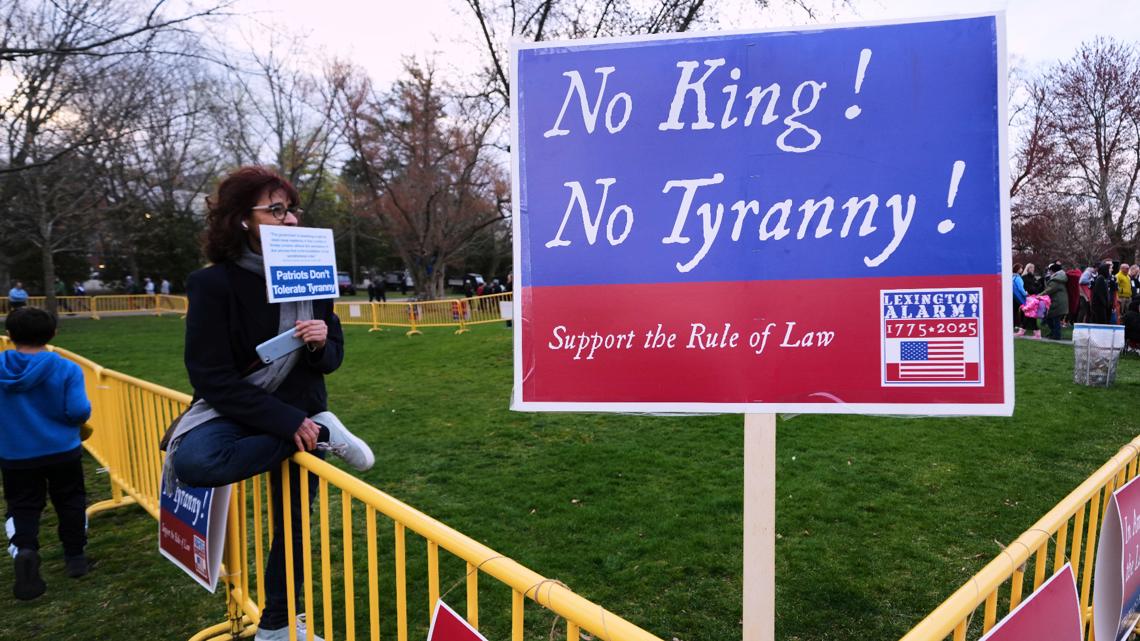

In a deeply divided time, many came to the original battlefield to remember the principles the U.S. was founded on.
LEXINGTON, Massachusetts — Thousands of people came to this Massachusetts town Saturday just before dawn to witness a reenactment of how the American Revolution began 250 years ago, with the blast of gunshot and a trail of colonial spin.
Starting with Saturday’s anniversary of the Battles of Lexington and Concord, the country will look back to its war of independence and ask where its legacy stands today.
The day offers an opportunity to reflect on this seminal moment in history but also consider what this fight means today.
“It’s truly momentous,” said Richard Howell, who portrayed Lexington Minute Man Samuel Tidd in the battle.
“This is one of the most sacred pieces of ground in the country, if not the world because of what it represents,” he said. “To represent what went on that day, how a small town of Lexington was a vortex of so much … Lexington was the first town that was able to anywhere muster men and were the first to face the onslaught of the British.”
The semiquincentennial comes as President Donald Trump, the scholarly community and others divide over whether to have a yearlong party leading up to July 4, 2026, as Trump has called for, or to balance any celebrations with questions about women, the enslaved and Indigenous people and what their stories reveal.
The history of Lexington and Concord in Massachusetts is half-known, the myth deeply rooted.
What exactly happened at Lexington and Concord?
Reenactors may with confidence tell us that hundreds of British troops marched from Boston in the early morning of April 19, 1775, and gathered about 14 miles (22.5 kilometers) northwest on Lexington’s town green.
Firsthand witnesses remembered some British officers yelled, “Thrown down your arms, ye villains, ye rebels!” and that amid the chaos a shot was heard, followed by “scattered fire” from the British. The battle turned so fierce that the area reeked of burning powder. By day’s end, the fighting had continued around 7 miles (11 kilometers) west to Concord and some 250 British and 95 colonists were killed or wounded.
But no one has learned who fired first, or why. And the revolution itself was initially less a revolution than a demand for better terms.
Woody Holton, a professor of early American history at the University of South Carolina, says most scholars agree the rebels of April 1775 weren’t looking to leave the empire, but to repair their relationship with King George III and go back to the days preceding the Stamp Act, the Tea Act and other disputes of the previous decade.
“The colonists only wanted to turn back the clock to 1763,” he said.
Stacy Schiff, a Pulitzer Prize winning historian whose books include biographies of Benjamin Franklin and Samuel Adams, said Lexington and Concord “galvanized opinion precisely as the Massachusetts men hoped it would, though still it would be a long road to a vote for independence, which Adams felt should have been declared on 20 April 1775.”
But at the time, Schiff added, “It did not seem possible that a mother country and her colony had actually come to blows.”
A fight for the ages
The rebels had already believed their cause greater than a disagreement between subjects and rulers. Well before the turning points of 1776, before the Declaration of Independence or Thomas Paine’s boast that “We have it in our power to begin the world over again,” they cast themselves in a drama for the ages.
The so-called Suffolk Resolves of 1774, drafted by civic leaders of Suffolk County, Massachusetts, prayed for a life “unfettered by power, unclogged with shackles,” a fight that would determine the “fate of this new world, and of unborn millions.”
The revolution was an ongoing story of surprise and improvisation. Military historian Rick Atkinson, whose “The Fate of the Day” is the second of a planned trilogy on the war, called Lexington and Concord “a clear win for the home team,” if only because the British hadn’t expected such impassioned resistance from the colony’s militia.
The British, ever underestimating those whom King George regarded as a “deluded and unhappy multitude,” would be knocked back again when the rebels promptly framed and transmitted a narrative blaming the royal forces.
“Once shots were fired in Lexington, Samuel Adams and Joseph Warren did all in their power to collect statements from witnesses and to circulate them quickly; it was essential that the colonies, and the world, understand who had fired first,” Schiff said. “Adams was convinced that the Lexington skirmish would be ‘famed in the history of this country.’ He knocked himself out to make clear who the aggressors had been.”
A country still in progress
Neither side imagined a war lasting eight years, or had confidence in what kind of country would be born out of it. The founders united in their quest for self-government but differed how to actually govern, and whether self-government could even last.
Americans have never stopped debating the balance of powers, the rules of enfranchisement or how widely to apply the exhortation, “All men are created equal.”
“I think it’s important to remember that the language of the founders was aspirational. The idea that it was self-evident all men were created equal was preposterous at a time when hundreds of thousands were enslaved,” said Atkinson, who cites the 20th-century poet Archibald MacLeish’s contention that “democracy is never a thing done.”
“I don’t think the founders had any sense of a country that some day would have 330 million people,” Atkinson said. “Our country is an unfinished project and likely always will be.”


