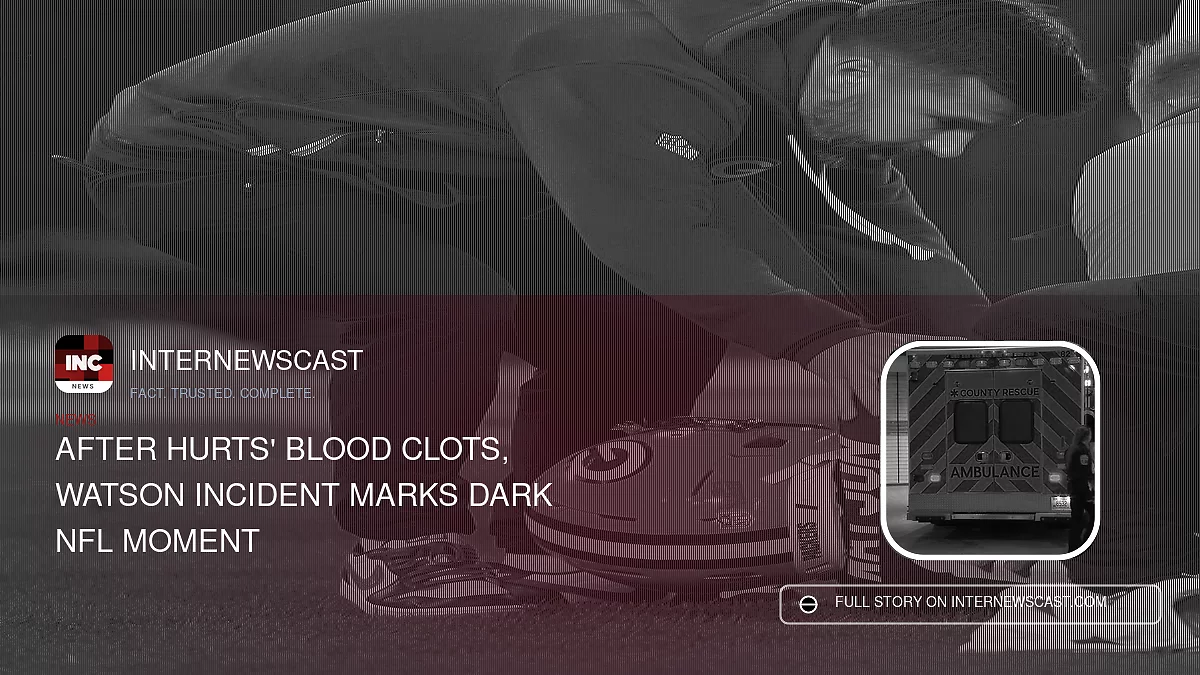

Thursday Night Football produced one of the strangest and most unforgettable scenes in recent NFL history.
A little more than an hour after being seen entering an ambulance at Lambeau Field, Green Bay Packers wide receiver Christian Watson emerged from that same vehicle wearing his pads and returned to the field.
The extraordinary sequence quickly spread across social media, with many comparing it to something from WWE. Yet beyond the spectacle and Watson’s determination, the incident raises a more serious question: should his return have been celebrated at all?
Watson later said he had been ‘spitting up blood’, prompting doctors to send him to hospital as a precaution and check for internal bleeding.
Although his CT scan was clear, he had suffered a broken rib. He may have felt well enough to continue and received medical clearance, but that does not necessarily mean returning to the game was the right decision.
The image of a player being taken to hospital in an ambulance, only to be hurried back to the same game soon afterward, does little to reassure those concerned about player welfare in the NFL.

Christian Watson stepped out of an ambulance and returned to play against the Panthers

Watson was ‘coughing up blood’ before he was taken to hospital for further examination
Watson’s case follows another alarming example from last month, when Philadelphia Eagles quarterback Jalen Hurts played against the Jacksonville Jaguars in London after spending much of the previous night in hospital with a blood clot in his calf.
Hurts went on to play, but additional clots later reached his lungs. He will miss the rest of the season following a frightening medical situation that could have ended far more seriously.
The experiences of Hurts and Watson highlight a difficult reality: most NFL players are prepared to do almost anything to remain on the field.
The bigger question is when teams must intervene and protect players from their own determination.
Buffalo Bills guard Alec Anderson offered a glimpse this week into the physical toll of playing professional football week after week.
‘Once that Toradol wears off, it feels like you’re in a car accident, in all honesty,’ he said on The Schultz Report.
The long-term dangers are also becoming increasingly difficult to ignore. A Boston University study released this week estimated that 74.5 percent of more than 2,000 deceased former NFL players likely had chronic traumatic encephalopathy, or CTE, the neurodegenerative disease associated with repeated high-impact trauma.
ALSO READ: Xavier Becerra Returns Major Donation Following Daily Mail Investigation
Following the findings, the NFL said it ‘continuously strives to make the game of football safer, including by implementing strategies to reduce concussions and head impacts. We encourage former players to utilize these resources to identify and seek treatment when they are concerned about their health.’

Watson ran out onto the field and received a raucous reception at Lambeau Field

Earlier in the game, he was writing in agony after breaking a rib and then coughing up blood
After another CTE study was published in August, the NFL Players’ Association said: ‘This is a sobering reminder that football carries real risks, and those risks can have lasting consequences for players and their families.
‘It also reinforces one of the NFLPA’s core priorities: improving player safety and supporting players throughout their lives, both during and after their careers.’
The league maintains that player safety is a priority and has introduced various measures, including rule changes intended to limit injuries.
However, the NFL also expanded its regular season to 17 games in 2021, the first increase to the schedule since 1978. The league has continued to leave open the possibility of an 18-game season, along with further international games.
The uncomfortable reality is that serious injuries will remain part of a collision sport such as football. The crucial issue is whether teams are willing to fulfill their responsibility by removing players from danger, even when those players insist they want to continue.
This season has already produced an unusually high number of moments in which the handling of player injuries and medical treatment has come under scrutiny.

Jalen Hurts recently played in London despite having a blood clot in his calf
There may have been no specific medical violation in Watson’s return on Thursday night, but that still leaves the central question: was it necessary?
The circumstances make the decision even harder to understand because Green Bay was already leading 27-10. That should not determine medical judgment, of course, but this was hardly a fourth-quarter Super Bowl situation.
Should a player who had been coughing up blood and suffered a broken rib barely an hour earlier really have been rushed from hospital back into the game?
Watson’s comeback was undeniably dramatic, courageous and entertaining. But with player safety under growing scrutiny, the NFL must seriously consider whether moments like this are examples of bravery—or evidence that players are not being protected enough.
SEE ALSO: Bikie revenge plot targets teen accused of hitting Knights fans