
You may feel you have encountered this argument before. Not these precise words, of course — I have not quite reached the stage of recycling myself. But, by my reckoning, this is now the sixth time I have found myself offering a newly arrived prime minister some guidance on how to handle Scotland.
I even produced one for Liz Truss, although her approach to Scotland became a largely theoretical concern with remarkable speed.
That so many prime ministers have needed advice on Britain’s second-largest nation, almost as if it were some distant outpost of empire recalled only in moments of inconvenience, says a great deal about the damage devolution has inflicted on the constitution.
It is now treated as routine for occupants of Downing Street to regard Scotland as an unfamiliar territory, one they can govern only with the indulgence of the Holyrood mafia.
That flawed assumption lay behind David Cameron’s self-defeating “respect agenda”. Over six years, it helped deliver 45 per cent support for Scottish independence, handed the SNP fresh powers to turn Scotland into the highest-taxed part of Britain, and left nationalism stronger, not weaker.
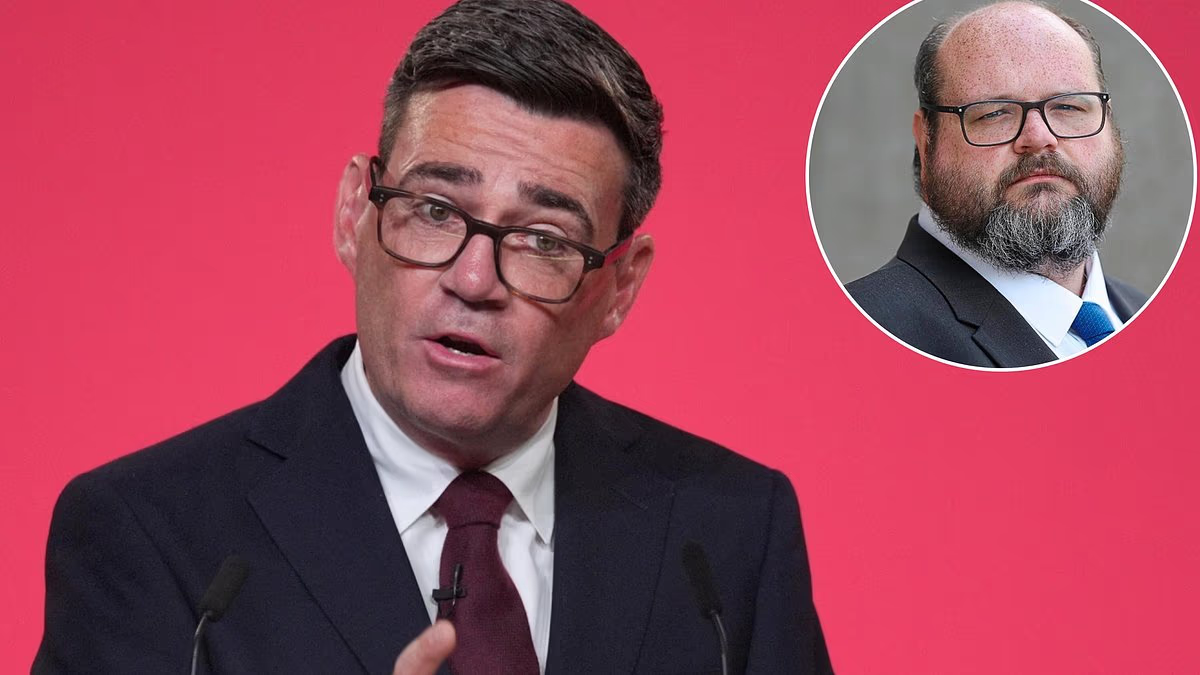
My advice to Andy Burnham is simple: do not fall into the same traps as those who came before you.
The incoming prime minister must banish any thought that, because he is English, his authority to govern Scotland is somehow diminished. Anyone who walks into Number 10 carrying even the faintest doubt about a UK prime minister’s mandate to lead every part of the United Kingdom would be better advised to turn around and leave immediately.
The second mistake Burnham must avoid is the familiar Whitehall habit of viewing Scotland almost entirely through the prism of the constitution. Neither independence nor devolution is currently setting the heather on fire — a reality that those of us who want a serious debate about Holyrood’s failures must acknowledge too.

Burnham must avoid his predecessors’ mistakes regarding Scotland
What people are talking about in Scotland is what they’re talking about elsewhere in the kingdom: the cost of living. It cannot be overstated how tough a time the average family is having right now. A barrage of rising bills (food, fuel, utilities and the rest) has robbed them of any sense of stability, let alone prosperity.
Family holidays have had to be downgraded or sacrificed altogether. Mum and Dad have been forced to eliminate treats for themselves, and sometimes more than just treats, so their children can enjoy a decent quality of life.
Any approach to Scotland that doesn’t begin here is doomed to fail because it really is the economy, stupid.
The number one priority for the new prime minister must be generating private sector growth, which will raise and spread prosperity as well as fund the public services everyone relies upon.
One practical means of increasing the incomes and opportunities of ordinary families is by granting new licences for oil and gas exploration in the North Sea, something Burnham’s team is reportedly opposed to.
Few policy choices could be as damaging, especially in the North-East of Scotland, as continuing the chokehold on domestic energy production. Doing so would send these communities a definite signal that Westminster is indifferent to the troubles they face.
The new team in Downing Street must also be alert to concerns about migration and asylum. Traditionally, these have been more pronounced in England than in Scotland, but recent months have seen a marked upturn which, despite the efforts of the lanyard classes, stubbornly refuses to go away.
These concerns stem not only from the inherent risks incurred by constant influxes of unvetted men from unfamiliar cultures but from experience of the pressures on social housing and services of mass immigration.
Calling these people racists or ‘far Right’ has so far failed to dissuade their worries and that is unlikely to change.
Many in Labour are convinced this is a communications problem; if they could only focus group better answers and buzzwords and framing. But the public want a change of direction, not of rhetoric, and their alarm will only grow unless they start to see changes, such as tighter border control and a tangible reduction in numbers.
On this point, Number 10 should be prepared for the SNP pushing one of its cherished hobby-horses: devolution of visa-granting powers so the Scottish Government can attract overseas talent – i.e. low-skilled, low-paid workers for the NHS and social care sector.
SNP ministers and their dutiful echoes in the media and civil society consider this proof of their progressivism, though I’ve never understood why.
Luring away carers and nurses from poor countries with much greater need than ours, therefore making it even harder for people in the developing world to access healthcare, can be called many things but I’m not sure progressive is one of them.
Keir Starmer’s successor should build on one of the prime minister’s few legacies worth the name: he did not treat Scotland like a political laboratory for the testing of all the latest constitutional fads and theories. There is something to be said for the noble governing tradition of leaving well enough alone.
Encouraged by the Holyrood political class, Whitehall has come to think of Scotland as a constitutional issue rather than a country.
New prime ministers tend to talk about us purely in terms of what additional powers can be devolved and to what level of administration.
The signs from the Burnham camp are worrying here, too, their boss having made his name as a mayor and parlayed this position into a shot at running the country. But that is no reason to become bogged down in more process for the sake of it.
No second referendum, no more tinkering. What Scots want is for the political arrangements they have right now to work as they are supposed to. Inventing new systems should be left to another day.
I confess to having little confidence in Andy Burnham. His only ambition appears to be for his own political career. If there are any great ideas for transforming the country, they remain impressively well-hidden.
Perhaps he will surprise us all and unveil a government programme that tackles the major ailments afflicting Britain today but I have my doubts. A politician with a clue? We’d have heard about it sooner.
Today, Burnham will be invited by the King to form a government, and then we will see what he has in store. Should it be more of the same, Starmer with a northern accent, Burnham will swiftly find his own leadership called into question.
Voters in Scotland, like those elsewhere in the UK, aren’t as enthused as politicians are by inside-the-bubble think-tankery. They want leadership, competence and a seriousness matching the gravity of the moment.
Unless Andy Burnham can live up to these expectations, someone will come along and do to him what he did to Keir Starmer. And I will find myself sitting down to write my seventh advice column to a new prime minister.
We need stability promptly and prosperity desperately. We need to bring a halt to the revolving door outside Number 10. Britain’s future is on the line.
The prime minister should lead in a manner that takes Scotland and the rest of Britain forward to calmer, sunnier, more advantageous times. Such a future is possible but only if the next prime minister doesn’t become distracted by the political process and chooses instead the national interest.


