Argentina’s players are facing demands for punishment after celebrating England’s World Cup exit with a banner asserting Argentina’s claim over the Falkland Islands.
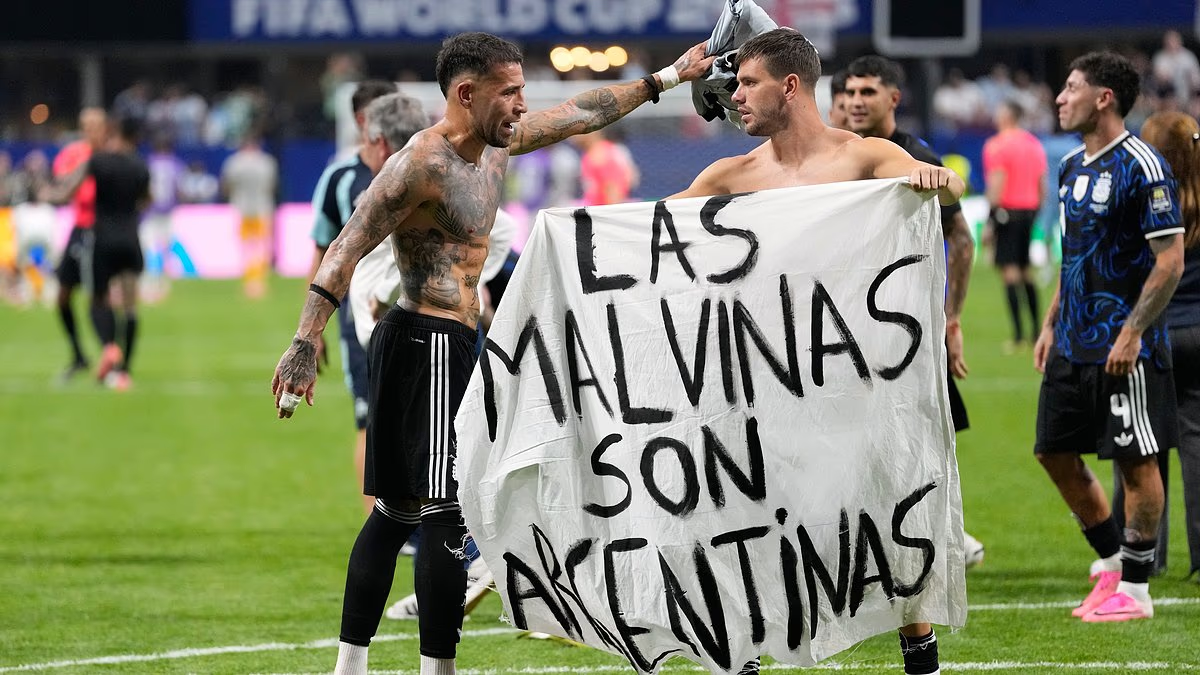
Tottenham captain Cristian Romero, former Spurs midfielder Giovani Lo Celso and Manchester United defender Lisandro Martinez were among those seen on the pitch with the controversial sign after the final whistle.
The display touched on a deeply sensitive issue: 255 British servicemen were among the 907 people killed in the 1982 Falklands War, when UK forces retook the islands following an Argentine invasion.
The banner used Argentina’s name for the Falklands, Las Malvinas, and was held up by members of the crowd, with Lionel Messi also seen dancing nearby.
FIFA had prohibited flags referring to the Falklands from being brought into the stadium because of their political significance, and the incident is expected to be referred to football authorities.
Argentina may now be subject to disciplinary proceedings, with a fine among the possible outcomes.
Reaction on X was swift, with some users calling for Romero to lose the Tottenham captaincy and urging Manchester United to sell Martinez over their involvement.
Other critics demanded suspensions for the final, though many conceded such a sanction appeared unlikely amid recurring claims that FIFA and match officials have shown bias toward Argentina during the tournament.

Lisandro Martinez and Giovani Lo Celso, who have played for clubs in the Premier League, celebrate with a banner claiming the Falkland Islands

Giovani Lo Celso and teammate Nicolas Otamendi celebrated on the pitch with the sign after the final whistle blew

Argentina fans hold a banner with the words ‘The Malvinas are Argentinian’, referring to the Falkland Islands
Previous financial sanctions have also done little to deter Argentine players from displaying slogans about the Falkland Islands in the past.
In 2014, the Argentine Football Association was fined just £20,000 after its team displayed an almost identical ‘Las Malvinas Son Argentinas’ banner before a friendly against Slovenia.
Authorities are said to be treating this case more seriously as it is on the World Cup stage – in front of England and their fans. Plus, FIFA had banned such banners and threatened disciplinary action to those who broke the rules.
Tensions over the ownership of the Falklands, which are located 300 miles off the coast of Argentina but owned by Britain, had been a major talking point in the build-up to England’s semi-final.
Argentina’s players were captured singing a chant in which they claimed the Falkland Islands were theirs in the aftermath of their last-16 victory over Egypt.
The country’s Foreign Minister, Pablo Quirno, also claimed the people living on the islands had been ‘artificially implanted’ – and that a referendum on British sovereignty was illegitimate.
And after Argentina’s victory, vice-president Victoria Villarruel posted on X that ‘it wasn’t just another match’ alongside a video of what appeared to be Argentine soldiers.
‘The Falklands are Argentine,’ she wrote.
‘They banned bringing them to the stadium and forgot that we carry them in our blood and our hearts.’
In the build-up to the game, Villarruel also branded England as ‘usurping pirates’.
She wrote: ‘Tomorrow we play against the usurping pirates. This isn’t just another match.
‘I’m not going to be politically correct or cold-hearted; against the English, it’s always something more.’
Falklanders were asked in a 2013 ballot whether they wanted the islands to remain under British rule, with 99.8 per cent voting yes.

Captain Harry Kane comforts goal scorer Anthony Gordon after the final whistle following their 2-1 defeat to Argentina

The banner, which used the Argentinians name for the Falklands – Las Malvinas – was also passed around the team’s jubilant crowd of supporters

Kane looks to the skies as Argentina celebrate on the final whistle in Atlanta, Georgia

Giovani Lo Celso adjusts the banner on the pitch after Argentina’s victory

Goalkeeper Jordan Pickford sobs at the final whistle after England came within minutes of progressing to the World Cup final
Prime Minister Keir Starmer and Foreign Secretary Yvette Cooper rejected the referendum attack and tried to cool tensions.
The animosity dates back principally to a ten-week war in 1982, when an Argentinian invasion of the Falklands was seen off by the British – at the cost of 907 lives.
It spilled over into football four years later when Maradona scored his infamous ‘hand of God’ goal in the 1986 World Cup quarter-final clash.
He used his fist to put the opening goal past England, allowing Argentina to win 2-1 and go on to claim the World Cup trophy.
During tonight’s match, an impressive performance from the Three Lions at the start of the second half saw Antony Gordon put the side in front.
But substitutions to send England into a defensive set-up would heartbreakingly backfire.
England were just less than six minutes away from their first World Cup final for 60 years when Enzo Fernandez scored the equaliser that denied them.
This was followed two minutes into injury time by a header from Lautaro Martinez, who secured Argentina’s place in Sunday night’s final against Spain in New York.
England fans complained about the conduct of the Argentinian fans after the game.
One supporter told the Daily Mail: ‘Obviously [we] were upset about the game, walking out the stadium, minding our own business.
‘Some guy, Argentina fan, comes up waving his flag, shoves it in our face, winding us up.
‘You know obviously someone’s going to retaliate, right? But luckily we didn’t retaliate but there’s a lot of animosity.
‘When Argentina scored, an Argentinian guy next to me took his shirt off, waving it, slapping it in my face, absolutely disgusting.
‘Disgusting behaviour from the Argentinian fans, absolutely disgusting.
‘Tonight there’s not enough cops to police all of this. I’m telling you right now it’s going to kick off later in bars and stuff for sure, 100 per cent.’

The banner, which used the Argentinians’ name for the Falklands – Las Malvinas – was passed into the crowd
It was England’s fourth-ever appearance in the final four of a World Cup, making this the most high-stakes match since 1966.
But in a story familiar to long-suffering fans, they just couldn’t keep ahead at the final whistle.
The royals were among those quick to congratulate the team for their impressive run to the semis, with King Charles III taking to social media and writing: ‘Commiserations to Harry and the team.
‘While you Three Lions may be licking your wounds today, you remain the pride of a nation – and will rise again.’
And outgoing Prime Minister Sir Keir Starmer paid tribute to England’s ‘passion’ and ‘energy’.
Writing on X, he said: ‘Gutted. Tonight wasn’t the result we all hoped for, but this England team has given it their all.
‘The passion and energy they’ve shown representing the badge has made us all proud.’