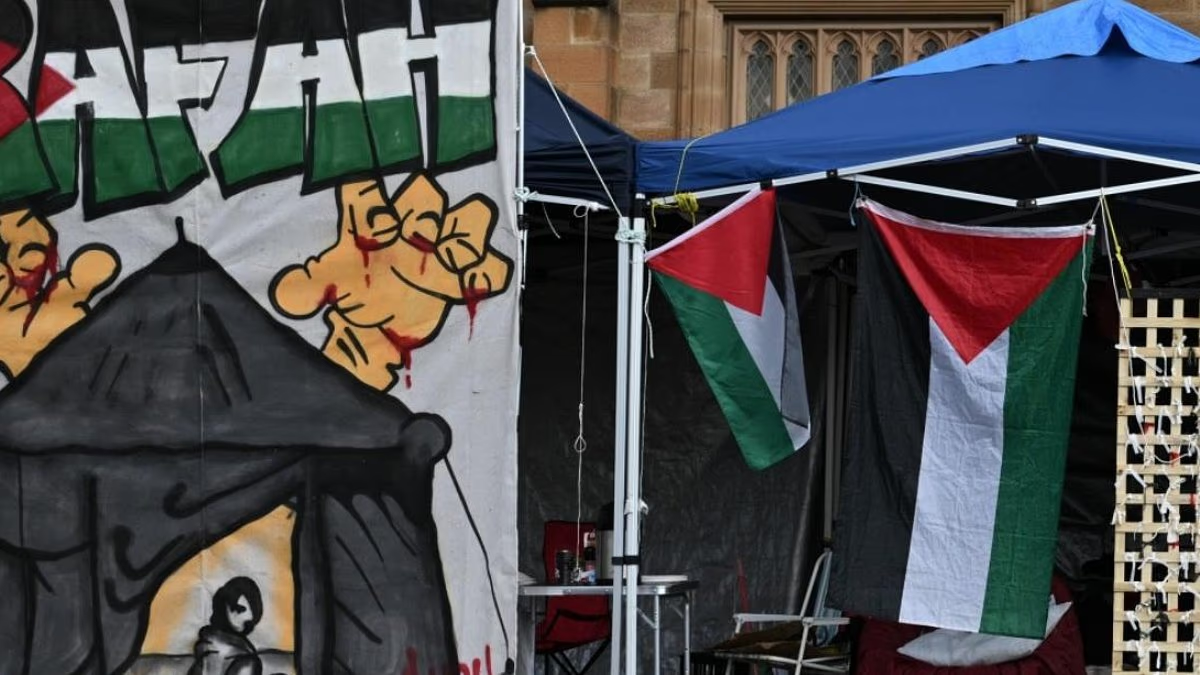

Opposition education spokesman Julian Leeser is right to point to a serious and very real failure in Australian higher education when it comes to antisemitism on university campuses.
He deserves credit for saying so clearly and publicly.
Yet his effort to draw a direct line between campus protests and the Bondi massacre goes too far, and risks undermining the strength of his broader argument.
There is no doubt that some campuses allowed an atmosphere to develop in which antisemitic rhetoric was dressed up as political activism. That failure warrants close and serious examination by the Royal Commission into Antisemitism.
But to describe the mass murder of that day as the “inevitable endpoint” of campus politics is to claim a causal connection Leeser cannot prove. It turns a legitimate critique of institutional failure into something far more sweeping: an allegation of collective responsibility for mass murder.
Leeser’s proposed measure for identifying antisemitism is also problematic. He argues that criticism of Israel becomes antisemitic when it applies a standard not imposed on countries such as the United States or Britain. That test is far too broad, even for someone who has generally been sympathetic to Israel’s position.
Israel is often judged by obvious double standards, and in many cases that double standard is fuelled by hostility toward Jews. But selectivity on its own is not proof of antisemitism. It may also reflect ignorance, inconsistency or ordinary political hypocrisy.
Universities should be expected to act firmly against misconduct, including threats, harassment, exclusion and support for violence. They should not, however, become arbiters of whether every criticism of a foreign government meets a perfectly consistent geopolitical standard.

Liberal MP Julian Leeser’s attempt to connect university protests directly to the Bondi massacre is destructive overreach

Moderate Liberal MP Julian Leeser
Leeser also accuses vice-chancellors of being ‘weak and spineless’. Nobody is spared – he simply condemns an entire class of institutional leaders, branding campuses the ‘epicentre’ of antisemitism.
Beneath the hyperbole lies a valid grievance. After October 7, some administrators who ordinarily speak the fluent language of inclusion became curiously inarticulate.
Universities that instinctively enforce cultural safety for almost any other minority suddenly discovered endless complexities when Jewish students sought protection.
Leeser is entitled to expose this hypocrisy, and frankly should be commended for doing so. However, he’s not entitled to pretend that every VC behaved identically.
Imagine substituting other categories of society and making such sweeping generalisations. Assigning a single moral character to every member of a certain group within our community sounds uncomfortably like the very thinking Leeser rightly condemns.
For a politician campaigning against collective blame, it’s a careless intellectual error.
A parliamentary inquiry into antisemitism in Australian universities, chaired by Labor MP Josh Burns, recorded sharply different realities across the sector. Some universities faced serious disruptions, others saw very few incidents and dealt swiftly with misconduct.
At UWA, where I’m a professor, heated arguments never metastasised into the prolonged encampments or intimidation reported at some east coast campuses.

A police image of alleged Bondi shooters Naveed and Sajid Akram
Calling problems out seriously means responding to local realities, not manufacturing a crisis everywhere because one exists in Sydney or Melbourne. Treating all these institutions as interchangeable is, to be completely frank, polemic and callow.
The generalisation collapses entirely when you consider that several universities, including Melbourne, Monash, and Wollongong, have adopted the exact International Holocaust Remembrance Alliance definition for antisemitism that Leeser demands as the solution.
And before the Liberal moderate calls anyone else ‘weak and spineless’, he might want to look closer to home. Moderates have spent years, decades even, privately deploring the direction of their party while publicly accommodating it, confusing private disapproval with public courage. If that’s not weak and spineless, I don’t know what is.
Leeser has a partial defence from this moderate contagion: his 2023 resignation from Peter Dutton’s frontbench to campaign for the Indigenous Voice showed some courage, but even then context matters.
Yes, it cost him a senior position and reflected a sincere commitment to a cause. But it wasn’t a leap into the abyss. When he resigned, Newspoll had the Yes vote leading 53 per cent to 39, or 58 to 42 once undecided voters were allocated a binary choice.
The political expectation was that the referendum would pass, leaving Dutton stranded on the wrong side of history. A calculation I’m sure Leeser thought long and hard about before his courage was deployed in this narrow context.
Would he have surrendered his frontbench position had polling already shown the referendum heading for a crushing defeat? His sacrifice was made in the belief that solid political ground awaited him on the other side.
Antisemitism on campus is too serious to be fought with exaggeration and collective blame. Leeser has identified a genuine problem, but his overreach risks weakening the very case he is right to make.


