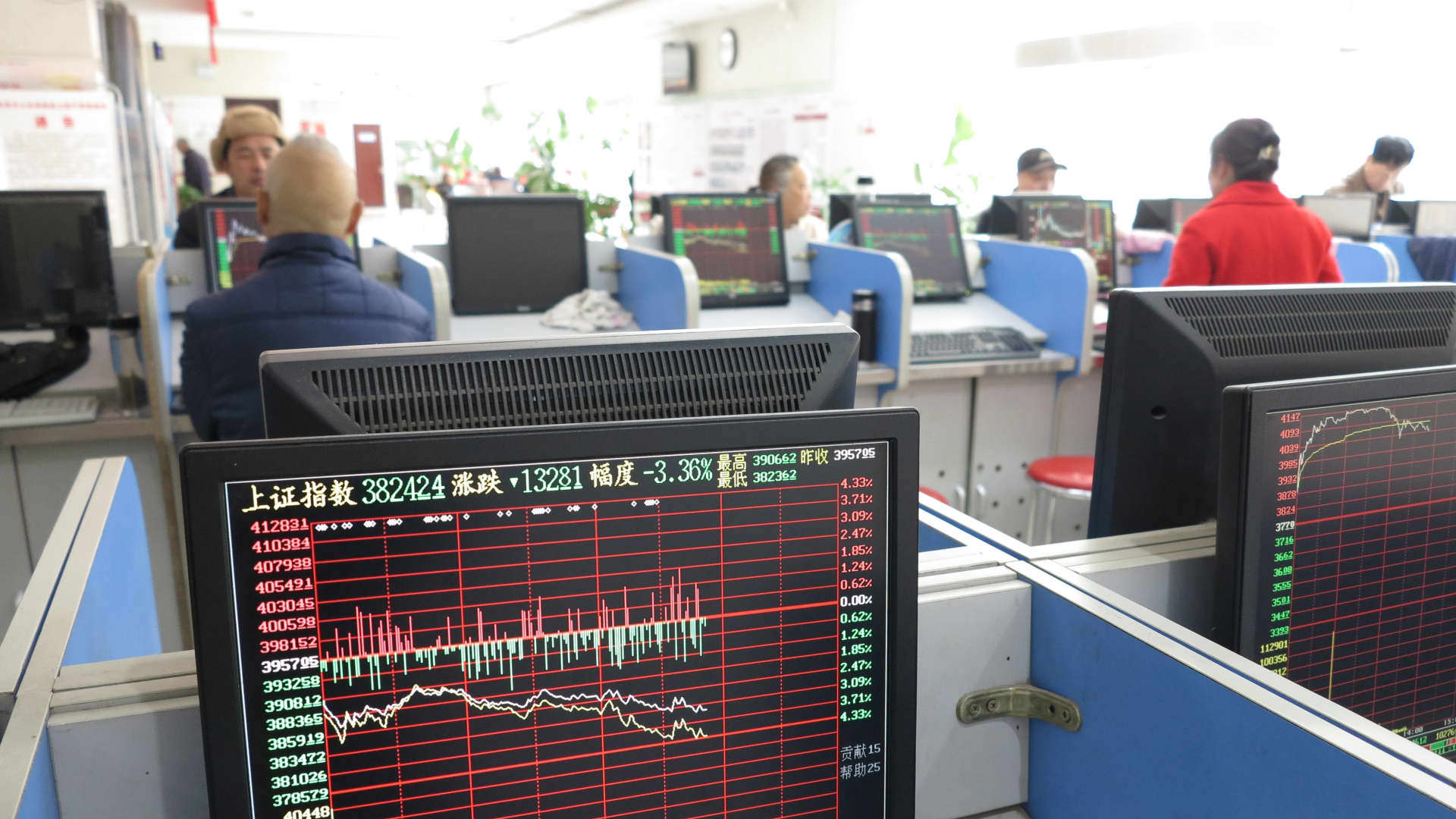

FUYANG, CHINA – MARCH 23, 2026 – Investors monitor market activity at a securities trading hall in Fuyang, Anhui province, China, on March 23, 2026. (Photo credit should read CFOTO/Future Publishing via Getty Images)
Cfoto | Future Publishing | Getty Images
Chinese stocks staged a powerful rebound on Friday after an unusually timed state media report lifted sentiment. Top policymakers pledged to expand the role of state-backed funds in supporting the market, giving investors fresh reassurance.
The STAR index jumped 14%, led by chipmakers including CXMT, Cambricon and SMIC. The CSI Semiconductor index, which tracks 40 chip stocks, gained 17.6%—its largest one-day advance on record and above the previous peak of nearly 17% set in late 2024, according to Wind Information.
The rally extended across mainland China and Hong Kong. The Hang Seng index rose 2%, while the CSI 300 advanced 4%, marking its strongest gain since October 2024, Wind data showed.
The surge comes as governments increase support for domestic semiconductor industries while tightening controls on sensitive technologies amid the global competition to lead in artificial intelligence.
The United States introduced a new rule last week that would further limit Chinese companies’ access to advanced AI chips, including through overseas data centers. The move has added pressure on Beijing to speed up its drive for semiconductor self-sufficiency.
State support brings relief to investors
Friday’s advance followed a steep sell-off on Thursday, when the CSI 300 fell to its lowest level since the U.S.-China tariff war intensified in spring 2025, according to Wind data.
In recent months, investors have assessed whether Chinese artificial intelligence developers can build viable businesses while also contending with tighter U.S. restrictions on advanced semiconductor technology.
Chinese Premier Li Qiang chaired a Friday morning meeting of the State Council, the country’s top governing body. Officials pledged to strengthen the role of the “National Team”—a reference to state-backed funds—in stabilizing markets and ensuring sufficient liquidity, according to a readout published by state media outlet Xinhua.
The direct reference to the “national team” marked the first time the term had appeared in a State Council meeting readout, said Bob Chen, a Shanghai-based venture capitalist and economist.
Stock market performance is now prioritized at the highest level for the Chinese government.
Bob Chen
Shanghai-based venture capitalist
The readout also said that “capital markets are crucial to the broader economy,” an uncommon message from a government that has not consistently embraced the financial sector.
“Stock market performance is now prioritized at the highest level for the Chinese government,” Chen said, adding that the stance was strengthening investor confidence.
“That’s very strong language from the top officials,” said Zong Ke, a portfolio manager at a Shanghai-based quantitative fund.
Ke said trading volumes accelerated soon after the readout was released at around 1 p.m. local time, or midnight ET. Total turnover across the Shanghai, Shenzhen and Beijing exchanges was 52% higher than in the previous session.
Policymakers also promised to expand the role of “stabilization funds,” including Central Huijin Investment, the state-owned investment company that holds equity stakes on behalf of the State Council.
The announcement “effectively institutionalized Central Huijin’s role as a state stabilization fund,” said Hong Hao, managing partner of Lotus Asset Management. “And it’s significantly positive news for the market.”
Hao said he expects the rally to last longer than the “fleeting bounce” that followed previous stimulus discussions in Beijing and faded within days. “This time it’s for real.”
The Cabinet meeting’s readout is usually published well after markets close. Its release around midday, while trading was still underway, was unusual and interpreted by investors as a bullish signal.
The State Council also promised stronger policies to channel medium- and long-term capital, including insurance and social security funds, into equities. Officials encouraged listed companies to increase dividends and share buybacks, while also pledging to crack down on financial fraud and strengthen investor protections.
The national team will speed up asset purchases, Ke said. He also expects additional support, including further relaxation of institutional restrictions that have limited long-term funds’ ability to invest in stocks.
Still, Beijing’s dependence on intervention to limit stock-market volatility has prompted questions about whether the gains can be sustained over the longer term.
For now, however, the market needs this type of support, Ke said. The immediate priority is to ease liquidity pressure and rebuild confidence, preventing a deeper decline.
Chinese AI stocks also face less downside risk than their U.S. counterparts because the companies have invested less in artificial intelligence so far and their shares have already undergone a sharp correction, Ke said.
That combination, along with the promised state support, has strengthened investors’ belief that the market could be close to reaching a bottom, Ke added.