Share this @internewscast.com
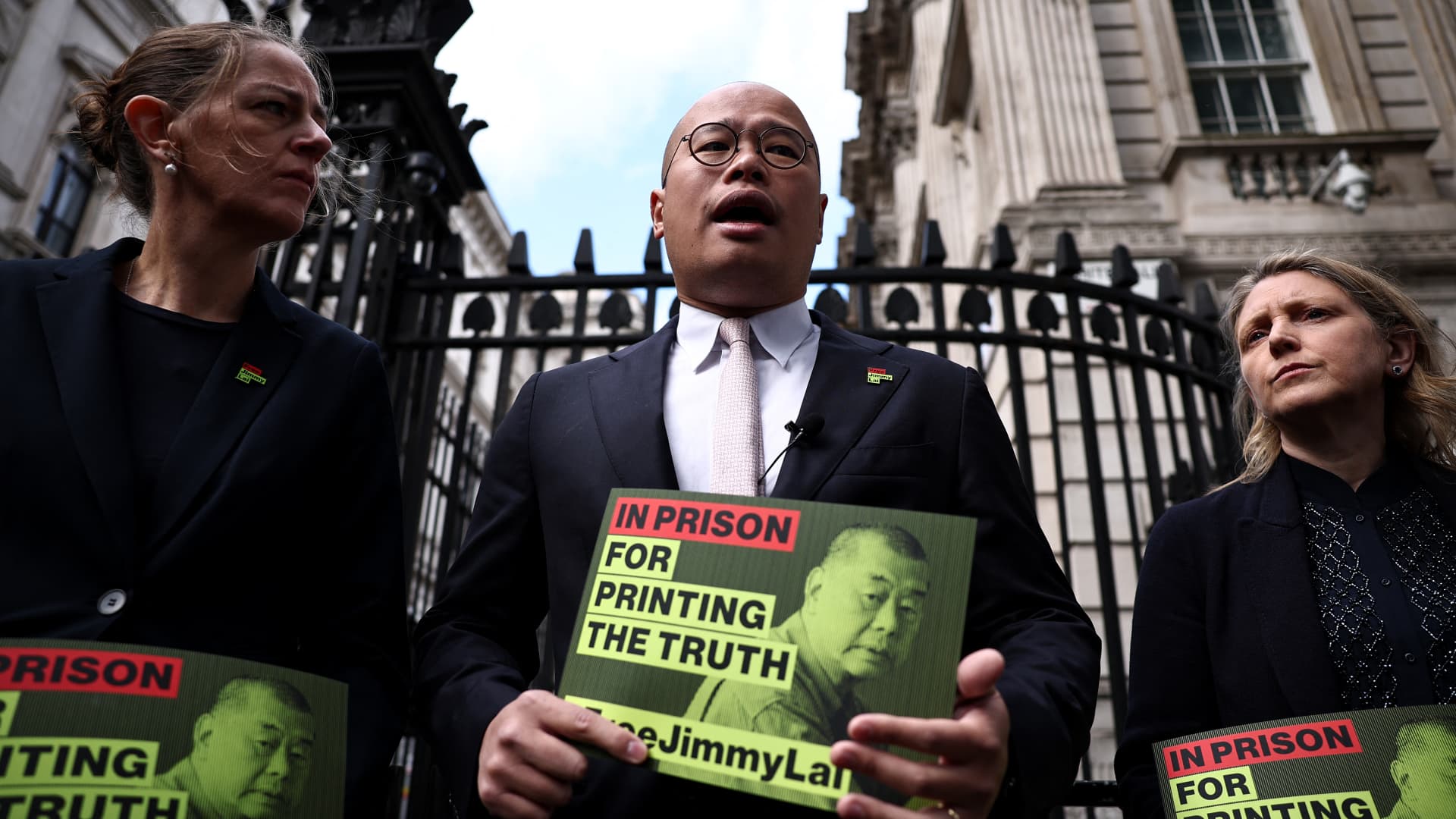
Sebastian Lai, the son of pro-democracy media tycoon Jimmy Lai, addressed the media during a press conference outside Downing Street in London on September 15, 2025. The event unfolded against the backdrop of heightened tensions between the United Kingdom and China, following the U.K.’s recent decision to enhance a visa program for Hong Kong residents.
In a swift response, China’s embassy in London condemned the U.K.’s move, describing it as meddling in China’s domestic matters. This diplomatic friction arose after a court in China sentenced Jimmy Lai to 20 years in prison under the country’s stringent national security law.
The British government announced an expansion to the British National Overseas (BNO) visa scheme, a decision unveiled on Monday. This development now allows children of BNO status holders, who were under 18 during the 1997 handover of Hong Kong to China, to apply for the visa independently of their parents.
In a statement issued in Chinese and translated by CNBC, a spokesperson from the Chinese embassy criticized the U.K.’s move. The spokesperson claimed that the BNO visa scheme has led Hong Kong residents astray, persuading them to leave their homes only to encounter discrimination and hardship in the U.K., living as what they termed “second-class citizens.”
The embassy further denounced the expansion of this visa program, labeling it as both “despicable” and “reprehensible,” highlighting the growing diplomatic rift over issues related to Hong Kong’s autonomy and human rights.
The embassy described the scheme expansion as “despicable” and “reprehensible.”
“China has always firmly opposed the UK’s manipulation and interference in China’s internal affairs,” the embassy spokesperson said.
The scheme was launched in 2021 after Beijing imposed the sweeping national security law on Hong Kong. Since then, over 230,000 people have been granted visas, and almost 170,000 have relocated to the U.K.
The diplomatic tensions followed the sentencing of Lai by a Hong Kong court on Monday, in one of the city’s most prominent prosecutions. That was the heaviest penalty ever meted out under the national security law.
The 78-year-old founder of the now-shuttered Apple Daily newspaper was a vocal critic of Beijing and was among the first prominent figures arrested in August 2020. He was jailed on charges of conspiring to collude with foreign forces and publishing seditious materials. Lai pleaded not guilty to all counts.
British Prime Minister Keir Starmer raised the case with Chinese President Xi Jinping during a visit to Beijing last month, calling for the release of Lai, who is a British citizen. Critics and Lai’s family have argued that the U.K. did not take sufficient and concrete steps to reverse the course.
The sentencing showed how the Beijing-imposed national security law has “criminalised dissent, prompting many to leave the territory,” the British government said in a statement, adding that it will “rapidly engage [with Beijing] further on Mr Lai’s case.”
The expanded visa route came amid what the British government described as a “deterioration of rights and freedoms” in Hong Kong. The government estimated that 26,000 people will arrive in the U.K. over the next 5 years.
Hong Kong’s chief executive John Lee said Tuesday that Lai deserved the harsh sentencing for all the harm that he had done, including “using Apple Daily to poison the minds of citizens” and “colluding with foreign forces to take sanctions and hostile actions against China and Hong Kong.”
Other governments have renewed calls for Lai’s release following the ruling. Marco Rubio, U.S. Secretary of State, called the ruling “unjust and tragic” and urged the authorities to grant humanitarian parole for Lai.