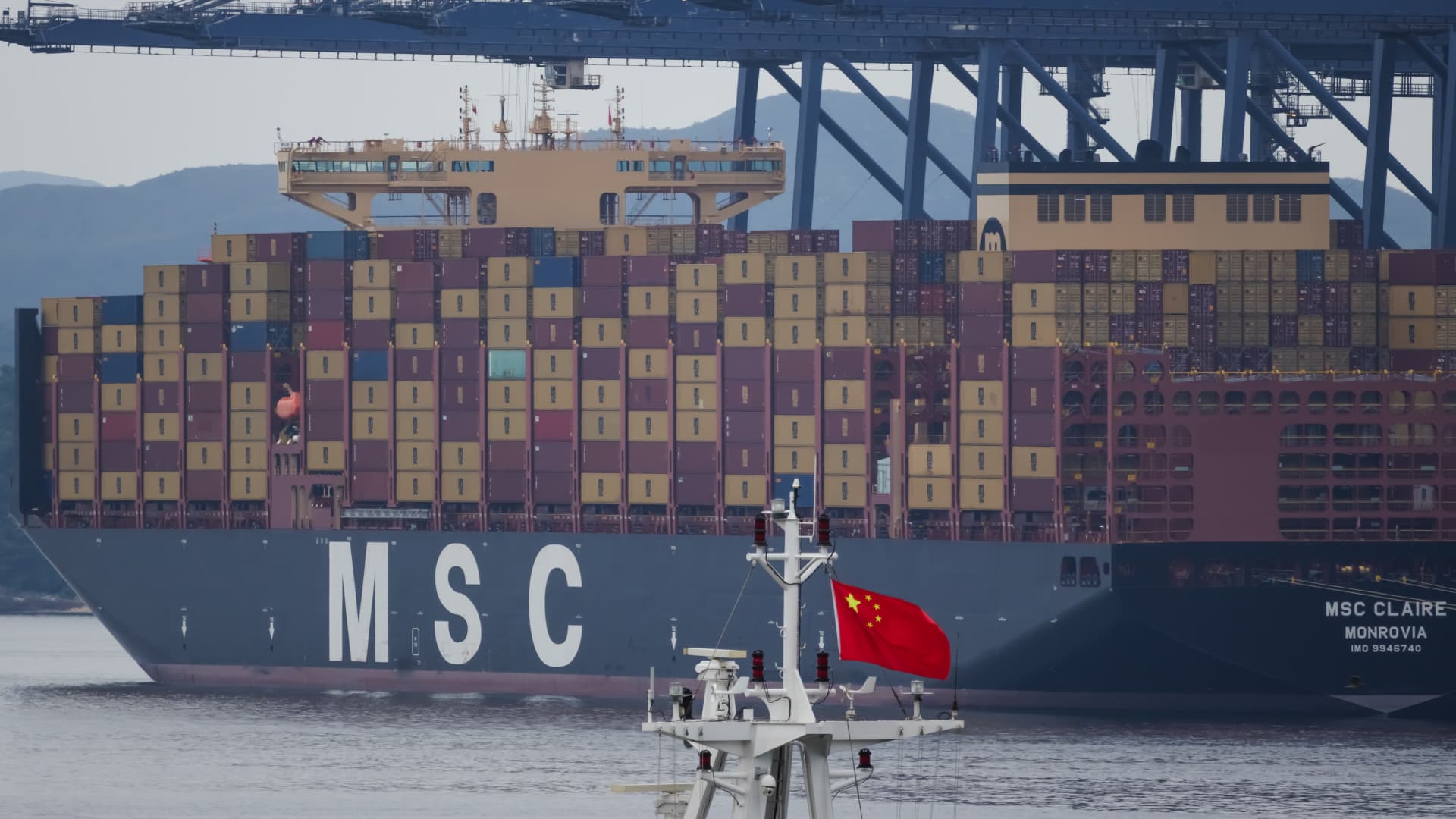
SHENZHEN, CHINA – AUGUST 30: A Chinese flag flies from a vessel as the MSC Claire container ship sits beneath gantry cranes at Yantian Port on August 30, 2026, in Shenzhen, Guangdong Province, China. China is preparing to publish its latest official manufacturing purchasing managers’ index as investors evaluate the outlook for factory activity, domestic demand and exports amid continued pressure on the world’s second-largest economy. (Photo by Cheng Xin/Getty Images)
Cheng Xin | Getty Images News | Getty Images
China’s exports and imports jumped more than anticipated in October, but the country’s trade surplus fell sharply even as it surpassed $1 trillion for the year to date.
Goods exports rose 35.2% from a year earlier, official data released Tuesday showed. That topped the 33.5% increase forecast in a Reuters poll, although growth eased from September’s 36.3% gain.
Imports expanded 41.6% in October, customs figures showed, accelerating from 31% in September and far exceeding the 32% increase expected by analysts surveyed by Reuters.
The surge in imports, the strongest since May 2021, was led largely by demand for technology products, key minerals including copper and energy commodities such as liquefied natural gas, oil and coal, said Tianchen Xu, a senior economist at the Economist Intelligence Unit.
Imports of high-tech goods increased 72% by value in October from a year earlier, according to CNBC calculations based on official figures. Crude oil, LNG and coal imports rose by roughly 41%, 50% and 60%, respectively, in value terms.
China’s monthly trade surplus narrowed to $105.3 billion in October, its lowest level since April, according to LSEG data. The surplus has reached $1.04 trillion so far this year, compared with a record $1.2 trillion for all of 2025. Trading partners are increasingly pressing Beijing to strengthen domestic demand and bring its economy into better balance.
Robust export growth has enabled policymakers to rely on relatively limited economic support while pursuing their annual growth target of 4.5% to 5%. Domestic consumption, however, remains weak: Retail sales grew just 1.1% in September, highlighting a persistent imbalance in the world’s second-largest economy.
A significant portion of the export surge has come from strong global demand for Chinese chips and other hardware linked to artificial intelligence. Any cooling in the worldwide AI investment cycle could therefore weaken momentum and put further pressure on exporters’ profit margins.
“Momentum looks to have slowed,” said Nguyen Hoang Nam, a China economist at Capital Economics, who estimated that exports fell 2% month over month on a seasonally adjusted basis.
A separate China Beige Book survey found that new domestic and export orders for goods slowed in October compared with a year earlier. Official data also showed factory activity unexpectedly contracted last month as overseas orders weakened. “The stronger side of the economy got weaker,” the New York-based research firm said in an Oct. 30 note.
China’s exports to the United States jumped 32.9% by value from a year earlier, while imports rose nearly 35%, producing a $32.7 billion surplus. Shipments to the U.S. were up 12.1% through October, partly reflecting a low comparison base after exports plunged 20% last year following steep tariff increases.
Washington and Beijing agreed in September to extend a broader trade truce for two months through January. The agreement also included several other measures, including export-control exemptions for certain critical minerals and the suspension of special port fees imposed on each other’s vessels.
Chinese President Xi Jinping and President Donald Trump are expected to meet for the third time this year at next week’s APEC leaders’ summit in Shenzhen, China.

The European Union also struck a deal with Beijing last month to limit imports of Chinese hybrid vehicles over the next several years as part of efforts to narrow its trade deficit with China. Chinese exports to the bloc climbed 24.4% in October, while imports fell by more than 4%, pushing the surplus to $33.4 billion.
Analysts say the vehicle restrictions, which take effect Dec. 1, are unlikely to significantly slow China’s broader export boom.
The annual cap of 350,000 imported cars exceeds the 300,000 hybrids China shipped to Europe last year, although it remains well below the annualized pace of 800,000 vehicles recorded over the past three months, according to Brad Setser, a senior fellow at the Council on Foreign Relations.
“Europe still is a long way from a coherent trade and industrial policy with respect to autos, let alone a coherent economic policy towards overall trade with China,” said Setser, a former U.S. Treasury official who specializes in global trade and capital flows.
Correction: This story has been updated to clarify that the official data was released on Tuesday.


