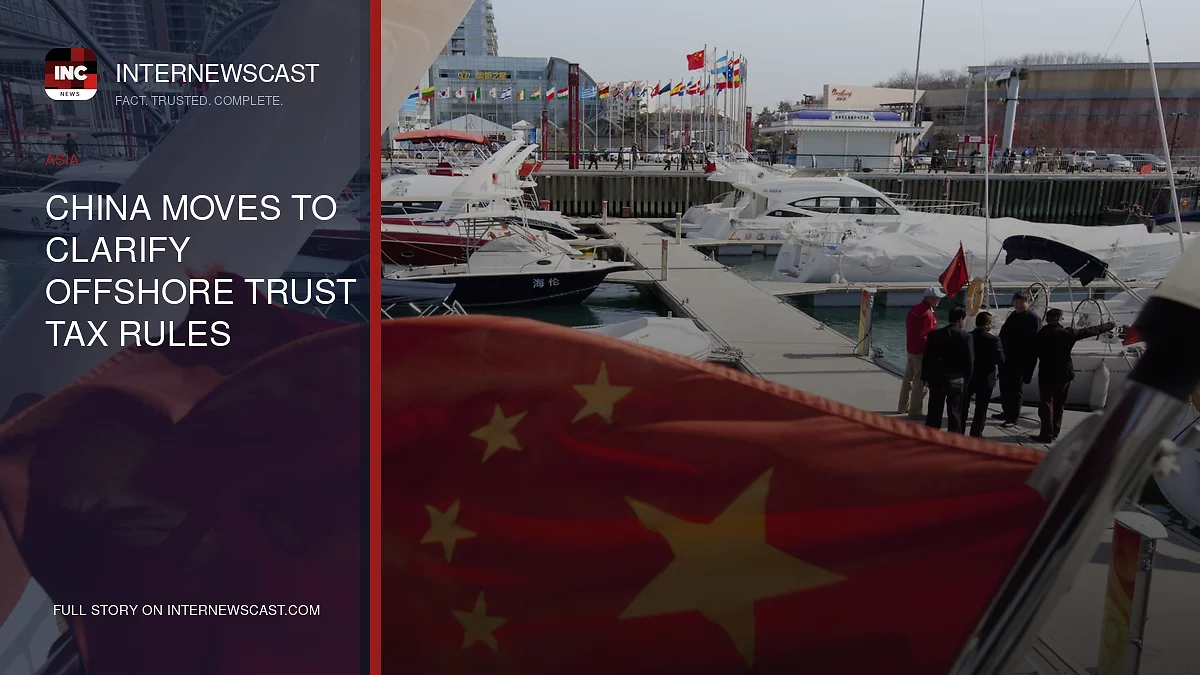

Rising affluence and a stronger appetite for family-focused leisure activities are fueling demand across the boating market, from small dinghies to luxury yachts.
Nelson Ching | Bloomberg | Getty Images
Beijing is working to bring greater clarity to new tax rules targeting offshore trusts, after the measures triggered uncertainty among affluent Chinese citizens and the advisers who manage their wealth.
China’s State Taxation Administration is holding broad training sessions for local tax officials to standardize how the levy on offshore trusts should be enforced, including structures that were established decades ago, according to several tax lawyers working both onshore and offshore.
The tax authority has also circulated draft guidance to law and accounting firms in China and is preparing to hold consultations with lawyers in the coming weeks, multiple lawyers and advisers said, requesting anonymity because the policy discussions are sensitive. Some expect additional draft materials to be released before the guidance is eventually made public.
Windson Li, co-head of tax for Asia at DLA Piper, said the STA has been running internal training at the provincial, municipal and county levels in an effort to keep interpretations consistent across local tax offices.
The Chinese Embassy in Singapore, as well as tax bureaus in Beijing, Shanghai and Guangdong, did not respond to CNBC’s requests for comment.
The clarification effort follows Beijing’s decision last month to impose a 20% tax on offshore trusts, a vehicle long used by wealthy Chinese families to keep hundreds of billions of dollars outside the country. The move prompted a rush for legal and tax advice, along with a scramble to raise cash to cover potential liabilities.
The levy applies at nearly every stage of a trust’s life, from establishment to profit distribution and wind-up. Individuals must also declare and settle outstanding taxes on assets already transferred into such structures within 90 days of the rules’ release – by Oct. 21 – or face surcharges for late filing or non-payment.
Confusion
While the rules ended decades of regulatory ambiguity about the vehicles, they have also created fresh confusion over implementation.
Trusts established after 2023 face the 20% charge at inception, but it remains unclear how many years back owners of older structures, which are subject to an annual recurring tax, must declare, said Yuan Cao, Beijing-based partner of law firm Yingke.
Advisors also warn that many trust assets could fall afoul of foreign-investment reporting rules issued in July, potentially inviting scrutiny from foreign-exchange authorities over how the money left China in the first place.
Some questions include whether the standard statute of limitations of three to five years applies to offshore trusts that were set up before 2023; how extensive documentation must be for a filing to be accepted, or rejected; and whether the October deadline is the cut-off for declaration or full tax payment, DLA Piper’s Li said.
Local authorities are expected to become broadly aligned with the STA’s interpretation of those details over the coming weeks, he added.
It is not uncommon for China’s central government to fine-tune major policy announcements through follow-up circulars. However, time spent waiting for clarification on the rules also eats into the 90-day window.
There had been widely different approaches from different local authorities before last month’s rules, said a Hong Kong-based lawyer, who asked not to be named due to the sensitivity of the matter. The lawyer added that the STA recognizes there is uncertainty.
Some wealthy individuals have negotiated previous lump-sum settlements with provincial tax offices to resolve their liabilities, and it’s unclear whether those remain valid under Beijing’s new rules, according to multiple lawyers.
BEIJING, CHINA – AUGUST 11: The gate of the State Taxation Administration of The People’s Republic of China is pictured on August 11, Beijing, China.
Vcg | Visual China Group | Getty Images
A gathering storm
The tax push comes as Beijing hunts for new sources of fiscal revenue. Land sales, long a mainstay of local government finances, have collapsed amid the property downturn.
Personal income tax will become an increasingly important source of fiscal revenue, as Beijing broadens the tax base to capture wealthier individuals and offshore wealth, while enforcement improves, said Dan Wang, China director at Eurasia Group.
Chinese tax residents are required to pay tax on their worldwide income, including taxable returns from overseas insurance products, officials said earlier this month.
In the first half of this year, personal income tax collected reached roughly 900 billion yuan ($133.5 billion) up 13% from a year earlier — the largest absolute increase among major Chinese tax categories, Wang noted.
Officials have also toughened their stance on capital leaving the country. Beijing banned three cross-border online brokerages from serving mainland users earlier this year, and some cities, including Beijing and Hangzhou, have begun taxing overseas insurance proceeds received by Chinese citizens, according to Chinese local media.
“These measures can easily create a sense that a storm is gathering,” said Neo Wang, chief China strategist at Evercore ISI, who added that these concerns may be overdone.
China’s State Council in late July also issued new exit and entry regulations – effective in September – that expand the circumstances under which citizens can be barred from leaving the country, including for violations of export-control rules that could endanger national technology and industrial security.
The framework could give local authorities firmer legal ground to restrict departures by people they consider to owe tax, some advisors said.
“Barring people with outstanding taxes from leaving China isn’t new, and some had been stopped at the border before the latest rules were announced,” said Max Li, a director at U.K.-headquartered advisory firm EIK Business. “The latest regulations tighten an existing practice, and shouldn’t come as a surprise.”


