
Share this @internewscast.com
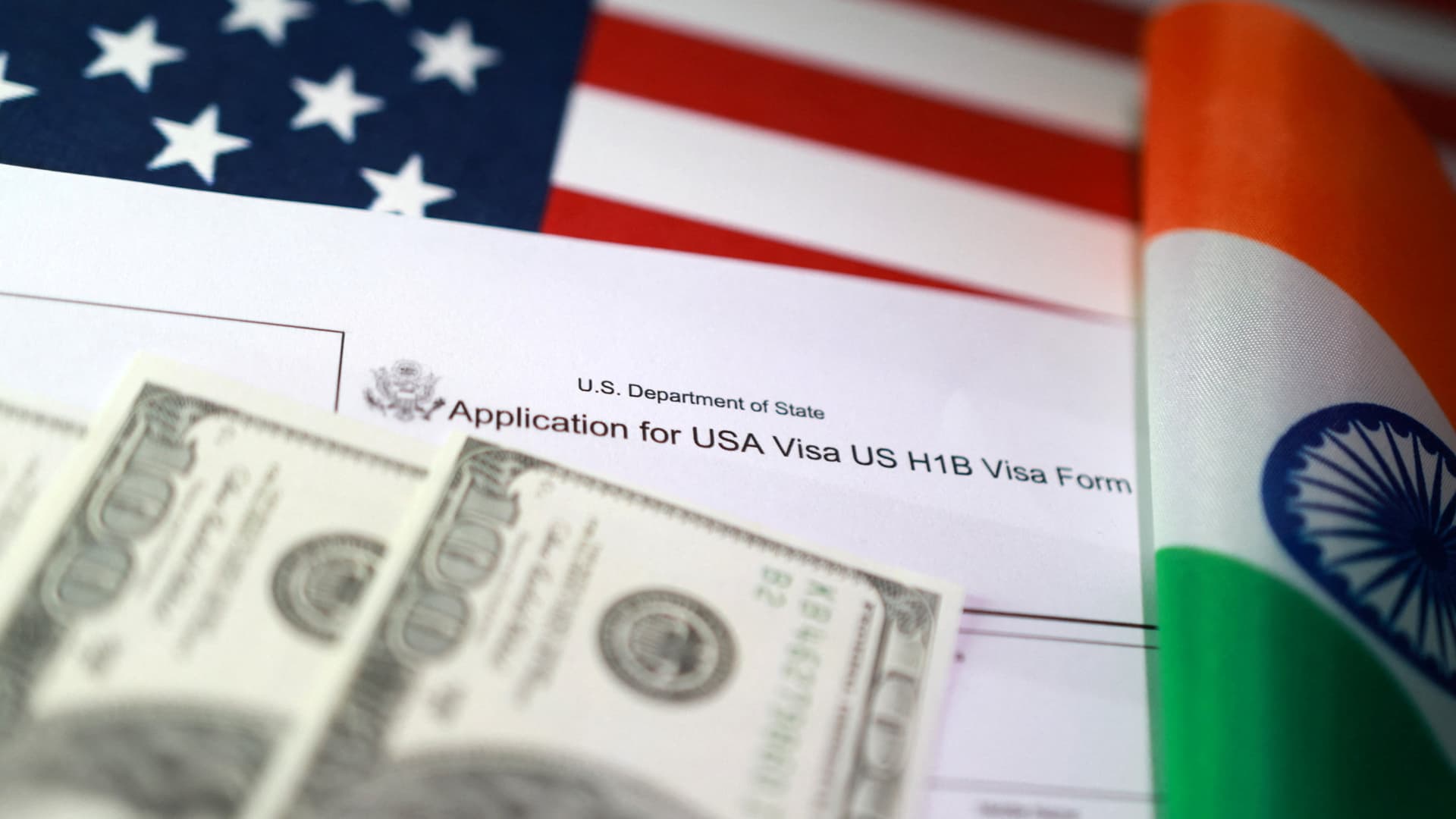
H-1B visa applicants are bracing for a tough year as the U.S. government intensifies its scrutiny and regulation of the program, drawing significant political resistance. The U.S. administration has rolled out several measures aimed at tightening control over the issuance of these visas.
On Monday, the U.S. Embassy in India announced via social media platform X that it had begun conducting online presence reviews for all H-1B and H-4 visa applicants since December 15. This move is part of an effort to address and reduce “abuse of the H-1B program.”
Adding to the challenge, the U.S. Department of Labor introduced a new proposal last week aimed at implementing a wage protection law. Experts believe this could deter companies from sponsoring H-1B visas. Manish Daftari, a partner at immigration consultancy Vialto Partners, explained to CNBC that this law would “substantially increase the prevailing wage across the board for all H-1B holders,” predicting that businesses might cut back on the number of sponsorships as a consequence.
Moreover, the Department of Homeland Security is reportedly finalizing a proposal for a weighted selection rule. This new rule would prioritize applicants with higher salaries in the H-1B lottery process, potentially shifting the landscape for visa issuance.
Cecilia Esterline, a senior immigration policy analyst at the Niskanen Center, cautioned that these regulatory changes could make the H-1B route less accessible to recent graduates and early-career professionals, even those in vital or emerging fields.
“These rules could make the H-1B largely inaccessible to recent graduates and early career professionals– even if they work in emerging or critical fields,” warned Cecilia Esterline, Niskanen Center’s senior immigration policy analyst.
Any changes to the H-1B rules will likely disproportionately hurt Indians, as they dominate the program, making up more than 70% of the recipients in recent years.
Amazon, Meta, Microsoft, Tata Consultancy Services, and Google are the top five employers sponsoring H-1B visas, according to data from the U.S. Citizenship and Immigration Services.
“If one or both rules are implemented, there may be some job losses, but the biggest impact will likely be that companies move away from sponsoring H-1Bs for employees,” said Daftari.
H-1B disruptions
Many H-1B applicants are already facing significant delays as U.S. consulates in India are rescheduling visa appointments to comply with the social vetting requirements.
The rescheduling of appointments that has occurred in the last two weeks — often with no notice — “has created substantial disruption in people’s ability to return to the U.S.,” said Daftari.
Most of the December and January appointments have been moved to March and April, with some pushed back even as far as August, he said.
The U.S. Department of State is conducting social media reviews of all H-1B and H-4 applicants globally as part of standard visa screening.
The goal of the social media review is to identify security threats and discrepancies in applicant information, such as job title differences on LinkedIn, but experts have questioned the need for extra scrutiny for all applicants.
Applying social media review to all cases, including renewing applicants, “is an inefficient and possibly ineffective policy” which could create “delays for American employers and consumers,” said Esterline.
Political undertones
Visa candidates are set encounter increased challenges next year as more policy changes come into force.
“Most of these policies appear to be for appeasing domestic political constituencies,” said Amitendu Palit, senior research fellow at the Institute of South Asian Studies. He noted that there might be an eventual workaround for some of these rules as the need for “skills in U.S. tech is non-negotiable.”
U.S. Vice President JD Vance said Sunday that his government has worked “to restrict H-1B visas” because it believes it is wrong for companies “to bypass American labor just to go for cheaper options in the third world.”
Vance was most likely referring to U.S. President Donald Trump’s move to raise the H-1B visa fee to $100,000 for new applications.

While these restrictions caused a slowdown in hiring and a shrinking of the talent pool, they also had the desired effect as companies explored ways to upskill their existing workforces and build new talent pipelines to American universities and large companies.
But the decisions to levy hefty fees for H-1B visas also incurred backlash from industries and policymakers.
In October, the U.S. Chamber of Commerce filed a lawsuit against the Trump administration for imposing a $100,000 fee for the H-1B worker visas.
Earlier this month, the New York Times reported that attorneys general of 20 states, including California and New York, have sued the Trump administration for raising the fee for H-1B visas.
“This administration has taken advantage of valid concerns about the H-1B to justify a broad-brush approach to limiting H-1B access,” Esterline said.