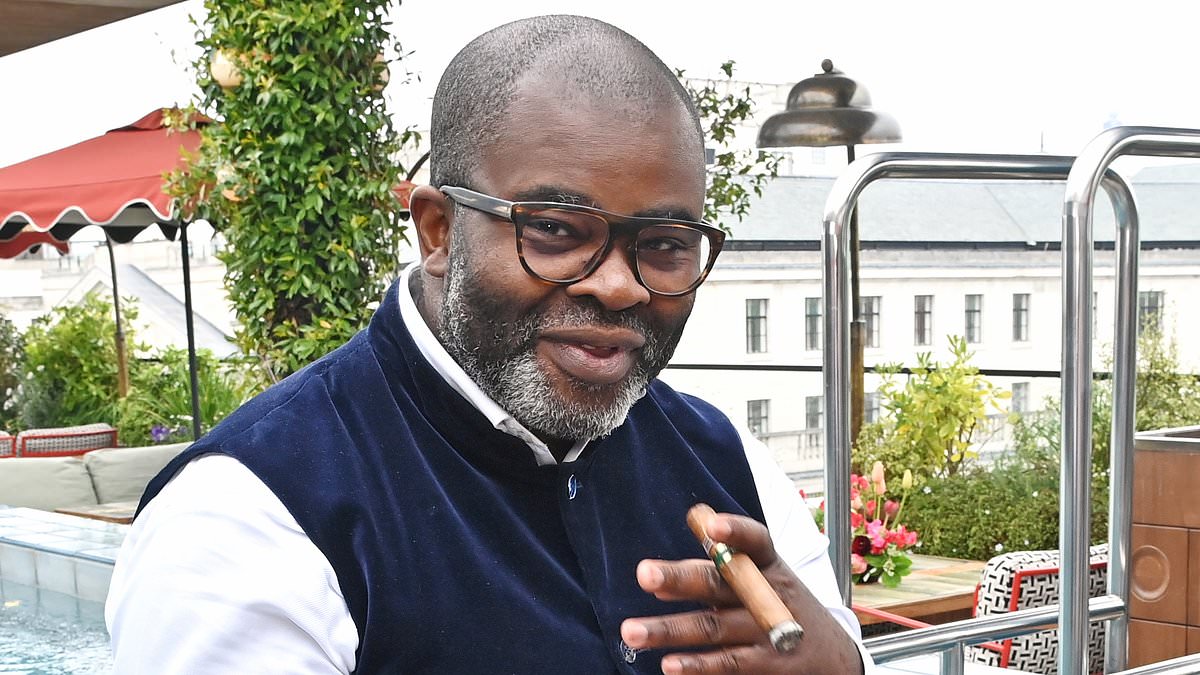
Misan Harriman, chairman of the Southbank Centre, tells his 567,000 Instagram followers that he will “never let the truth slip away” — but one notable detail is missing from his profile.
Visitors can see that he describes himself as “dyslexic” and “neurodivergent”. He also highlights that he was Oscar-nominated for his short film The After and received an NAACP award for the same project, a film centred on grief in the wake of tragedy.
What does not appear, however, is any mention of his position leading one of Britain’s largest publicly funded arts institutions, home to the Royal Festival Hall. The omission is mirrored on his X account as well.
The explanation, he suggests, comes down to six words: “Opinions expressed are solely my own.”
Critics argue that the disclaimer functions like fine print, allowing Harriman to frame his online statements as those of a private individual rather than the chair of a taxpayer-backed cultural organisation. They say this gives him broad freedom to advance personal views while distancing those comments from the Southbank Centre, a role in which some might expect him to actively champion the institution online.
One of the issues at the centre of that criticism is Israel. Harriman’s repeated attacks on the country, as one Observer article put it, have “raised suspicion among many Jews” and led to accusations ranging from anti-Semitism to minimising concerns about anti-Semitism.
In response to such accusations, he has said his words have been taken out of context, and has previously stated his solidarity with the Jewish community and Jewish activists.
A group of MPs, peers and public figures, among them Danny Cohen, a former director of the BBC, have now called for Mr Harriman, 48, a friend of the Duke and Duchess of Sussex, to be sacked.
Misan Harriman’s accolades include being nominated for an Oscar for his short film The After and winning the NAACP award for the same movie
Misan Harrison is friends with Harry and Meghan, often photographing them (Pictured: his portrait of the Duke and Duchess of Sussex in the National Gallery)
His supporters – among them Gary Lineker – are adamant that he is the victim of a sustained ‘dishonest smear campaign’.
What may add to the controversy is our disclosure that two of the companies Mr Harriman runs – he was lauded as a ‘highly successful entrepreneur’ in the official announcement of his appointment as chairman of the Southbank in 2021 – are in the red, including one which is more than £1million in debt.
But it is his social media posts – and two in particular – which have invited initial scrutiny.
First, in the wake of the Golders Green stabbing of two Jews on April 29, he expressed his solidarity with the Jewish community before sharing the claim posted on X by Ayoub Khan, the independent MP for Birmingham Perry Barr, that the media ignored an attack on a Muslim victim by the same perpetrator.
It prompted Mr Harriman to ask: ‘Wait, so there was a third victim on the same day who was Muslim?! And our press isn’t reporting it?’
Second, after Reform UK’s success in the local elections, he quoted the late Holocaust survivor and writer Susan Sontag about the rise of the Nazis in 1930s Germany, who said: ‘[Some] 10 per cent of any population is cruel, no matter what, and 10 per cent is merciful, no matter what, and the remaining 80 per cent can be moved in either direction.’
Mr Harriman then added: ‘The surge of Reform is real. It is a surge, and it should be a warning and a rallying call at the same time.’
There are less widely reported examples that have caused offence, too. Mr Harriman has ‘thanked God’ for Kneecap, the hip-hop trio from Belfast accused of naked anti-Semitism, and he shared a video that ‘Palestinian land is sold in Jewish synagogues in Britain’.
Pictured left to right: David Oyelowo, Misan Harriman, and Meghan, Duchess of Sussex, speak during The After LA Tastemaker in November 2023
He has urged his followers (on Facebook, this time) to read an article attributing the bombing of a hospital in Gaza in 2023 to Israel, when Israel was probably not responsible.
And he reposted a conspiracy theory that Ivanka Trump and her husband Jared Kushner, who are both Jewish, were ‘selling-off the Albanian coastline to Jewish billionaires and [the] Israeli military’, which came to light this week.
Would the chairman of a FTSE 100 firm or a football club or any major body get away with sharing such divisive ‘personal’ views without being held to account – regardless of whether or not they are anti-Semitic – let alone someone who is nominally in charge of an institution which has received nearly £100million in government funding and National Lottery money, via the Arts Council of England, over the past five years?
This is the reason Mr Harriman has been in the news, not because of a so-called smear campaign by the Press – something we’ll return to in more detail. Either way, the Southbank Centre’s inaction has left the board susceptible to accusations of hypocrisy.
Note the comments of chief executive Elaine Bedell in an interview a few years ago, when she said: ‘The Southbank needs to appeal to the whole population, and that has to include the 52 per cent who voted for Brexit.’
Ms Bedell and her fellow board members would surely have expected Mr Harriman, who made his name as a photographer documenting the Black Lives Matter phenomenon, to use his considerable voice on social media to publicise events at the Southbank – especially in its 75th anniversary year – instead of highlighting issues such as Gaza, along with support for Extinction Rebellion and the Green Party as well as sharing controversial theories about Israel.
‘How can the Southbank Centre continue turning a blind eye to this?’ asked Mr Cohen when contacted by the Daily Mail. ‘It is hard to imagine that the Southbank Centre and its trustees would be so slow to act if these kinds of posts had been directed at any other minority community in the UK.’
Mr Harriman’s journey to custodian of the Southbank, via careers in photography and as a City headhunter, was always controversial.
‘He seems to have little interest or expertise in classical music or any other performing art form – something of a hindrance, one may think, for a man chairing an organisation with three concert halls and six resident orchestras,’ said Richard Morrison, the chief culture writer at The Times.
Born in Nigeria, he was brought up by billionaire businessman Hope Harriman (whose eldest son is Andrew Harriman, the England rugby star and flying wing for Harlequins in the mid-1980s and early 90s) before moving to Britain and attending Bradfield College, a public school in Berkshire.

Misan Harriman attends the UK premiere of ‘Disclosure Day’ at Cineworld Leicester Square in London
He only took up photography in 2017, following a career in the City, after his Swedish wife Camilla bought him a camera for his 40th birthday and he began chronicling protest movements.
Just three years later he became the first black man to shoot a cover for British Vogue, for the magazine’s ‘Activism Now’ issue. He was ‘the voice that was missing’, said editor Edward Enninful.
Tom Cruise, Cate Blanchett, Angelina Jolie, Olivia Coleman, Rihanna and, of course, Prince Harry and Meghan, have all been photographed by him.
In the book about the Sussexes, Finding Freedom, Mr Harriman is said to have dined with Meghan at 5 Hertford Street – the private members club in Mayfair – on the eve of her blind date with Harry in 2016.
He would later claim some credit for Meghan meeting Harry, telling Vogue: ‘Meg reminded me that had I not introduced her to a mutual friend then she wouldn’t have met Harry. I’m grateful for whatever small part I played.’
When the couple shared news of baby Lilibet’s impending birth on Valentine’s Day in 2021, it was famously accompanied by a black and white photograph taken by Mr Harriman of a pregnant Duchess lying under a tree at their Californian home in Montecito, smiling at a barefoot Duke as she caresses her bump.
Three months later, he was made the chairman of Europe’s largest hub of the performing arts overlooking the Thames, which not only includes the Royal Festival Hall but also the Queen Elizabeth Hall, The Purcell Room and the Hayward Gallery.
In the statement announcing his arrival, chief executive Ms Bedell described Mr Harriman as a ‘truly inspirational leader who’s entirely aligned to the vision and values of the Southbank Centre’.
He was also a ‘highly successful entrepreneur’, the press release trumpeted, as well as a photographer who founded What We Seee, a ‘media content, tech and commerce company that inspires millions around the world’.
His social media output, sharing some 135 videos in the past fortnight, appears at odds with the former statement, and could it be that the financial records of his companies are at odds with the latter?
What We Seee has net liabilities of £161,503, according to micro accounts filed in March, 2025. Its website now links to Mr Harriman’s more recent venture, Culture3, which he co-founded in May 2022.
The media and culture agency says it is ‘built to put your brands into the conversations that matter to win influence, credibility and buzz’. Latest accounts to May last year showed total liabilities of £1,218,003.
Until recently, Culture3 listed an impressive roster of ‘clients and partners’ which included UN culture agency Unesco, streaming giants Netflix and Apple TV, as well as blue chip firms Mastercard, PricewaterhouseCoopers, L’Oreal and Kellogg’s.
But PricewaterhouseCoopers, one of the ‘Big Four’ accounting firms globally, said the claimed association was inaccurate and its logo should not be on the website.
It said Culture3 had been hired by a client to deliver content for a TED talk – a short, powerful public speaking presentation – that PricewaterhouseCoopers happened to sponsor and that the agency had made an ‘extraordinary leap’ to suggest on its website that they were linked.
After the Daily Mail made enquiries of the organisations in question – PricewaterhouseCoopers was the only company to respond – all the claimed links and their logos were removed from the Culture3 website.
Another company, a brokerage that Mr Harriman co-ran, was struck off by Companies House in 2019, with final accounts revealing debts of £75,000.
However, a recruitment business with offices registered in Mayfair does, at least, seem to be balance-sheet healthy, with current assets of £264,484.
And Mr Harriman also jointly controls a media company along with his wife which has reserves of £65,735.
Surely, all this might at least raise questions, even without the row over Mr Harriman’s social media commentary – especially given he was billed as a ‘highly successful entrepreneur’ before he was made the chairman of the Southbank Centre.
Both Mr Harriman and the Southbank Centre have been approached for comment, but have not responded to our emails.
More than 30,000 people, including many celebrities, have now signed a petition in support of Mr Harriman, while the press regulator Ipso has received more than 25,000 complaints over what has been described as a ‘dishonest smear campaign’ against him.
One of the key reasons, according to his supporters, is that the video post Mr Harriman shared, claiming that the third victim of the Golders Green attack – a Muslim – went unreported, was ‘factually correct’.
- Fact: only in their fourth press release, at 10pm on April 29, the day of the stabbings, did the Met refer to a previous incident.
- Fact: the victim was not initially named or identified as a Muslim.
- Fact: he was described only as the ‘occupant’ of an ‘address’ who received ‘minor injuries’ following an altercation.
- Fact: only when the suspect Essa Suleiman later appeared before Westminster Magistrates on May 1 was his long-time friend Ishmail Hussein named as the ‘other’ victim.
- Fact: newspapers reported this.
- Fact: the Daily Mail’s coverage of Suleiman’s court appearance led with his attempt to kill his best friend.
Many of the complaints have been assisted by AI, from a site specialising in churning out template letters – ‘file eight Ipso complaints in one click’ – on behalf of third parties.
‘As we have begun processing these complaints, we have received objections from members of the public that they did not understand at the time of submission that their data would be shared with us and did not consent to this,’ a statement from Ipso said.
These concerns have now been passed to the Information Commissioner’s Office.
So who’s guilty of starting a ‘smear campaign’?


