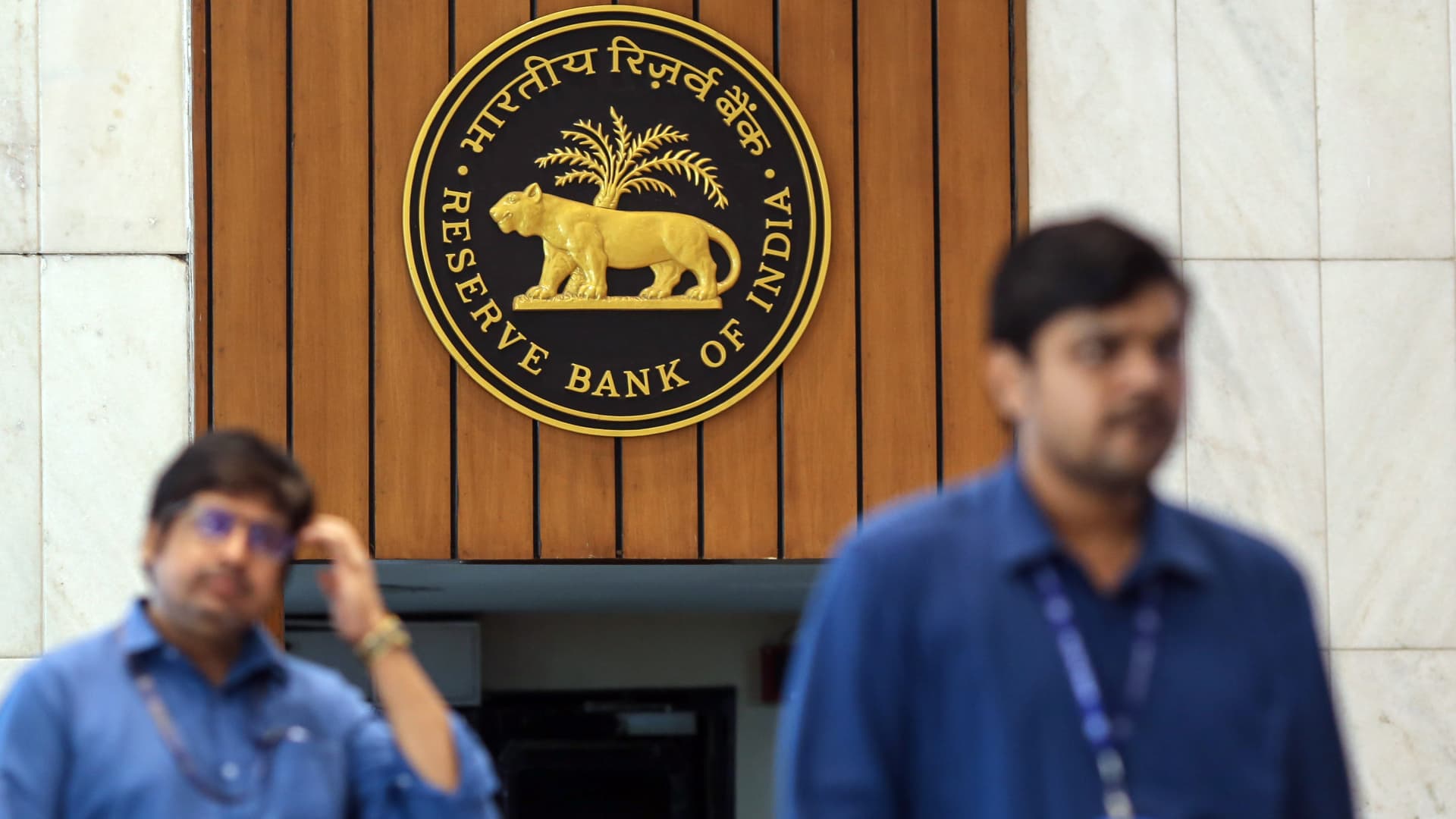

A pedestrian passes by an installation of the Indian rupee symbol outside the Reserve Bank of India (RBI) headquarters in Mumbai on May 17, 2026.
Image Credit: Punit Paranjpe | AFP | Getty Images
Amidst rising global energy prices that have significantly impacted its currency, India’s central bank opted to maintain interest rates at 5.25% on Friday. This decision comes as the ongoing conflict in Iran presents a looming threat to inflation.
The Reserve Bank of India’s decision to hold rates steady was anticipated by economists surveyed by Reuters and CNBC.
In a move reflecting its cautious stance, the RBI adjusted its inflation forecast for the fiscal year ending in March 2027, increasing it by 50 basis points to 5.1%. Simultaneously, it lowered its economic growth projection for the year to 6.6%, a slight decrease from the previously estimated 6.9%.
Governor Sanjay Malhotra highlighted in his address that the “monetary policy has turned more cautious,” citing the “geopolitical impasse” in the Middle East as a factor clouding the global economic outlook. He also noted that “sharply escalating energy prices and global supply chain disruptions continue to hinder economic activity.”
Krishna Bhimavarapu, APAC economist at State Street Global Advisors, told CNBC that the RBI with its “hawkish stance,” is preparing the market for a possible rate hike in August.
The conflict in the Middle East has posed a severe risk to the Indian economy, as energy supply disruptions have inflated the country’s import bill, piling pressure on the rupee that has already been hit by record foreign investor outflows.
In an attempt at shoring up the currency, Prime Minister Narendra Modi last month urged citizens to pause gold purchases, conserve fuel, and avoid overseas travel.
Policymakers have also taken action to defend the rupee, including selling dollars through state-run banks to stem its slide, according to a Reuters report. The government has also raised duties to curb demand for gold, a move aimed at conserving foreign exchange reserves.
Despite these measures, the rupee remains fragile. On a year-to-date basis, the rupee has weakened by over 6% against the dollar as per LSEG data, trading at 95.78 against the greenback.
The RBI faces a tough choice as the Iran war slows the world’s fastest-growing major economy, while inflation risks loom. In April, even before the government passed on the fuel price increases, India’s inflation rose for a sixth straight month to 3.48% from 3.40% in March.
Though inflation remains under the RBI target of 4% for now, India is expected to face weather-related disruptions due to El Nino this year that could cause crop shortages and push food prices higher. Food inflation, a key constituent of India’s consumer price index, rose 4.2% in April from 3.87% in March.
As per a Reuters poll, India’s economy is expected to grow by 7.2% in January-March quarter, slowing from 7.8% in the previous quarter. The official quarterly GDP print will be released later on Friday.
“The biggest risk for India in terms of inflation is the delayed south-west monsoon, with a high probability of El Nino,” Bhimavarapu said.
Yield on India’s 10-year government bonds were down about 4 basis points at 6.958%, the Nifty 50 stock index was up 0.22%.


