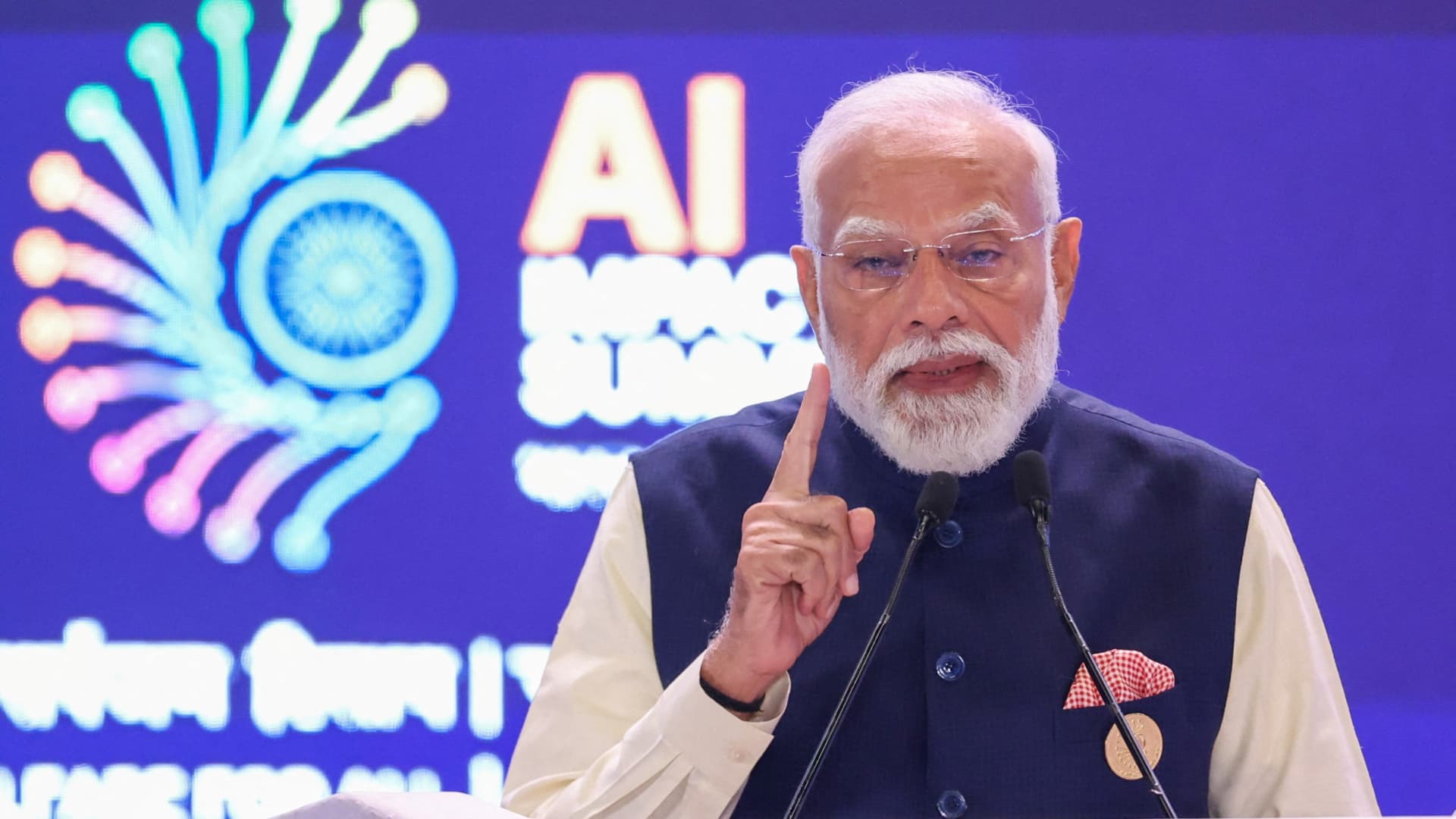

On February 19, 2026, India’s Prime Minister Narendra Modi took the stage at the AI Impact Summit in New Delhi, addressing a packed audience.
Despite marking his 12th year in office with strong domestic popularity, Modi’s India is losing its shine among international investors, even as it remains the fastest-growing major economy in the world.
Experts highlight that India’s increasing stance against artificial intelligence in trade, coupled with the financial pressures from the ongoing Middle Eastern conflict, is prompting an unprecedented withdrawal of foreign investments from the country.
“India is not the clear-cut, growth-driven market it appeared to be a few years ago,” stated Alexandra Hermann Prasad, a leading economist at Oxford Economics. Though India’s economic strength is still notable globally, it is now grappling with challenges like reduced consumer spending, shaky investment confidence, heightened energy expenses, and a more discerning global capital environment, she explained.
This year, foreign portfolio investors have offloaded Indian stocks worth $29.5 billion, following a sale of $18.9 billion last year.
Foreign portfolio investors have sold Indian equities worth $29.5 billion so far this year, after selling $18.9 billion last year.
On the foreign direct investment front, India has attracted gross capital of over $90 billion on a 12-month trailing basis ending January 2026, up 13% year on year. But this was eclipsed by higher repatriation of capital by foreign firms and a rise in overseas investment by Indian companies, taking net FDI to a “near all-time low.”
This has significantly weakened the Indian rupee against the dollar at a time when global oil prices are rising, creating a treacherous situation for India, which imports more 85% of its crude requirements.
As the shocks from the Middle East crisis get passed on to consumers, inflation is set to rise while growth is expected to slow, further narrowing India’s appeal among global investors. Last Friday, the Reserve Bank raised its inflation forecast to 5.1% for the financial year ending March 2027 and warned that the economy is likely to grow at a slower rate of 6.6%, from a forecast of 6.9% earlier.
Reform prospects
To stem the flow of capital, the Indian government issued a slew of measures last Friday, including exempting capital gains tax for foreign investors in the Indian bond market. While these reforms are timely, India needs to move ahead with big reforms to draw global investors, experts said.
“I think it helps the mood music, but it doesn’t change the symphony,” Stephen Davies, chief executive and founder of Javelin Wealth Management, told CNBC’s Inside India on Tuesday. “We need to see a bit more in terms of a bit more market-friendly policies coming through,” Davis added.
According to the CSIS India reforms scorecard, which measures the progress of 30 big reforms across all of Modi’s terms, the government has finalized only two reforms across the last two years — the start of the third term — a much slower pace than in Modi’s first or second terms.
“Land acquisition processes and legal remediation of disputes have not measurably improved,” Richard Rossow, senior adviser and chair on India and emerging Asia economics at policy think tank CSIS, told CNBC. He added that labor regulations improved only marginally, while access to reliable, reasonably priced electricity and water “remain core challenges to India’s industrialization goals.”
Rising criticism
The Modi government’s recent handling of the Indian economy is facing criticism. While some experts are calling for reforms, others point to India lagging in the global AI race.
Last month, Indian economist Surjit Bhalla, a former member of the prime minister’s Economic Advisory Council, said Modi’s political party should use the economic stress of the Middle East crisis to push through reforms. So far, though, no major steps have been announced in this direction.

Global equity research firm Bernstein, in an open letter to Modi in April, warned that AI advancements threaten the quality jobs in India’s information technology sector, which could impact domestic consumption. It added that the country also faces a risk of being a “permanent consumer in the AI economy,” as unlike China and the U.S., it does not own any AI models.
Venugopal Garre, managing director and head of India research at Bernstein, told CNBC last week that the country has missed the AI boat, and the only proxy AI play it can participate in is through data centers. But that will not replace the high-quality jobs lost in the IT sector, he said.


